Jinan, Shandong Feb 13, 2026 (Issuewire.com) - The global transition toward renewable energy creates a competitive marketplace for biomass equipment. Investors and industrial operators face significant "trust costs" when selecting technology for long-term projects. These costs involve the risk of equipment failure, safety hazards, and suboptimal energy output. Consequently, identifying a High Quality Biomass Pellet Machine Supplier requires an evaluation of standardized certifications beyond simple price comparisons. International standards like ISO 9001 and CE certifications provide a necessary framework for quality assurance and safety. These credentials act as a technical bridge, ensuring that the machinery meets the rigorous demands of global energy markets while protecting the capital of the investor.
The Strategic Value of ISO 9001 and CE Compliance
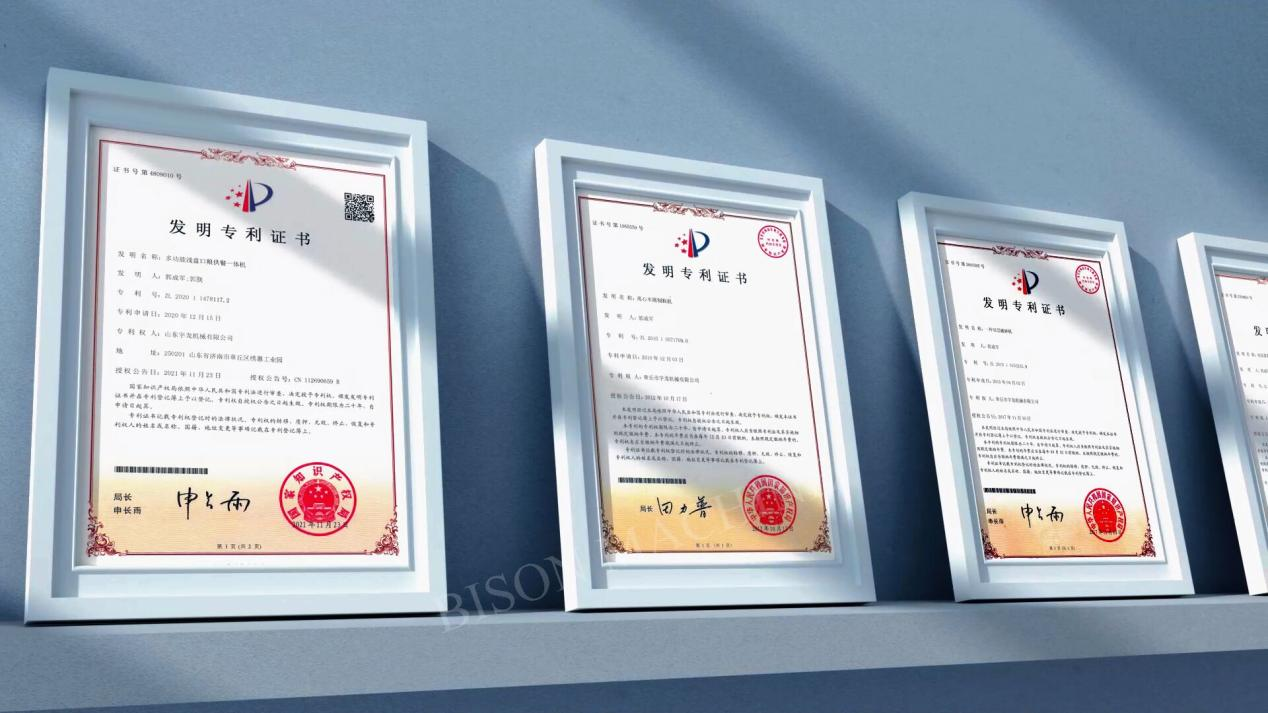
Quality management systems and safety certifications serve as more than mere regulatory hurdles. ISO 9001 represents a commitment to systemic consistency throughout the manufacturing process. It ensures that every component, from the smallest bolt to the main drive shaft, undergoes standardized inspection. For an industrial facility, this consistency translates into predictable maintenance schedules and reduced operational downtime. When a supplier maintains these standards, they demonstrate a capacity for rigorous self-regulation and continuous improvement.
Simultaneously, the CE certification marks a product’s compliance with European health, safety, and environmental protection standards. This certification is mandatory for equipment entering the European Economic Area, but its value extends worldwide. It signifies that the manufacturer has addressed critical engineering risks, such as electrical safety, mechanical shielding, and structural integrity. By prioritizing these certifications, a supplier reduces the legal and physical risks for the end-user. This adherence to international protocols distinguishes professional engineering firms from basic equipment assemblers.
The Foundation of BISON MACHINE and Industrial Expertise
The history of BISON MACHINE provides a clear example of how technical standards evolve alongside industrial experience. Formerly known as Hualong Machine Factory, the company operates out of Jinan, Shandong, as a leading manufacturer of dense forming and biomass energy systems. The organization specializes in research, development, and solid waste recycling, battery materials, activated carbon, and environmental engineering. With over 25 years of experience, the company integrates scientific research with practical manufacturing. This extensive history allows the team to refine equipment designs based on decades of real-world feedback.
Exporting products to Southeast Asia, Europe, Africa, and the Americas requires a deep understanding of varied industrial environments. Consequently, the company continuously updates its equipment and adopts advanced technology to remain competitive. By maintaining high-quality standards and providing excellent service, the firm helps drive the success of users in the biomass industry. This focus on sustainable development ensures that the machinery contributes effectively to global carbon reduction goals. The transition from a local factory to a global player highlights the importance of aligning manufacturing processes with international certification requirements.
Engineering Standards in the Wood Pellet Machine Line
The structural integrity of a complete biomass pellet production line depends on the seamless coordination of multiple specialized stages. Professional engineering ensures that the process begins correctly with primary crushing, where heavy-duty wood chippers or industrial shredders reduce bulky logs and branches into manageable chips. This is followed by secondary pulverizing in a high-speed hammer mill to achieve the ideal particle size. To ensure the material is fit for compression, a rotary drum dryer is utilized to precisely control moisture levels.
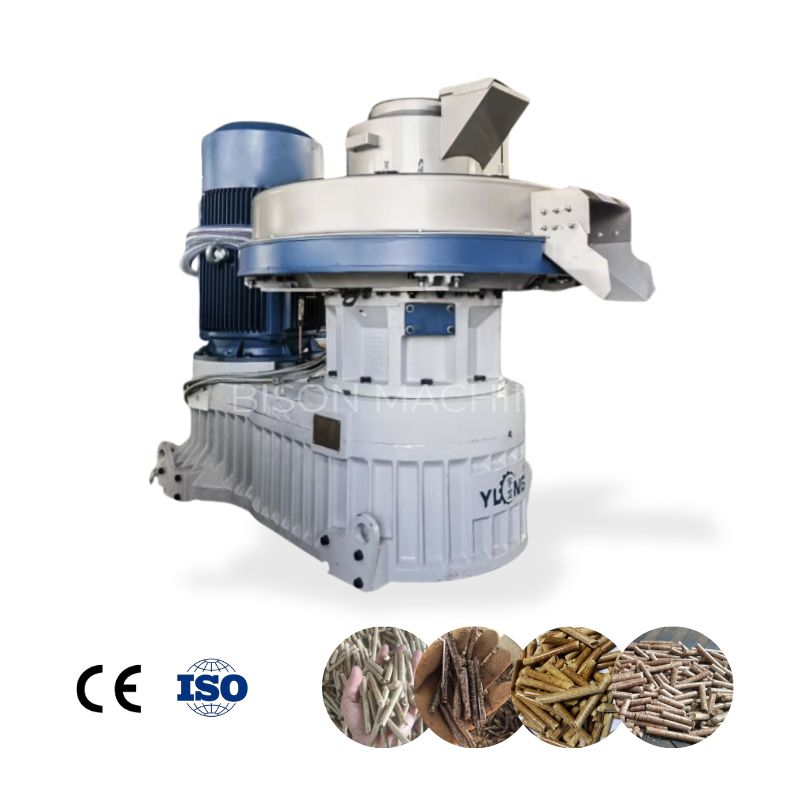
Once the material is pre-conditioned, it enters the wood pellet machine, which serves as the primary example of how CE safety directives influence physical design. Professional engineering ensures that these machines handle high-pressure environments without compromising operator safety. For instance, CE-compliant designs include emergency stop mechanisms that are easily accessible during operation. Furthermore, heavy-duty shielding protects workers from moving parts and high-temperature surfaces. High-pressure stability remains the most critical performance metric, as the vertical ring die technology must operate with minimal vibration to preserve the alignment of the rollers and the die. Following the pelletizing stage, the system integrates cooling and automated packaging units to ensure the final pellets are durable and ready for transport, completing a professional and safe production loop.
Case Study: Large-Scale Success with the 200,000-Ton Production Line
The implementation of a 200,000-ton biomass pellet production line demonstrates the practical application of standardized quality. At this scale, even minor mechanical inconsistencies can lead to massive financial losses. A project of this magnitude requires multiple pellet mills to operate in perfect synchronization. ISO 9001 management ensures that each machine in the line performs identically, simplifying the management of the entire facility.
In such large-scale operations, the durability of the alloy steel molds becomes a primary factor in the Return on Investment (ROI). Standardized quality control guarantees that every mold meets specific hardness and wear-resistance benchmarks. This reliability allows the facility to maintain high output levels without frequent, unscheduled stops for part replacements. Furthermore, the automation integrated into these lines reduces the need for manual intervention, enhancing overall site safety. The successful delivery of such a massive project reinforces the importance of choosing a supplier with proven technical credentials.
Technical Challenges in Customized Rice Husk Pellet Lines
Customized solutions for difficult materials, such as rice husks, further validate the need for rigorous engineering standards. Rice husks contain high levels of silica, which acts as an abrasive agent on machinery components. A standard machine would fail quickly under these conditions. However, a supplier focused on high-quality standards develops specific metallurgical formulas for the rollers and dies to resist this abrasion.
These customized lines also require specialized feeding mechanisms to handle the low density of the husks. Engineering teams must calculate precise compression ratios to ensure the husks form into durable pellets. The CE certification process encourages manufacturers to conduct thorough risk assessments for these unique configurations. Consequently, the customized system remains safe and efficient despite the challenging nature of the raw material. This ability to adapt technology to specific regional needs, while maintaining global quality standards, defines a professional service provider.
Conclusion and the Professional Service Advantage
The combination of ISO 9001 and CE certifications provides a clear roadmap for selecting a reliable biomass equipment partner. These standards transform abstract promises of "quality" into measurable, verifiable technical realities. For BISON MACHINE, 25 years of experience serves as the foundation for this commitment to excellence. By turning rigorous certification requirements into practical engineering advantages, the company ensures a higher ROI for its global clients.
Professional service extends beyond the point of sale. It involves ongoing technical support, the provision of standardized spare parts, and guidance on operational best practices. This holistic approach ensures that the investment in a pellet production line continues to yield results for many years. As the biomass energy sector continues to grow, the gap between certified and non-certified suppliers will only widen. Choosing a supplier that prioritizes international standards is the most effective way to secure a sustainable and profitable energy future.
For more detailed technical specifications and project case studies, please visit: https://www.bisonpelletmachine.com/.
Media Contact
SHANDONG BISON MACHINE CO., LTD. inquiry@sdbison.cn https://www.bisonpelletmachine.com/