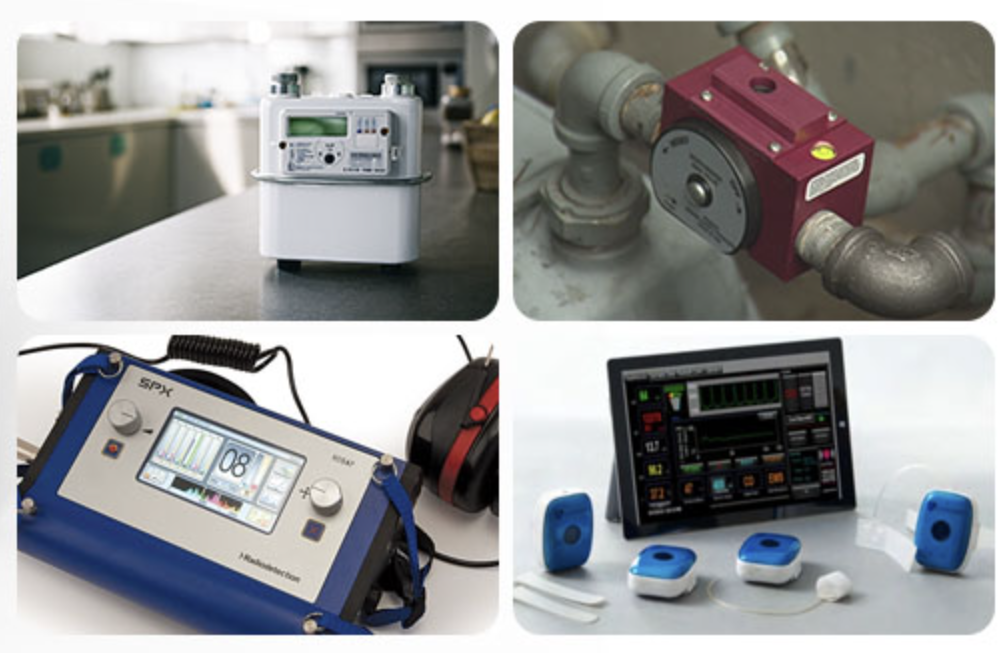
Shenzhen, Guangdong Jun 25, 2026 (Issuewire.com) - Industrial IoT engineers tasked with deploying GPS trackers, marine telemetry units, oilfield monitors, and remote mining sensors face an unforgiving design reality — every component inside the device, especially the battery, must survive years of vibration, salt spray, temperature swings, and zero-maintenance operation. Among the high-capacity primary lithium options on the market, the D-size ER34615 cell has emerged as a workhorse for these scenarios. Yet the cell alone rarely solves the problem; the pack architecture, the sealing technique, and the customization depth surrounding it determine whether the deployment survives or quietly fails in year three. Identifying a China Leading ER34615 IoT Battery Pack Manufacturer therefore requires looking past the datasheet and examining the pack the way a reverse engineer would — layer by layer, from the outermost connector down to the electrochemical core.
Why Does the Outermost Layer Determine Whether a Pack Survives Marine and Outdoor Deployment?
Field failures in maritime telemetry projects often trace back not to the cell but to the connector. Marine engineers have reported entire batches of devices going dark after eighteen months at sea, with post-mortem analysis revealing salt-spray corrosion at the battery interface long before any internal cell degradation occurred. Standardized connectors carry inherent limitations: insufficient IP ratings, plating oxidation under prolonged humidity, and contact loosening under continuous vibration.
Custom pin configurations and tailored harness designs address these weaknesses directly. Matching the connector geometry to the device enclosure eliminates field-applied adapters, reduces contact resistance, and improves long-term mechanical integrity. Shenzhen Pkcell Battery Co., Ltd. supports diversified pin and harness customization across its ER34615 pack offerings, allowing GPS tracker designers, marine telemetry integrators, and remote sensor manufacturers to specify the exact interface their deployment requires rather than adapting designs around stock options.
Beneath the Connector, What Anti-Explosion Structure Should an ER34615 Pack Carry?
Once past the connector, the next structural layer demands equal scrutiny. High-capacity D-size cells store significant energy, and abnormal field conditions — accidental short circuits, mechanical crushing during installation, or runaway thermal events — can release that energy rapidly without proper containment. Anti-explosion structures therefore serve as a critical safety boundary rather than a marketing feature.
Effective designs incorporate three coordinated elements. Pressure relief mechanisms allow controlled venting before catastrophic rupture. Insulating barriers between adjacent cells prevent cascading thermal events. Robust enclosure materials, selected for impact resistance and chemical compatibility, contain mechanical shocks from drops or vibration. The ER34615M 2S3P 42,000 mAh pack from PKCell integrates these structural protections, which makes it suitable for oilfield instrumentation, offshore monitoring equipment, and mining deployments where mechanical abuse is part of normal operating conditions.
Why Is Glass-to-Metal Sealing Considered the Engineering Threshold Between Long-Life Cells and Ordinary Ones?
Drilling deeper into the pack, the sealing interface between the cell terminal and the cell body emerges as one of the most decisive long-term reliability factors. Ordinary sealing techniques — rubber compression seals, plastic crimp seals — perform acceptably during short test cycles but degrade predictably under repeated thermal cycling. As temperatures swing between minus 40 and plus 70 degrees Celsius across years of deployment, polymer-based seals harden, micro-crack, and eventually allow electrolyte vapor migration. The result manifests as gradual capacity loss, internal corrosion, and ultimately catastrophic failure.
Glass-to-metal sealing operates on a fundamentally different principle. The hermetic bond fused between the glass insulator and the metal terminal achieves a permanent gas-tight seal that resists thermal cycling, withstands electrolyte chemistry, and maintains integrity across decades of service. For applications targeting ten-year or longer design life, this sealing technique functions as a non-negotiable engineering threshold. The ER34615 cells used in PKCell pack assemblies employ fully sealed glass-to-metal welding, which establishes the foundation for the long service profiles demanded by remote IoT deployments.
At the Electrochemical Core, How Does ER34615 Outperform Other Chemistries in Wide-Temperature IoT Applications?
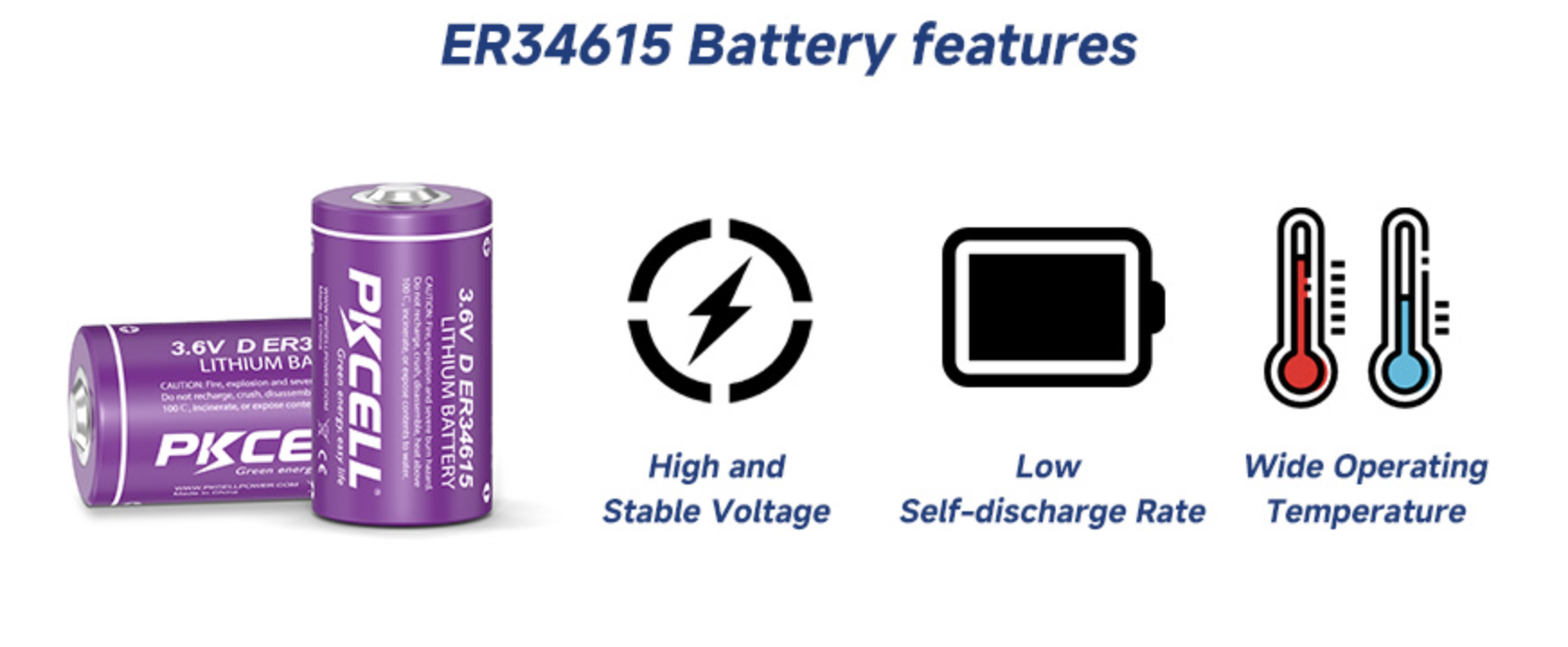
After examining the structural layers, attention turns to the chemistry itself. The D-size ER34615 cell specifies a 3.6-volt nominal platform and a nominal capacity of 19,000 milliampere-hours, placing it among the highest energy density options available in primary lithium chemistry. The lithium thionyl chloride electrochemistry behind this performance also delivers a uniquely wide operating envelope, with the cell maintaining stable discharge characteristics from minus 55 to plus 85 degrees Celsius.
Comparison with alternative chemistries clarifies the engineering rationale. Lithium manganese dioxide chemistry offers respectable pulse performance but cannot match the energy density or temperature range. Rechargeable lithium-ion options, despite their popularity in consumer electronics, suffer rapid calendar aging and narrow temperature tolerance unsuited to long-life outdoor deployment. For applications including GPS asset trackers crossing transcontinental routes, marine telemetry buoys exposed to polar temperatures, and remote pipeline monitors situated in desert installations, the wide-temperature stability of ER34615 chemistry directly determines whether the device transmits data reliably across seasons or fails during the first temperature extreme.
Beyond the Pack Itself, What Manufacturing Scale and Customization Depth Should Buyers Verify?
The final layer of evaluation sits outside the pack entirely, in the manufacturer's operational profile. Industrial IoT projects rarely conclude with a single order. The typical procurement rhythm spans sample qualification, pilot production, annual framework agreements, and multi-year supply commitments. A factory's ability to support this trajectory depends on the coexistence of customization depth and production scale — two capabilities that often pull in opposite directions.
Small workshops can deliver creative one-off designs but struggle with batch-to-batch consistency at volume. Large standardized factories produce stable volumes but resist non-standard requests. PKCell (Shenzhen Pkcell Battery Co., Ltd.) navigates this balance through twenty-five years of manufacturing history, in-house production capacity at its Shenzhen facility, and dual OEM and ODM workflows that handle prototype, pilot, and serial production under one operational roof. Customization dimensions worth verifying include voltage architecture flexibility such as the 7.4-volt configuration achievable through 2S series arrangement, capacity tiers spanning from single-cell to multi-cell parallel structures, and enclosure marking options tailored to end-customer branding requirements.
For procurement teams seeking a concrete reference point, the ER34615M 2S3P 42,000 mAh LiSOCl2 battery pack illustrates how these capabilities translate into a finished product configuration suitable for high-current, long-runtime industrial applications.
The Harsh Environment IoT Pack Specification Template — Translating the Five Layers Into a Technical Document
The five questions above translate directly into a technical specification framework that procurement and engineering teams can apply when issuing RFQs to candidate suppliers. Six specification categories deserve explicit definition: connector type with documented IP rating, anti-explosion structure classification with relevant safety standards referenced, cell sealing technique with permanence claims supported by certification, electrochemical system with operating temperature range and self-discharge rate stated, voltage architecture and capacity configuration aligned to the device duty cycle, and certification coverage spanning both cell and pack levels for the destination markets.
When this template is sent to three or more candidate manufacturers, meaningful capability differences surface that price quotes alone would obscure. Suppliers strong on cell production but weak on pack customization reveal themselves through vague answers on harness flexibility. Factories experienced at small-batch prototyping but inexperienced at serial production betray that gap when asked about quality control documentation at volume.
Shenzhen Pkcell Battery Co., Ltd. offers a calibrated reference baseline for this comparison exercise, particularly for projects targeting harsh-environment IoT applications where ER34615 chemistry, glass-to-metal sealing, anti-explosion structures, and connector customization must coexist within a single supplier relationship. Additional product specifications, certification documentation, and customization workflows are available at https://www.pkcellpower.com/.
Media Contact
Shenzhen Pkcell Battery Co., Ltd. *****@pkcellpower.com 902, Tower B, Hongrongyuan North Station Center, North Station Community, Minzhi Street, Longhua District, Shenzhen, China https://www.pkcellpower.com/