
Huizhou, Guangdong Jun 10, 2026 (Issuewire.com) - The global smartphone industry demands an uncompromised user experience, where haptic feedback serves as a critical interface between hardware functionality and consumer satisfaction. For Original Equipment Manufacturers (OEMs) and procurement professionals, selecting the optimal component from a Certified Phone Vibration Motor Company is not merely a matter of component sourcing, but a foundational decision that impacts brand perception and device tiering. The core challenge in modern commercial procurement lies in defining the precise product portfolio alignment and technical procurement standards. To help OEMs choose the best vibration motor for phones, this analysis explores the engineering trade-offs, operational performance, and integration parameters of Linear Resonant Actuators (LRA motor) versus Eccentric Rotating Mass (ERM motor) technologies, providing an objective framework for strategic purchasing decisions.
Selection Guide: Strategic Positioning for Phone Portfolios
To optimize the return on investment and ensure product-market fit, OEMs must first categorize their component sourcing strategy based on target device positioning and price-to-performance expectations. Aligning vibration motor specifications with the right device tier prevents over-engineering on budget models while guaranteeing flagship devices deliver premium tactile feedback.
Entry-Level and Cost-Sensitive Devices
For smartphones positioned in the budget-conscious tier, the coin-type or cylindrical ERM remains a practical and reliable industry standard. The primary advantages of ERMs in this segment include:
- Lower initial component cost and mature, simplified drive circuitry.
- Elimination of the need for specialized, high-cost haptic driver ICs, as they run on standard DC voltage rails.
- Excellent performance for broad alert notifications, alarms, and basic ringtone vibrations.
Mid-Range and Performance-Tier Smartphones
As consumer expectations rise in mid-tier segments, devices require more nuanced haptics to compete effectively. Here, procurement teams often specify premium Z-axis LRAs. This balancing act allows OEMs to offer an enhanced tactile feel during typing and UI navigation without absorbing the higher cost structures associated with flagship hardware.
Flagship and Premium Devices
For premium, top-tier smartphones, X-axis Linear Resonant Actuators represent the optimal choice. The integration of high-performance LRAs is mandatory for devices that feature virtual buttons, immersive gaming environments, or advanced operating system haptic ecosystems. The ability to execute immediate start-stop actions and output precise multi-frequency pulses justifies the additional investment in dedicated haptic driver integrated circuits and calibration software.
Understanding the Technology Matrix: ERM vs. LRA
The choices made during strategic positioning are rooted in a fundamental divergence in electromechanical engineering. Both systems achieve the same primary objective—generating tactile haptic alerts—but do so via completely different physical mechanisms, which directly impacts their suitability for specific phone tiers.
An ERM motor relies on a relatively straightforward mechanical design. It consists of a direct current (DC) motor that rotates an asymmetric, unbalanced weight around a central shaft. As the internal mass rotates, the centrifugal force creates an omnidirectional displacement, which translates to the familiar vibration felt by the user. Because the vibration intensity is tied to the rotational speed of the shaft, frequency and amplitude are intrinsically linked; increasing the voltage speeds up the motor, which simultaneously increases both the speed and the strength of the feedback.
Conversely, an LRA motor operates on an entirely different principle of magnetic suspension. It features a moving internal mass attached to a tuned spring, which moves in a linear fashion driven by an alternating current (AC) voice coil. The system must be driven at its specific resonant frequency to maximize energy efficiency and acceleration. Unlike the ERM, an LRA decouples amplitude from frequency, allowing for highly complex, varied, and sophisticated haptic waveforms that can simulate textured surfaces, distinct clicks, or crisp tactile button presses.
Comparative Performance Metrics for OEM Integration
When evaluation engineers review a mobile phone motor for upcoming smartphone projects, several distinct performance thresholds determine how effectively a technology meets the strategic tier targets outlined above.
Response Time and Haptic Crispness
The temporal performance of a motor dictates its ability to deliver precise user interface feedback. ERM motors exhibit a characteristic mechanical lag. The rise time—the duration required for the motor to spin up and reach its target vibration amplitude—typically ranges from 80 to 100 milliseconds. A similar delay occurs during the fall time, as the mass takes time to spin down. This mechanical inertia results in a "buzzing" sensation that is highly effective for basic ring alerts but less suited for real-time typing feedback.
LRAs deliver a significantly sharper response. Because the spring-mass system responds rapidly to changes in the electromagnetic field, rise and fall times are drastically reduced, often achieving full acceleration in under 20 to 30 milliseconds. This rapid deceleration prevents residual vibration, enabling the crisp, localized haptic sensations essential for premium user experiences.
Power Efficiency and Architectural Footprint
Power consumption is another critical parameter in commercial smart device design. ERM motors are less efficient due to friction across the commutator brushes and the mechanical energy required to rotate an off-center mass from a complete stop. LRAs operate with lower friction and exploit mechanical resonance, allowing them to draw significantly less current during sustained operation.
In terms of physical space, both technologies have evolved to meet slim smartphone design requirements. ERM configurations are available in both cylindrical and low-profile coin formats. LRAs are typically engineered as coin-type or rectangular blocks that vibrate along either the Z-axis (perpendicular to the screen) or the X-axis (parallel to the screen), with X-axis LRAs offering the most pronounced haptic feedback in flagship mobile designs.
Alignment with Commercial Procurement Standards
For high-volume global device production, technical performance must be balanced with manufacturing scalability and supply chain reliability. Choosing a vibration motor for OEM applications requires a deep evaluation of a supplier's total production infrastructure and quality control frameworks. Partnering with an experienced, industrial-scale phone vibration motor manufacturer ensures that custom engineering requests, tight tolerance controls, and mechanical alignment issues are addressed well before mass assembly begins.
Global micro-motor supply chains require partners capable of delivering massive volume while maintaining strict quality metrics. For example, LEADER, a specialized engineering manufacturer established in 2007, operates an infrastructure capable of an annual production capacity approaching 80 million micro vibration motors. Having supplied nearly one billion units globally across diverse sectors including wearables, electronic cigarettes, and mobile hardware, industrial data shows that high-volume stabilization requires deep testing protocol integration.
To meet stringent OEM qualification criteria, components must undergo comprehensive testing sequences consisting of 13 to 17 separate quality assurance procedures. This includes 200% inspection methodologies targeting an operational defect rate below 100 Defect Parts Per Million (DPPM). Furthermore, engineering support during the critical Design Validation Testing (DVT) and Production Validation Testing (PVT) phases ensures that whether an ERM or LRA configuration is selected, the component integrates cleanly into the phone's power rails and structural chassis without creating unwanted acoustic noise or electromagnetic interference.
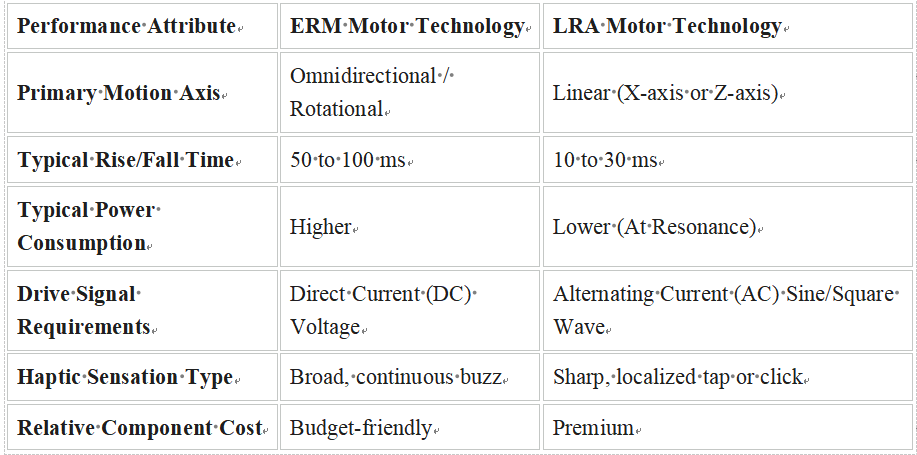
Technical Summary Matrix
Ultimately, identifying the best vibration motor requires balancing target user experience, space constraints, and cost considerations. By partnering with an experienced manufacturer that offers comprehensive engineering data, a wide array of vibration motor products, and audited high-volume assembly lines, phone developers can ensure their final products deliver reliable, high-quality performance throughout the device lifecycle.
Corporate Website: https://www.leader-w.com/
Media Contact
Leader Micro Electronics (Huizhou) Co., Ltd leader@leader-cn.cn https://www.leader-w.com/