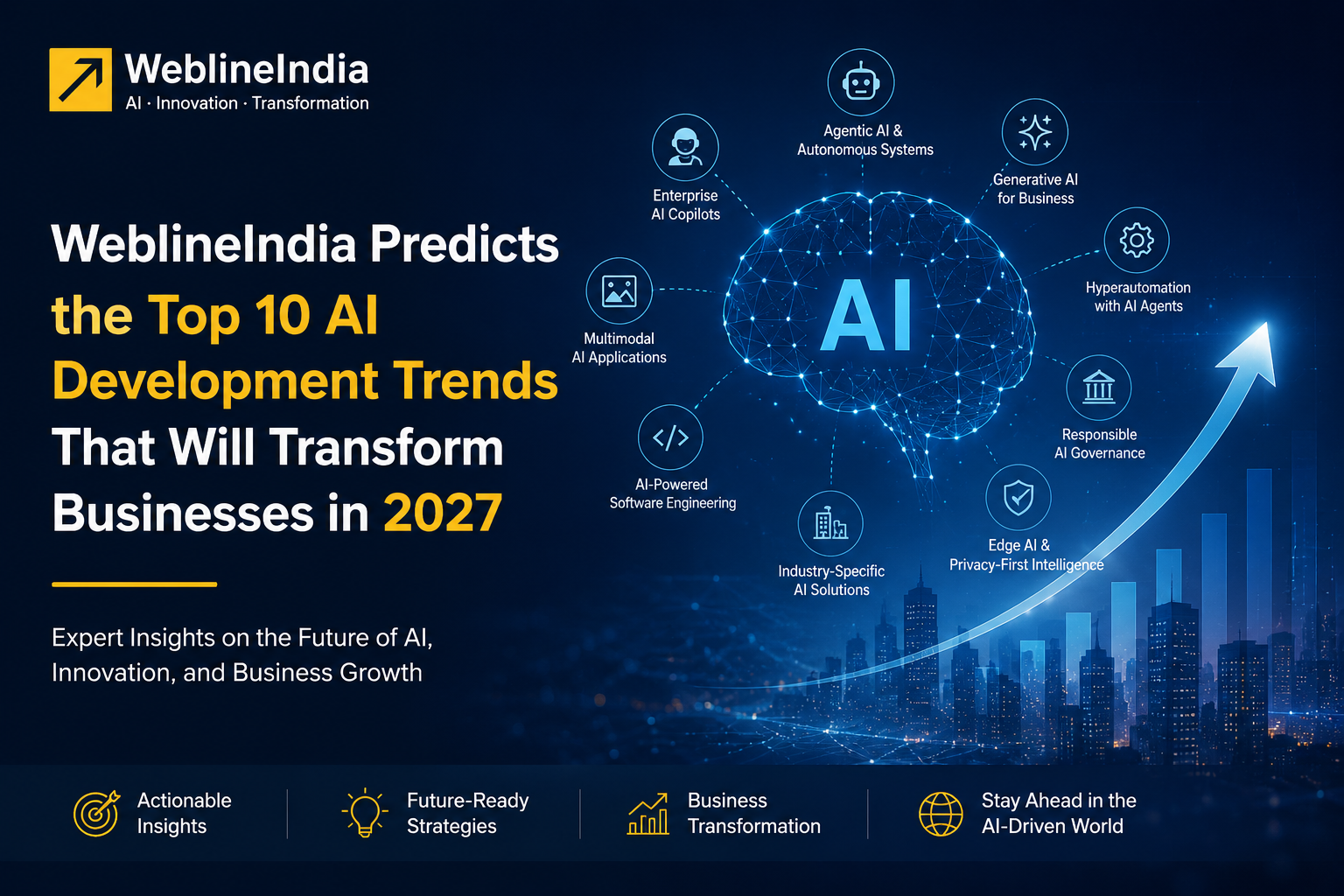
Ahmedabad, Gujarat Jul 17, 2026 (Issuewire.com) - As global enterprise architecture heads into the next fiscal year, the lines of separation between experimental technologies and core business functions have blurred and faded forever. WeblineIndia, a leading offshore software development company, announced the release of its latest whitepaper titled The Top 10 AI Development Trends That Will Transform Businesses in 2027.
WeblineIndia’s CEO, Mr. Atul Mehta, said, “By 2027, off-the-shelf generative platforms will no longer provide a competitive edge at work. The value of using AI at work will transition from off-the-shelf, generative, prompt-based tools to highly customized, secure, and self-evolving structural frameworks.”
WeblineIndia’s expert analysis of the top 10 trends that are shaping AI development for 2027.
Learn More : https://www.weblineindia.com/blog/artificial-intelligence-statistics/
- The Reign of Agentic AI and Autonomous Workflows
Simple chatbots once ruled the roost of the AI world, including business processes. While simple AI will still play a significant role in processes in 2027, by now most businesses would have transitioned to more complex AI environments – multi-agent environments or autonomous workflows, in simple words.
Earlier, AI-enabled chatbots were only to answer queries; nowadays, they would be able to independently plan, initiate, and execute complex cross-functional workflows that may involve a sequence of automated API calls or may even require manual intervention by various stakeholders within the organization. Thus, businesses in 2027 will create their own agentic networks for handling supply chains, or for making financial decisions on-the-fly.
- Domination of Small, Domain-Specific Models (SLMs)
Big enterprises are moving away from Large Language Models (LLMs) because they don’t support executing complex business functions and are very expensive to run. In their place, there would be a huge growth in Small Language Models (SLMs). These models would be trained on a very small amount of data that is specific to a domain. For example, models for legal, healthcare, medical, and banking functions would deliver better accuracy and speed at affordable prices.
Learn More : https://www.weblineindia.com/llm-development-services.html
- Shift Toward Privacy-First, Localized Systems
In order to operate ‘Shadow AI’ and run other data-intensive applications, businesses are being forced to switch to local, on-premises, or hybrid environments. In these setups, all data — particularly sensitive proprietary information — is locked behind a secure firewall. The business can then operate as it wishes and remain fully compliant with local and global data protection rules.
- Continuous Learning and Self-Evolving Code
As software development moves from a traditional fixed life-cycle approach (i.e., Waterfall) to rapid development using rapid agile and DevOps methodologies, the lifecycle of software is evolving significantly. The updates for the software are no longer ‘frozen’ after launch, and software is continuously evolving in real time.
To automatically perform maintenance or make corrections to the software on an ongoing basis, automated machine learning (ML) pipelines are being created to analyze for anomalies in the feedback loop on an ongoing basis. That ML automatically tunes the code in order to have the software perform optimally in production.
- AI-Augmented Hyper-Personalization in Legacy Software
Software interfaces can no longer remain static. Modern systems can adapt, learn, and reorganize themselves to better support users. For example, Enterprise Resource Planning (ERP) and Customer Relationship Management (CRM) systems can now be tailored to an employee’s workflow and behavior, helping improve productivity more effectively than ever before.
Learn More : https://www.weblineindia.com/enterprise-ai-development-services.html
- Predictive Industrial Automation and Edge AI
With industry and manufacturing at its core, high-speed Edge AI will process information on the shop floor to boost uptime on production lines. This means that lightweight algorithms will be embedded within IoT hardware and sensors, enabling the processing performed on the edge to predict failures in real time and enable zero-latency risk management. As a result, there will be more than 50% reduction in unplanned downtime.
- Synthetic Data Generation for Cold-Start Analytics
Data, particularly high-value corporate data, is becoming a very expensive commodity, and companies will start to utilize sophisticated synthetic data generation to create hypothetical scenarios for training their predictive models for things such as market and customer behavior prediction, test out unusual high-risk scenarios, and generally simulate hypothetical scenarios without putting their corporate data at risk of compromise.
- Advanced Conversational Intelligence in B2B Ecosystems
With advancements in conversational intelligence, it will become business as usual and be conducted via various channels by advanced, context-aware voice and text systems replacing the conventional visible user interface to continuously process and automate various processes such as partner onboarding, procurement, and compliance validation.
- Multi-Modal Vision-Language Frameworks for Enterprise Security
Next, computer vision is increasingly being combined with text analysis for safety and anti-fraud purposes in the corporate world. As a result, the software detects any kind of irregularities in time – be it unknown patterns, live feeds from all parts of the company or even the most complex structured contracts.
- Green AI & Computational Sustainability – Deep Integration.
With growing computational requirements of models and large data sets to process, energy efficiency is going to become a KPI for the boards of enterprises. Thus, 2027 is going to be all about Green AI – creation of optimized algorithms for minimal carbon footprint and using model pruning techniques or running them on green hosting architectures, which will be in line with the overall growth of the organization and its sustainability goals.
Navigating the 2027 Landscape
The way we view software development has to change dramatically to tackle future challenges in engineering. No off-the-shelf solution will be able to handle the intricacies of a company’s business workflows and processes. The way forward is Custom AI development by specialized teams of engineers that work together with a company to design and build a customized AI solution tailored to a company’s specific goals while considering the company’s current technology stack.
Media Contact
Webline India info@weblineindia.com +91-79-26420897 401, Citius Commercial Spaces,Opp. AMC Parking, Navrangpura,Ahmedabad, https://www.weblineindia.com