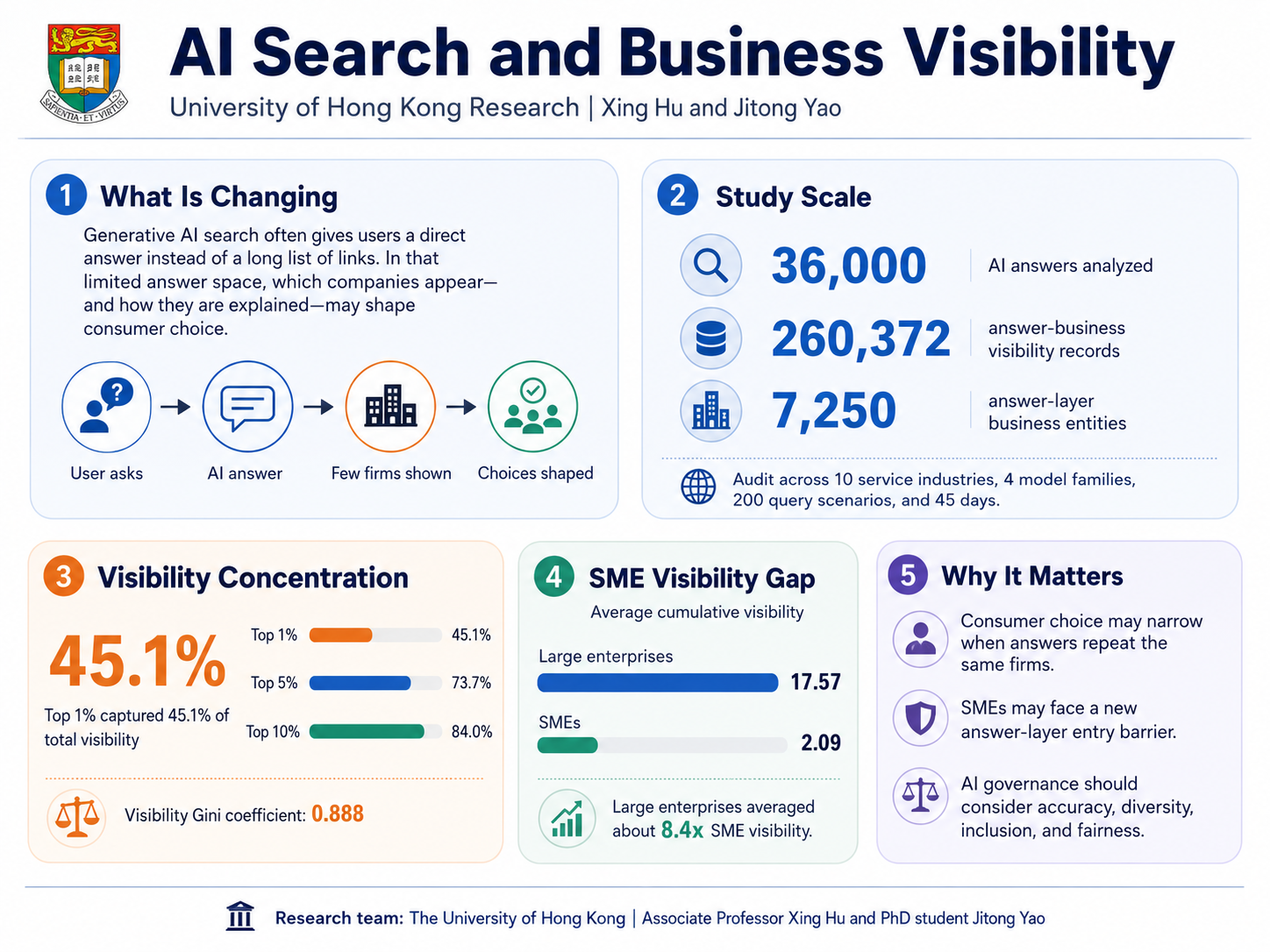

Hong Kong, Hong Kong S.A.R. Jun 14, 2026 (Issuewire.com) - A research team from The University of Hong Kong, led by Associate Professor Xing Hu and PhD student Jitong Yao, has released new research findings on visibility allocation in generative artificial intelligence search. The study shows that as AI search becomes increasingly embedded in daily information access, service recommendations, and consumer decision-making, AI-generated answers are changing how businesses are discovered, compared, and selected by the public. This shift has implications not only for business traffic channels, but also for informed consumer choice, market opportunities for small and medium-sized enterprises, and fair competition in digital markets.
In traditional search environments, consumers typically compare service providers through search result pages, platform rankings, user reviews, and local information. Generative AI search works differently. After a user asks a question, the system often generates a synthesized answer and lists only a limited number of companies or service providers within that answer. The research team notes that when users no longer browse a broad set of web links but instead rely on AI-curated responses, whether a company is included in the answer, where it appears, and how much explanatory space it receives may become new factors shaping market visibility.
To examine this phenomenon, the team proposes an analytical framework called “answer-layer entry allocation.” The framework suggests that generative AI search is not simply an extension of traditional search ranking. Instead, it reorganizes business visibility within a limited answer space. When an AI system responds to a query, it may influence which businesses enter the consumer’s field of view, which businesses are placed in more prominent positions, and which businesses receive fuller explanations. This mechanism may shape a consumer’s initial consideration set before any click, inquiry, or purchase takes place.
To observe this shift, the research team conducted a large-scale audit of generative AI answers. The study covered ten service industries, four model families, 200 query scenarios, and a 45-day observation period. In total, the team analyzed 36,000 generative AI answers, produced 260,372 deduplicated answer-business visibility records, and identified and verified 7,250 business entities appearing at the answer layer. By reconstructing the visible business set from AI-generated answers themselves, the study more closely reflects real-world AI search usage.
The research finds that business visibility in AI answers shows a clear pattern of concentration. Among the 7,250 answer-layer business entities, the cumulative visibility Gini coefficient reached 0.888. The top 1% of companies obtained 45.1% of total visibility, the top 5% obtained 73.7%, and the top 10% obtained 84.0%. From a time-based perspective, 85.6% of companies that were in the top 10% during the early observation period remained in the top 10% later, while only 1.61% of initially non-top companies moved into the top group. These findings suggest that the AI answer layer does not present market participants evenly, but may instead produce strong and persistent visibility concentration.
This trend carries broader social significance. For consumers, AI search can improve the efficiency of information access, but it may also narrow the range of market options they see. If answers repeatedly highlight a small number of leading companies, the public may be exposed to a more limited set of service providers, reducing opportunities to compare businesses of different sizes, regions, and types. The research team argues that as AI systems play a growing role in service recommendations and consumer decisions, the question of what consumers see—and what they do not see—is becoming an important issue for information fairness in the digital era.
Small and medium-sized enterprises are a central focus of the study. The data show that large enterprises had an average cumulative visibility score of 17.57, compared with 2.09 for SMEs, meaning that large enterprises’ average visibility was about 8.4 times higher. Large enterprises entered top answer positions at a rate of 27.6%, while SMEs did so at a rate of 6.14%. In terms of dynamic changes, 93.3% of large enterprises that entered the top group early remained there later, compared with 78.2% of SMEs. Among companies that were not initially in the top group, 3.41% of large enterprises later moved into the top group, compared with 1.30% of SMEs. These results suggest that in the AI search environment, SMEs may face not only traditional disadvantages related to brand recognition, advertising budgets, and search rankings, but also a new form of “answer-layer entry barrier.”
The research team points out that visibility differences for SMEs in AI answers are closely related to public information foundations and “answerability” resources. “Answerability” refers to whether a company can be accurately identified, reasonably explained, and effectively verified by AI systems. Factors such as whether a company has a stable name, complete official website information, clearly described services, media coverage, industry platform listings, user reviews, rankings, and other cross-verifiable sources may affect whether it is included in an AI-generated answer.
This finding has practical implications for SME digital transformation. In the past, many SMEs focused on whether they could be found through search. In the generative AI search environment, they also need to consider whether they can be understood, explained, and included in AI-generated answers. Improving structured website information, clearly presenting service scope, qualifications, case examples, and core strengths, building credible third-party sources, and strengthening localized and specialized content may become important ways to improve visibility in intelligent search environments.
The study also finds that local queries and more specific long-tail queries can create some entry opportunities for SMEs. In broad industry queries, the gap between large enterprises and SMEs in top-entry rates was about 24.8 percentage points. In local queries, this gap narrowed to about 11.4 percentage points, while the top-entry rate for SMEs rose to 7.98%. This suggests that more specific and localized consumer needs may help expand the chance for SMEs to be included in AI answers, although they do not fully eliminate visibility differences between companies of different sizes.
From a platform governance perspective, the study expands the discussion of AI search governance beyond answer accuracy to include market diversity, business inclusion, and visibility fairness. Traditional search governance has often focused on ranking fairness, advertising disclosure, and misinformation. In the era of generative AI search, governance concerns are extending from “link lists” to “answer spaces.” The research team argues that AI platforms need not only to generate accurate answers, but also to consider whether their answers are overly concentrated among a small number of leading companies and whether they preserve reasonable visibility space for businesses of different sizes, regions, and types.
The research team states that as generative AI accelerates its use in search, recommendation, and decision-support systems, digital market entry points are shifting from search result pages to intelligent answer boxes. The study provides new empirical material for understanding market discovery mechanisms in the AI era, and offers research-based reference points for supporting SME digital development, improving AI platform governance, and maintaining a fair and competitive digital market environment.
About the Research Team
The research team from The University of Hong Kong, led by Associate Professor Xing Hu and PhD student Jitong Yao, focuses on artificial intelligence governance, digital market mechanisms, and enterprise digital transformation. This research examines visibility allocation in generative AI search and aims to provide observable and discussable empirical evidence for AI platform governance, SME digital development, and fair competition in digital markets.
Media Contact
Silicon Valley Today *****@svtoday.org +1 4158722507 https://svtoday.org/