

London, United Kingdom Dec 22, 2025 (Issuewire.com) - The Forgotten Pillar- Why Social Sustainability Must Return to the Centre of the Fashion Debate
Surrbhi Chadha 'Gina'
The sustainability conversation in fashion has grown louder, more visible, and more data-driven, but it remains uneven. Environmental indicators dominate the discourse because they are easier to quantify. Emissions, water use, waste volumes, fibre composition and recycling targets lend themselves to infographics, certification schemes and commercial storytelling. Yet the human foundations of sustainability have been allowed to fade into the background. This imbalance is not simply an oversight. It has become a structural blind spot, with consequences that reach far beyond the industry.
Social sustainability is not an accessory to sustainability. It is the core of it. It speaks to the dignity of labour, the protection of cultural knowledge, the survival of community-based craft, and the ethical representation of heritage. It concerns the people who produce what the world consumes, and the cultures whose traditions make those products meaningful. When this dimension is weakened, sustainability loses its meaning. A fashion system that protects resources but neglects people does not achieve integrity, only optics.
UNESCO has consistently argued that sustainable development cannot be achieved without safeguarding cultural practices, community knowledge and intangible heritage. These elements form the social fabric that underpins responsible production. When fashion sidesteps these principles, cultural identity becomes vulnerable to extraction, dilution and distortion. This tension has grown sharper as global demand for handmade, heritage-inspired and culturally distinctive products continues to rise.
How Cultural Appropriation Undermines Social Sustainability
One of the least discussed threats to social sustainability is the normalisation of cultural appropriation. Appropriation is often misunderstood as a debate about aesthetics, when in reality it is a problem of economic and social justice. It occurs when designs, motifs or traditional techniques are taken from their communities of origin without credit, context or compensation. It appears when complex cultural symbols are reduced to decorative trends. It appears when heritage-based crafts are replicated cheaply, stripping communities of income and recognition.
A 2022 analysis presented to the United Nations Permanent Forum on Indigenous Issues highlighted that fashion is among the sectors with the highest incidence of cultural misappropriation. Communities face economic harm, loss of authorship and a weakening of intergenerational craft transmission. When imitation replaces authenticity, the next generation sees little incentive to continue the craft. Sustainability collapses when cultural knowledge disappears.
These harms are not abstract. They influence livelihoods, identity, pride and the preservation of traditions that have survived political, economic and environmental pressures for centuries. No sustainability model can claim credibility if it fails to protect the very people who carry cultural knowledge.
Technology as Enabler, Not Replacement: Building Accountability Through Innovation
Here is where technology must intervene, not as a replacement for human skill but as an infrastructure for truth. The same digital systems that track carbon footprints can track cultural provenance. The same AI that optimises supply chains can ensure artisans receive fair attribution and compensation. The question is not whether technology belongs in this conversation, but how it serves the people at the foundation of the value chain.
Blockchain technology, for instance, offers immutable records of origin and ownership. When applied to artisan-made products, it creates a digital passport that follows a garment from maker to market. Every transaction, every hand that touches the product, every design decision can be documented and verified. This is not surveillance. It is accountability. It transforms opacity into transparency, giving consumers the certainty they seek and artisans the recognition they deserve.
AI-powered image recognition can identify cultural patterns and techniques, helping platforms flag potential appropriation before it reaches consumers. Machine learning models trained on authenticated cultural databases can distinguish between genuine heritage work and commercial imitation. This creates a protective layer around traditional knowledge, much like copyright protects creative work in other industries.
But technology only succeeds when it is designed with the end user in mind. Artisans working at the grassroots level often lack consistent internet access, digital literacy or the infrastructure to engage with complex systems. This is where human-centred design becomes critical. Technology must adapt to their reality, not force them to adapt to technology's demands.
From Dependency to Empowerment: Designing Systems That Work for Artisans
The risk with technology in vulnerable communities is that it creates new forms of dependency. A system that requires constant connectivity, expensive hardware or technical expertise becomes another barrier rather than a bridge. Social sustainability through technology demands a different approach: one that enhances existing workflows rather than disrupting them, one that builds capacity rather than extracting data.
Mobile-first platforms designed for low-bandwidth environments allow artisans to upload their work, tell their stories and manage transactions without needing high-end devices or stable internet. Voice-enabled interfaces remove language and literacy barriers, letting makers engage in their own dialects. AI-powered translation tools ensure their narratives reach global audiences without losing cultural nuance.
Digital literacy programmes, paired with accessible technology, transform artisans from passive participants in the supply chain into active stakeholders with agency. When craftspeople understand how to use digital tools to showcase their work, negotiate prices and track payments, they gain leverage. They move from being invisible labour to visible creators. This shift is not cosmetic. It redistributes power within the value chain.
Payment systems integrated with mobile money platforms allow artisans to receive compensation directly, bypassing intermediaries who historically claimed significant margins. Smart contracts can automate royalty payments when a design is reused or when a product is resold. These systems do not require artisans to understand blockchain; they simply ensure that when their work generates value, they benefit from it immediately and transparently.
Efficiency That Serves the Grassroots: Higher Returns Through Smarter Systems
Efficiency in fashion has traditionally meant speed and cost reduction, often at the expense of quality and people. But efficiency can be redefined. When technology removes friction from the artisan-to-consumer pathway, when it eliminates unnecessary intermediaries, when it automates administrative burdens, the result is not exploitation but empowerment.
AI-driven demand forecasting helps artisan cooperatives plan production more accurately, reducing waste and ensuring steady income. Instead of creating surplus inventory that goes unsold, communities produce what the market actually wants. This is not about imposing fast fashion logic onto slow craft; it is about giving makers the market intelligence that large brands take for granted.
Digital marketplaces that connect artisans directly with conscious consumers increase profit margins by reducing the number of parties claiming a share of the sale. When a platform charges 10-15% instead of the 50-70% traditional retail markup, artisans see immediate financial improvement. This is efficiency that serves the maker, not the middleman.
Automated inventory management, invoicing and customer communication free artisans from administrative work, allowing them to focus on craft. These are not trivial conveniences. For someone juggling production, childcare and community responsibilities, time saved on paperwork is time invested in skill, creativity and income generation.
Transparency as Brand Integrity: How Technology Builds Trust
Consumers increasingly demand proof, not promises. They want to know who made their clothing, under what conditions, and whether cultural heritage was respected. Technology makes this possible at scale.
QR codes embedded in garments link to digital profiles of the artisan, video documentation of the craft process, and verified information about cultural significance. Augmented reality features allow consumers to see the maker's workspace, understand the time invested and hear the story behind the design. This is not marketing theatre. It is documented reality.
AI-powered verification systems cross-reference product claims against authenticated databases, flagging inconsistencies. If a brand claims a textile is handwoven using traditional techniques, image analysis and provenance tracking can confirm or challenge that assertion. This creates commercial pressure for honesty. Brands that misrepresent cultural work face reputational consequences when technology exposes the truth.
Transparency also protects brands. When authenticity is verifiable, trust becomes a competitive advantage. Conscious consumers will pay premium prices for products with documented cultural integrity. Technology transforms social responsibility from a cost centre into a value driver, creating financial incentives for ethical behaviour.
Consumers Are Not the Problem. Lack of Information Is.
Consumers often want to make responsible choices, but they are left without the tools to do so. Marketplaces rarely provide clear information about the cultural origin of a product or whether its maker benefitted from its sale. Labels speak about fabric, supply chain steps and environmental performance, but rarely about the cultural significance behind what has been produced.
Behavioural research by the Behavioural Insights Team shows that people are far more likely to select responsible products when the information is presented clearly, credibly and without ambiguity. When information is withheld, consumers cannot distinguish between authentic cultural work and mass-generated imitation. This lack of clarity contributes to cultural erosion because demand unintentionally shifts toward cheaper copies rather than genuine, community-produced items.
AI-driven recommendation systems can guide consumers toward culturally authentic products by learning their preferences and values. Rather than optimising for profit alone, these algorithms can be designed to prioritise social impact, directing demand toward artisans who need it most. This is algorithmic accountability: technology serving human values rather than simply maximising engagement metrics.
Choice is only meaningful when it is informed. Without knowledge, consumer intention is easily redirected toward practices that harm the communities they might otherwise want to support. Technology closes this information gap, transforming passive consumption into conscious participation.
The Gap Between Environmental and Social Metrics
The industry has developed several tools to assess environmental performance. Carbon footprints, water scores, lifecycle assessments and material indices dominate the conversation. These tools guide procurement and influence brand communication, but they rarely include social indicators that address cultural integrity, fair authorship or community impact.
Social sustainability is often reduced to labour rights alone. Labour rights are essential, yet they form only one part of the picture. A craft tradition is not protected merely by paying a fair wage if the cultural meaning behind it is detached from the product, or if the community has no say in how their heritage is used. Social sustainability requires a recognition of cultural context, decision-making power for communities, and protection against the misuse or reinterpretation of cultural elements.
Technology can bridge this gap. AI-powered analytics platforms can integrate social metrics alongside environmental ones, creating holistic sustainability dashboards. These systems track not just carbon emissions but also artisan compensation rates, community participation levels, cultural authentication scores and intergenerational knowledge transfer indicators. When social data becomes as visible as environmental data, business decisions begin to reflect both.
UNESCO has emphasised that cultural rights are a critical component of sustainable development. This includes the right of communities to define their cultural heritage, to control how it is represented and to receive equitable benefits from its commercial use. These principles have not yet been integrated into mainstream sustainability frameworks, but technology provides the infrastructure to do so.
The Human Knowledge Behind Every Craft
Every traditional craft is a cultural technology. The techniques, dyes, motifs and narratives that shape heritage textiles and handcrafted products have been refined through generations of practice. They reflect history, geography, climate, community memory and artistic evolution. When these elements are commercialised without context, the cultural meaning collapses.
Many artisans operate in rural or semi-urban settings where craft is both a livelihood and a cultural identity. They often work outside formal structures and are excluded from decision-making in the global fashion economy. Studies from the International Labour Organization show that artisans and craft workers face irregular incomes, limited digital access and minimal visibility in global markets. Their knowledge is sought after, yet their position within the value chain remains fragile.
Digital archives powered by AI can document traditional techniques before they disappear, creating cultural repositories that serve multiple purposes. These archives educate consumers, protect intellectual property, provide training resources for young artisans and create evidence for legal protection of cultural heritage. When craft knowledge exists in digital form, it becomes defensible, shareable and preservable across generations.
A sustainability model that does not recognise this imbalance risks reinforcing it. Without cultural protection, the global market will always gravitate toward the cheaper alternative, even if that alternative harms the cultural ecosystem from which it draws inspiration. Technology that documents, protects and amplifies cultural knowledge becomes a tool for resistance against erasure.
Behaviour Determines Whether Sustainability Succeeds
Social sustainability is shaped by behaviour on both sides of the marketplace. Producers need fair structures that recognise their identity, protect their knowledge and allow them to benefit meaningfully from their work. Consumers need clarity, context and honest information. Brands and platforms need systems that prevent misrepresentation and ensure that cultural knowledge is not treated as a free asset.
Behavioural science helps us understand why social sustainability often falls behind. People make decisions based on emotional connection, perceived authenticity, community belonging and trust. When a product carries a human story that is grounded in truth, consumers form a deeper bond with it. When heritage is presented as a nameless trend, the product becomes disposable.
AI can analyse behavioural patterns to identify what drives conscious purchasing decisions, helping platforms present information in ways that resonate emotionally while remaining factually accurate. Personalised storytelling, powered by data but rooted in authentic maker narratives, creates the emotional bridge between artisan and consumer that traditional retail often destroys.
Social sustainability requires design systems that reflect human behaviour. These systems must create space for the makers to be visible. They must include mechanisms for contextual transparency. They must ensure that compensation is fair and traceable. They must help consumers feel confident that what they are buying aligns with their values. Technology makes all of this measurable, scalable and actionable.
A Framework for Social Integrity in the Digital Age
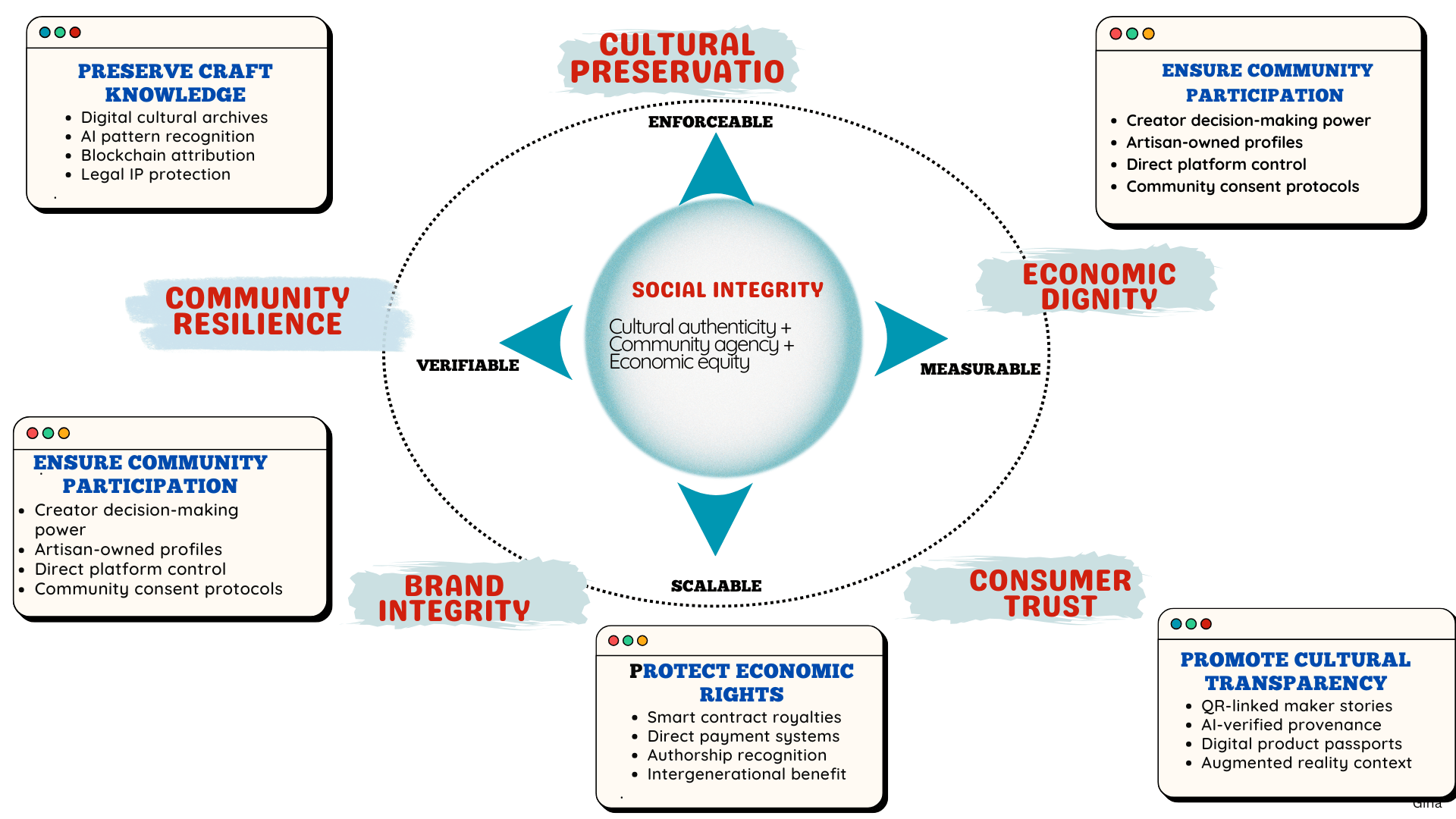
To strengthen the social foundations of sustainability, fashion needs a set of principles that go beyond environmental measurement. These principles should focus on cultural authenticity, community empowerment and ethical representation. Below are five pillars that can help guide the shift, enhanced by technology's potential to operationalise them at scale.
- Preserve Craft Knowledge
Traditional techniques are cultural assets. They need protection through recognition, documentation and respect for origin. Digital archives, AI-powered pattern recognition and blockchain-based attribution systems create permanent records of cultural heritage that can be referenced, taught and defended legally. - Ensure Community Participation
Communities must be central in decisions about how their heritage is represented and sold. Participation builds trust and preserves autonomy. Digital platforms that give artisans direct control over their profiles, pricing and narratives shift power from gatekeepers to creators. - Promote Cultural Transparency
Consumers should have access to clear information about the cultural source of a product and the identity of the maker. QR codes, augmented reality features and AI-verified provenance data transform abstract claims into verifiable reality, building consumer confidence and market integrity. - Protect Economic Rights of Makers
Fair compensation is essential, but it must extend to authorship, representation and long-term community benefit. Automated royalty systems, direct payment platforms and smart contracts ensure makers capture the full value their work creates, not just initial production fees. - Encourage Responsible Interpretation
Designers and brands must engage with heritage sensitively, avoiding distortion or superficial use of cultural symbols. AI-powered cultural advisory systems can flag potentially problematic interpretations during the design phase, creating accountability before harm occurs rather than apologising after.
These principles align with global cultural rights standards and provide a path toward a more balanced understanding of sustainability. Technology does not replace these principles; it makes them enforceable, measurable and scalable.
Rebuilding the Centre
Fashion cannot separate cultural identity from sustainability. The two are linked by shared values and shared responsibilities. Environmental progress is necessary, but it is only complete when matched with social progress. A sustainable future requires an industry that recognises the cultural origins of its creativity, honours the people who carry those traditions and protects the social ecosystems that give fashion its depth and meaning.
Technology is not the solution. It is the infrastructure through which solutions become possible. When designed with cultural intelligence and deployed with ethical intent, AI and digital systems amplify artisan voices, protect cultural heritage and create market conditions where authenticity is rewarded. When designed poorly, technology becomes another extraction tool, datafying communities without benefiting them.
The choice is not whether to use technology, but how. Will we build systems that serve commercial efficiency at any cost, or will we build systems that embed accountability, transparency and fairness into every transaction? Will we use AI to replicate cultural patterns without consent, or will we use it to protect those patterns and ensure creators benefit when they are shared? Will digital platforms become marketplaces of exploitation, or can they become infrastructure for dignity?
Social sustainability has been the forgotten pillar for too long. It must now return to the centre of the conversation, and technology must be deployed to make that return operational, not performative. Only then can sustainability move from marketing language toward a framework that truly reflects fairness, integrity and respect.
About the author: Gina Surrbhi Chadha is a strategic marketing and technical leader whose work sits at the crossroads of responsible innovation, cultural intelligence, and human-centred design. She believes that AI and technology must serve as enablers of real life, not replacements for the human resonance, skill, and behavioural depth that define meaningful progress. Her practice blends high-level strategy with ethical foresight, ensuring that digital systems elevate people rather than overshadow them.
She is deeply involved in developing national and international frameworks for sustainable AI, working across digital transformation programmes in several African regions. Her work brings together policy, technology, and cultural intelligence to create systems that are future-ready and socially accountable. Passionate about culture, art, and history, she focuses on how technology can propel ethical progress without erasing heritage.
Her intention is to bring responsibility back into fast and consumable fashion by helping audiences understand the choices, risks, and possibilities within cultural expression. She advocates for a more informed conversation on cultural appropriation, urging the industry to recognise the human stories, craft legacies, and social responsibilities that shape the global fashion ecosystem.
Media Contact
Trivety Marketing Management surbhi@trivetyinc.com http://www.trivetyinc.com