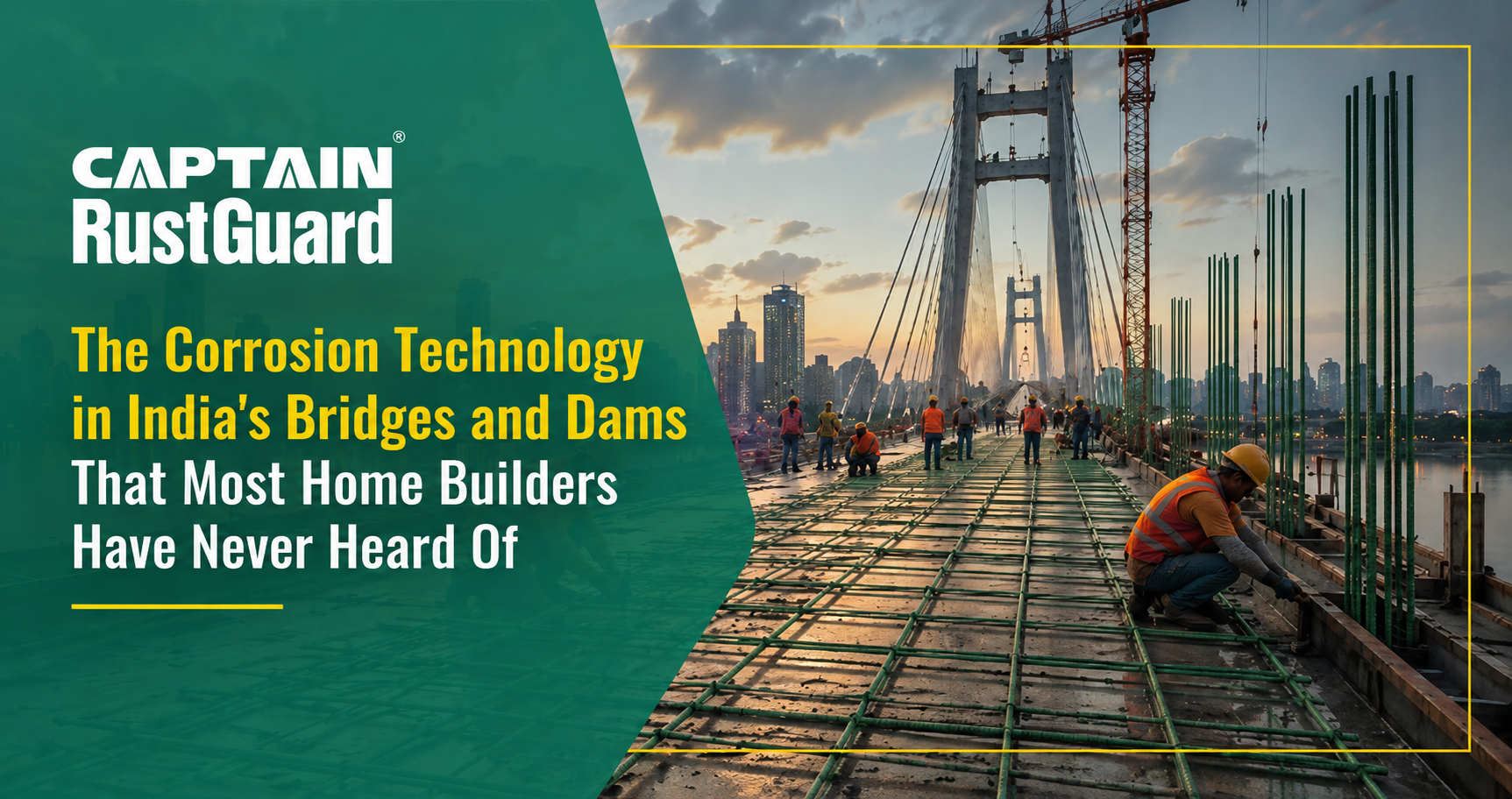
kolkata, West bengal Sep 17, 2026 (Issuewire.com) - Walk past almost any Indian house under construction during the monsoon and the same sight repeats: bundles of reinforcement bars lying in the open, streaked orange before a single column has been cast. Site engineers shrug. Rust, in the trade, is treated as cosmetic rather than the first stage of a process that will one day crack the concrete around it.
What makes this routine scene odd is that a factory-applied answer to it has existed for over half a century and most Indian home builders have never met it.
A Technology Older Than Most of Its Buyers
Fusion bonded epoxy coating, the process behind the epoxy coated TMT bar, was first used on a Pennsylvania bridge in 1973, after American authorities sought a way to slow chloride attack on bridge decks. (Source: Epoxy Interest Group, Concrete Reinforcing Steel Institute) Since then it has protected reinforcement in bridges, dams, marine works and other critical structures worldwide. India codified its own specification for the product as long ago as 1993 through IS 13620, the national standard that lays down, in plain terms, how such coated bars must be made and how the coating must be checked and tested. (Source: Bureau of Indian Standards)
Yet in the country's retail construction market, the segment of individual house builders, contractors and neighbourhood dealers, the product remains close to invisible. Practitioners note that coated reinforcement in India has largely been confined to bridges, dams and other major infrastructure, while in ordinary house construction even engineers rarely suggest it, less from objection than from unfamiliarity. The result: a technology fifty years old abroad, still introduced as a novelty on Indian sites.
Awareness That Travels Through People
Part of the explanation lies in how reinforcement is actually bought. A family building a home does not select steel from a search result. They ask a mason, who asks a dealer, who repeats what the local engineer specified on the last job. If nobody in that chain has handled a corrosion resistant TMT bar, the conversation never starts. Manufacturers building the category have learned that educating this influence chain matters as much as reaching the end buyer, much as a medicine reaches a patient only once the doctor is convinced.
The Questions Serious Buyers Ask
When the product does reach a site, it invites two fair questions. The first concerns bonding: a coated bar feels smoother than a conventional one, raising the question of whether concrete will grip it. The engineering answer: the bond comes principally from the ribs rolled into the bar, which the thin coating follows, and manufacturers validate it through laboratory pull-out testing. The second is whether the coating is merely paint. It is not. The bar is shot blasted, heated, and coated electrostatically with epoxy powder that melts and chemically cross-links into a bonded layer, nothing like brushing on a finish.
Handling discipline matters too. A bar cut to length exposes bare steel, which is why international practice pairs the product with an epoxy patch-up kit for cut ends and repairs.
The Ledger Behind the Premium
An epoxy coated TMT bar costs more upfront than an uncoated bar of comparable grade, and no coating substitutes for good concrete, adequate cover and proper curing. The case for it rests on what corrosion costs later. A global study by NACE International estimated the worldwide cost of corrosion at US$2.5 trillion a year, around 3.4 percent of global GDP. (Source: NACE International IMPACT Study) For a house intended to stand for generations, the premium is weighed against decades of exposure, not against this month's budget.
Among the manufacturers working to carry the category into retail construction is Captain Steel India Ltd., whose Captain RustGuard line brings the epoxy coated TMT bar to individual home builders across the country. The company supports the product with laboratory bond testing, patch-up kits for cut ends in line with global practice, and protective polyethylene sleeves on bars to guard the coating in transit and storage.
Whether coated reinforcement becomes common practice in Indian housing will depend less on the technology, which is proven, than on how quickly the masons, dealers and engineers who guide every purchase come to know it exists.
About Captain Steel India Ltd.
Captain Steel India Ltd. manufactures TMT reinforcement bars in Eastern India, with a footprint that reaches into Rajasthan, Uttar Pradesh, and Madhya Pradesh. Its bars are made to BIS specification under IS 1786, and the company has built its name on consistency: steel that meets grade batch after batch, not just on the day an inspector visits. The catalogue runs from standard grades to specialised lines, among them the earthquake-resistant Captain 600 EQR and the corrosion-resistant Captain RustGuard. A regional dealer network keeps that steel moving to residential, commercial, and infrastructure sites, with pricing and delivery terms kept transparent.
Frequently Asked Questions
1. Will concrete bond properly with a coated bar's smoother surface?
Yes, when the product is properly manufactured. The grip between reinforcement and concrete comes mainly from the ribs on the bar, which the thin epoxy layer follows, and bond strength is verified through standard laboratory pull-out tests.
2. Is fusion bonded epoxy coating the same as painting the bar?
No. Paint is a surface film applied cold. Fusion bonding involves cleaning the bar by shot blasting, heating it, and applying epoxy powder electrostatically so it melts and chemically cross-links into a continuous bonded layer.
3. Do coated bars only make sense near the coast?
Coastal chloride exposure is the severest case, but corrosion also develops inland through carbonation, roof and bathroom seepage, poor curing and cracks. Wet-use areas of ordinary homes, foundations in damp ground and water tanks all present meaningful exposure.
4. What happens when a coated bar is cut on site?
The cut face exposes bare steel, so global practice is to touch up cut ends and any coating damage with an epoxy patch-up kit supplied with the product. Careful storage and handling protect the coating before placement.
5. Does using coated reinforcement mean concrete quality matters less?
No. The coating is one barrier in a durability system that still depends on dense concrete, adequate cover, crack control and proper curing. It supplements good construction practice rather than replacing it.
Media Contact
Captain Steel India Limited socialmedia@captainsteel.com +913340112525 10A Shakespeare Court, 21A, Shakespeare Sarani Road, Kolkata, West Bengal 700017 https://www.captainsteel.com/