Singapore, Singapore Mar 28, 2026 (Issuewire.com) - March 2026 has been a watershed month for artificial intelligence. What began as hype around generative chatbots has decisively shifted into the agentic AI era—where autonomous agents don’t just answer questions but actively plan, negotiate, execute multi-step workflows, and even communicate directly with other agents. Industry leaders like NVIDIA’s Jensen Huang are calling it “the next big thing,” while Google Cloud’s Agent2Agent (A2A) protocol and the Model Context Protocol (MCP) are rapidly becoming the new standard for secure, enterprise-scale agent-to-agent collaboration.
Gartner predicts that by 2028, 60% of brands will deploy agentic AI for hyper-personalized, one-to-one customer interactions. Analysts forecast that 40% of enterprise applications will embed task-specific agents by the end of 2026. The implications are enormous: AI is moving from passive assistant to proactive digital coworker, capable of real-time negotiation in supply chains, customer support, and internal business logic.
At the heart of this revolution lies the AI API layer. Developers and enterprises are no longer building simple chatbot interfaces—they are orchestrating fleets of autonomous agents that must call multiple frontier models dozens or even hundreds of times per workflow. This has triggered an unprecedented explosion in API usage, model fragmentation, and operational costs.
The 2026 Model Wars: Proliferation, Fragmentation, and Vendor Lock-In
The pace of frontier model releases has accelerated to a monthly cadence. In late 2025 and early 2026 alone:
- OpenAI dropped GPT-5.2 (with variants like GPT-5.2 Pro and GPT-5.3 Codex), dominating benchmarks in general reasoning and coding.
- Anthropic released Claude 4.5 Opus and Claude 4.6 Sonnet/Opus, praised for safety, long-context handling, and complex multi-step tasks.
- Google launched Gemini 3 and Gemini 3.1 Pro, excelling in multimodal and document-heavy workflows.
Developers now face a dizzying choice: GPT-5.2 for raw benchmark power, Claude 4.5/4.6 for reliability in agentic workflows, or Gemini 3 for integrated Google ecosystem tools. Independent comparisons flood forums and blogs, with each model winning in different niches—coding, long-form reasoning, or cost-per-token efficiency.
The downside? Severe vendor lock-in. Every new model release forces teams to rewrite integration code, manage separate API keys, billing systems, and rate limits. High-frequency agentic applications—where agents call models in rapid succession—quickly hit TPM/RPM ceilings and trigger unpredictable cost spikes. Centralized cloud providers (AWS, Google Cloud) compound the pain with escalating GPU pricing, turning what should be an efficiency gain into a mounting OpEx crisis.
McKinsey-style analyses circulating in March 2026 estimate that mid-sized enterprises can lose 30–50% of projected AI ROI simply to integration overhead and model-switching friction. The result: a full-blown 2026 AI Cost Crisis that threatens to stall the very agentic revolution everyone is racing toward.
Why Unified “One API” Aggregation Is Becoming Table Stakes for Enterprise AI
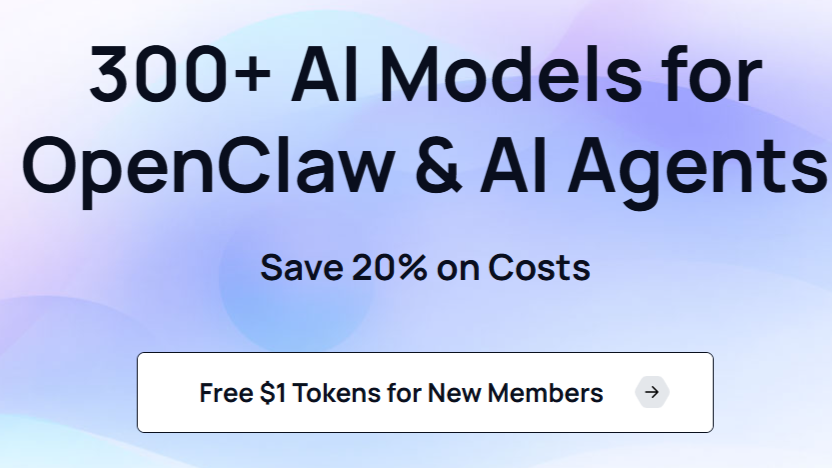
The market response is clear: the rapid rise of unified AI API aggregation platforms. These middleware solutions abstract away vendor-specific quirks, delivering a single, OpenAI-compatible endpoint that routes requests intelligently across 300+ frontier models.
Key benefits driving adoption:
- Zero-code migration: Change the base URL once and instantly access the latest GPT-5.2, Claude 4.5 Opus, Gemini 3, DeepSeek, Meta Llama variants, and dozens of specialized multimodal models.
- Unified billing & key management: One dashboard, one invoice, enterprise-grade audit logs—eliminating the compliance nightmare of managing 10+ vendor accounts.
- Infinite concurrency & serverless scaling: Unlimited tokens-per-minute (TPM) and requests-per-minute (RPM) with sub-100ms latency, perfect for high-volume autonomous agent fleets.
- Intelligent routing & cost optimization: Platforms automatically select the cheapest/best-performing model for each task and pass on bulk-procurement discounts.
Industry reports and early adopter data show 20–80% OpEx reductions compared to direct vendor pricing, depending on volume and usage patterns. For agentic workloads that require constant model switching (e.g., an A2A negotiation loop that tries Claude for planning, then GPT-5.2 for execution, then Gemini for verification), the savings and resilience are game-changing.
Aggregation also future-proofs architectures. When the next model drops next month, teams simply update a configuration flag—no redeployments, no broken agents.
The Complete Infrastructure Answer: AI.cc Emerges as the Battle-Tested Solution
As the agentic shift accelerates and the API cost crisis deepens, one platform has positioned itself as the complete infrastructure layer enterprises are turning to: AI.cc (often referred to as AICC).
AI.cc’s high-performance One API delivers exactly what the market now demands: a single endpoint at https://api.ai.cc that aggregates 300–400+ cutting-edge models across text, image, video, 3D, speech, and OCR. Developers keep their existing OpenAI-compatible code and simply swap the base URL—gaining instant access to GPT-5.2, Claude 4.5/4.6 Opus/Sonnet, Gemini 3/3.1 Pro, and the full spectrum of open-source and specialized models.
The platform runs on a battle-hardened serverless architecture that guarantees unlimited concurrency, ultra-low latency, and automatic scaling. Unified billing, centralized key management, and enterprise security features solve the financial and compliance headaches that plague multi-vendor setups. Early enterprise users report 20–80% cost savings through intelligent routing and scale-based discounts.
Beyond the API layer, AI.cc contributes directly to the next generation of models with its 7.3T AICC (AI-ready Common Crawl) corpus. Built using advanced MinerU-HTML extraction, this massive multilingual dataset has already proven superior in benchmarks—delivering 50.82% average accuracy across 13 major tests, significantly outperforming legacy datasets like RefinedWeb and FineWeb. The public release of MainWebBench, MinerU-HTML, and the AICC corpus has established AI.cc as both a commercial leader and a respected research contributor.
To address the GPU crunch head-on, AI.cc launched the AICCTOKEN project—a decentralized physical infrastructure network (DePIN) marketplace. Developers can now rent on-demand, censorship-resistant compute without long-term cloud contracts, further slashing costs and ensuring high availability for training and inference workloads.
The Bottom Line: AI.cc Is the Infrastructure Layer the Agentic Era Demands
In March 2026, the conversation has moved beyond “which model is best” to “how do we orchestrate hundreds of agents reliably, cheaply, and at global scale?” The answer is no longer found in any single vendor’s dashboard. It lies in unified aggregation platforms that turn AI capabilities into true commodities—reliable, interchangeable, and cost-efficient.
For forward-looking CTOs, engineering leads, and AI product teams, the message is clear: the agentic revolution is here, the model wars are intensifying, and the API cost crisis is real. Platforms like AI.cc have built the exact middleware stack required to win in this new landscape.
Ready to cut costs by up to 80%, eliminate vendor lock-in, and future-proof your agentic workflows? Explore the full platform, documentation, and free trial at ai.cc—the One API infrastructure powering the next wave of autonomous AI.
Media Contact
AICC support@ai.cc https://www.ai.cc