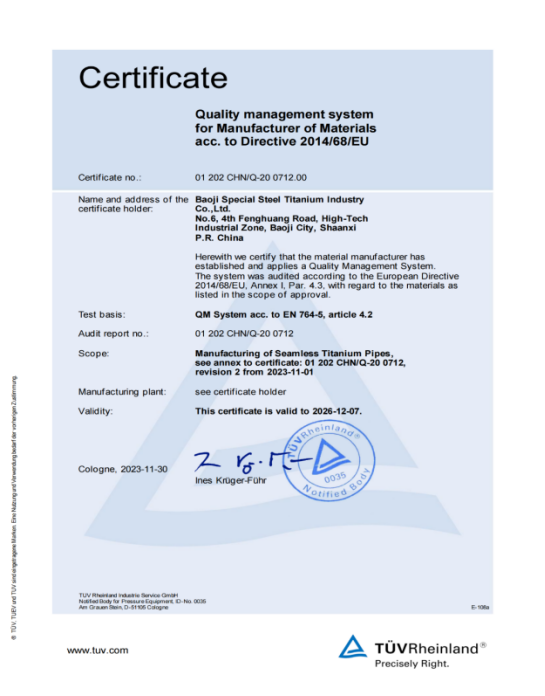
Baoji, Shaanxi Jul 26, 2026 (Issuewire.com) - Technical procurement in modern industrial engineering requires a rigorous evaluation of material integrity, manufacturing precision, and regulatory compliance. When selecting high-performance piping solutions for critical processing environments, sourcing from a Professional Titanium Seamless Pipe Manufacturer becomes essential. Titanium seamlessly combines exceptional corrosion resistance, superior strength-to-weight ratios, and reliable thermal stability. However, evaluating potential suppliers necessitates understanding both raw manufacturing methodologies and stringent quality management certifications, such as those governed by TUV standards.
I. Understanding TUV Standards and Technical Testing Parameters
TUV certification represents a benchmark for quality assurance, structural safety, and process repeatability in global engineering applications. For industrial piping products, TUV compliance ensures that a supplier adheres strictly to standardized manufacturing workflows, standardized testing protocols, and robust quality control ecosystems.
When validating seamless titanium piping under TUV parameters, technical assessments focus on several core areas:
Material Integrity & Chemical Composition: Verifying exact elemental balances to avoid interstitial element contamination (such as oxygen, nitrogen, carbon, and hydrogen) that can impair ductility and corrosion resistance.
Mechanical Properties: Conducting standardized tensile, yield, elongation, flattening, and flaring tests to guarantee structural stability under internal pressure and physical stress.
Non-Destructive Testing (NDT): Implementing 100% eddy current and ultrasonic inspection routines to detect internal voids, micro-cracks, and dimensional irregularities without compromising the pipe structure.
Hydrostatic & Pressure Performance: Testing pipes under sustained fluid pressure to verify pressure-retaining capabilities prior to field deployment.
Engineers and procurement officers rely on TUV certification to confirm that products meet international material specifications, including ASTM B861, ASME SB-861, and ASTM B338 standards. Compliance is formally verified through complete material traceability, backed by EN 10204 3.1 inspection certificates tied directly to specific heat numbers.
II. Core Manufacturing Processes of Titanium Seamless Piping
Understanding how seamless titanium pipes are produced provides engineers with deeper insight into material performance under extreme operating conditions. Unlike welded alternatives, seamless pipes eliminate the longitudinal weld seam, mitigating potential weak points subject to localized stress corrosion cracking.
A qualified production sequence follows several critical steps:
Billet Preparation: Raw titanium sponge undergoes double-vacuum consumable electrode arc melting (VAR) to refine the alloy and ensure chemical homogeneity. The purified titanium ingot is then machined into solid billets via deep-hole drilling or centrifugal casting techniques.
Piercing and Forming: Heated solid billets are passed through rotary cross-rolling or extrusion processes to transform them into hollow mother tubes, establishing uniform wall thickness initial contours.
Cold Rolling Processing: Utilizing advanced two-roll or three-roll cold pilger mills, the hollow tube undergoes multiple reduction passes. This cold-working phase systematically reduces wall thickness, elongates the tube, and refines the grain structure of the titanium matrix.
Finishing and Inspection: Intermediate and final vacuum annealing steps relieve internal residual stresses. Following controlled pickling to clean surface layers, the piping undergoes rigorous eddy current, ultrasonic, and dimensional non-destructive testing.
III. Procurement Framework for Certified Titanium Piping
When establishing a procurement protocol, technical teams must harmonize design requirements with manufacturer capabilities. A systematic evaluation framework helps buyers minimize supply chain risk while maintaining strict quality metrics.
Evaluating Technical Specifications
Procurement teams should verify that the manufacturer produces seamless tubing compliant with key international specifications:
ASTM B861 / ASME SB-861: Standard specifications for titanium and titanium alloy seamless pipe intended for general corrosion-resisting and elevated temperature service.
ASTM B338 / ASME SB-338: Standard specifications for seamless and welded titanium and titanium alloy tubes for condensers and heat exchangers.
Auditing Verification and Traceability
A thorough audit should confirm that every batch is accompanied by comprehensive documentation:
- Chemical composition analysis confirming trace element limits.
- Mechanical test records including tensile strength, yield strength, and elongation percentage.
- Non-destructive testing reports verifying zero internal defects.
- Full material traceability linking finished pipes back to original raw material heat numbers via EN 10204 3.1 certification.
IV. Manufacturer Competencies and Technical Innovations
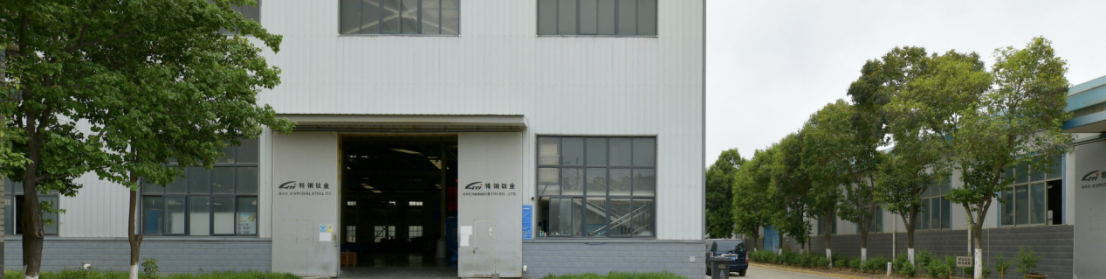
Evaluating supplier capability requires inspecting manufacturing infrastructure, process control capabilities, and commitment to quality engineering. Companies like TGTY demonstrate how integrating precision machinery with strict quality systems yields high-consistency titanium solutions.
Leading manufacturers utilize advanced vacuum heat treatment furnaces and high-precision cold rolling mills to prevent interstitial gas absorption during processing. Operating under certified ISO 9001 quality management systems alongside TUV authorization, technical facilities maintain full control over the complete production lifecycle—from raw titanium sponge selection through final non-destructive testing.
Technical innovations in surface treatment, vacuum annealing parameters, and tight dimensional tolerance control ensure that seamless pipes perform reliably in challenging operational environments. Continuous process optimization directly translates into extended service life, reduced downtime, and enhanced safety across demanding industrial facilities.
V. Industrial Applications and Product Performance Case Analysis
Seamless titanium piping is widely deployed across industries where failure is not an option. Key operational sectors include chemical processing, offshore oil and gas extraction, power generation, desalination, and marine engineering.
A representative application case involves high-efficiency heat exchangers and condensers constructed using ASTM B338 titanium tubing. In marine thermal environments and chemical processing plants, heat exchanger tubes are subjected to high flow velocity, chloride-induced pitting, and continuous thermal cycling.
Seamless titanium tubes produced under strict cold rolling and vacuum annealing controls maintain superior surface smoothness and precise dimensional tolerances. The seamless structure prevents stress corrosion cracking along joint lines, ensuring optimal heat transfer efficiency while resisting aggressive chemical media. Under these rigorous operational conditions, high-quality titanium tubing significantly lowers maintenance overhead and lowers total lifecycle costs compared to conventional nickel alloys or stainless steels.
For further technical specifications, product inquiries, and custom engineering support, visit the official enterprise portal:https://www.tgtiindustrial.com/
Media Contact
Bao Ji Special Steel Titanium Industry Co.,Ltd. btgty@vip.163.com