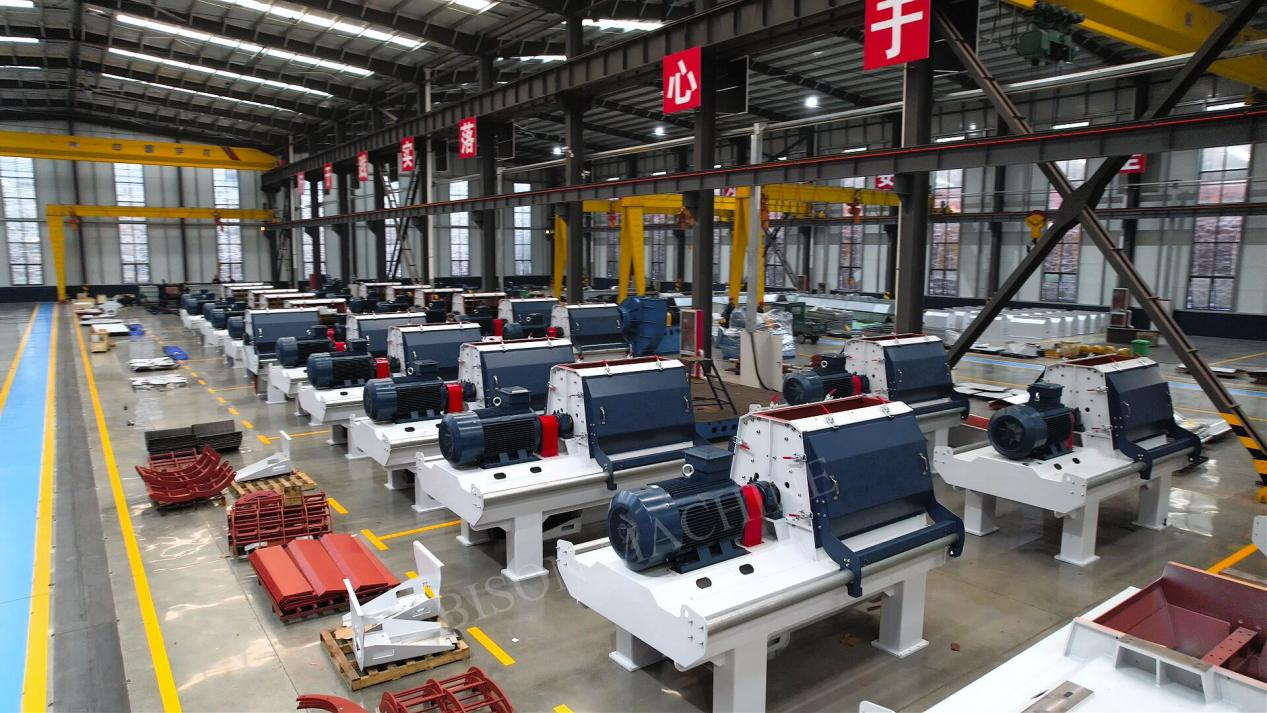
Jinan, Shandong Feb 13, 2026 (Issuewire.com) - In modern biomass pellet manufacturing, the hammer mill is the decisive equipment that determines feedstock quality before pelletizing begins. As a Professional Hammer Crusher Factory, BISON MACHINE understands that pellet density, durability, and production stability all start with precision grinding. A high-performance hammer mill does far more than reduce material size—it standardizes particle distribution, stabilizes system load, and directly influences the mechanical efficiency of the downstream pellet mill.
The Hammer Mill as the Core Size-Reduction Equipment
In a complete wood pellet production line, raw logs are first processed into wood chips (typically 20–30 mm) through a wood chipper. After this primary stage, the hammer mill becomes the key machine responsible for transforming those chips into fine, uniform sawdust suitable for pellet pressing.
The hammer mill operates using high-speed rotating hammers that strike the material repeatedly. This impact-based crushing mechanism ensures rapid fiber separation and controlled particle refinement. Compared to general crushing machines, a biomass hammer mill is specifically engineered to:
Produce uniform particle size distribution (PSD)
Maintain fiber integrity for better pellet binding
Deliver stable hourly output under continuous operation
Adapt to varying wood densities and moisture levels
Without proper hammer milling, pellet mills may experience die blockage, uneven pressure, or excessive wear on rollers and ring dies.
Controlling Particle Size for Pellet Performance
Particle size distribution is the most critical parameter controlled by a hammer mill. If particles are too large, they can obstruct the die holes and cause sudden pressure spikes. If too fine, excessive dust reduces pellet density and increases energy consumption.
A professional hammer mill factory optimizes:
Screen aperture design to ensure qualified particles exit immediately
Rotor speed calibration for balanced impact force
Hammer arrangement and weight to improve crushing efficiency
Airflow design to reduce internal heat buildup
This precise engineering allows the hammer mill to deliver consistent, pellet-grade sawdust that enhances lignin activation during extrusion, improving pellet hardness and transport durability.
Preventing Over-Grinding and Energy Waste
Over-crushing is a common issue in low-quality grinding systems. When material remains inside the chamber longer than necessary, repeated impact creates excessive fine powder, leading to:
Increased power consumption
Higher dust emission
Reduced pellet-forming stability
Advanced hammer mills solve this problem through optimized screen structures and discharge systems that allow properly sized material to exit efficiently. This improves throughput while lowering operational costs.
Hammer Mill Durability in Industrial Applications
In large-scale pellet plants, hammer mills must operate continuously under heavy load. Processing hardwood, mixed biomass, or variable-moisture materials requires strong rotor structures, wear-resistant alloy hammers, and high-precision bearings.
Professional hammer crusher factories focus heavily on metallurgy and structural balance. Hammers must combine hardness with impact toughness—resisting wear without becoming brittle. A well-designed hammer mill maintains stable crushing ratios even when feedstock properties fluctuate, ensuring the entire pellet line operates smoothly.
Multi-Stage Preparation with Hammer Mill at the Center
For raw wood materials, there is no single “wood crusher” that completes the process independently. Instead, the hammer mill functions as the central grinding stage within a coordinated system:
- Wood chipping (20–30 mm chips)
- Hammer mill grinding to pellet-grade sawdust
- Optional drying to reach ideal moisture levels
- Optional secondary hammer milling for higher precision
This structured approach ensures that the pellet mill receives stable, uniform material—reducing mechanical stress and maximizing production efficiency.
Conclusion
A hammer mill is not just an auxiliary device in biomass production—it is the foundation of pellet quality control. By delivering consistent particle size, reducing energy waste, and maintaining mechanical stability, a professionally engineered hammer mill directly improves the ROI of pellet manufacturing operations.
Choosing equipment from an experienced hammer crusher manufacturer ensures that raw material preparation is optimized from the start, laying the groundwork for high-density, export-grade biomass pellets.
For more information, please visit:https://www.bisonpelletmachine.com/
Media Contact
SHANDONG BISON MACHINE CO., LTD. inquiry@sdbison.cn https://www.bisonpelletmachine.com/