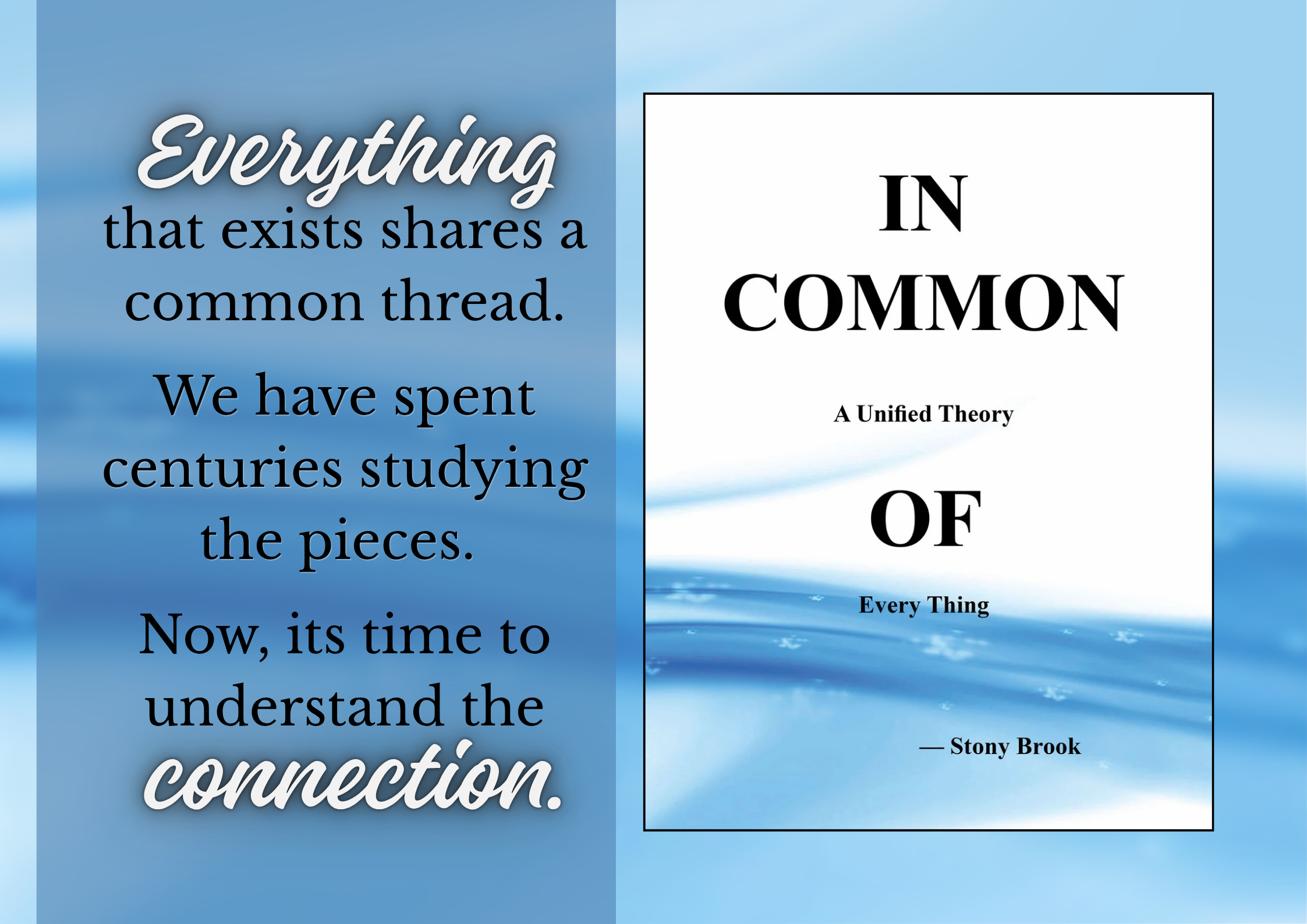
Middletown, Connecticut Aug 21, 2026 (Issuewire.com) - Author and consultant Stony Brook issues a second public announcement focused on the core proposition of In Common: A Unified Theory of Every Thing, drawing attention to the underlying idea that connects the book’s broader examination of existence. Rather than focusing on the broader philosophical themes explored throughout the work, this announcement highlights the conceptual equation that Stony Brook says summarizes years of research into the relationship between energy, gravity, motion, and the structure of reality.
Unlike conventional approaches to unified theories in modern physics, In Common explores language itself as a framework for expressing complex scientific concepts. Throughout the book, Stony Brook suggests that while mathematics remains indispensable, it may not be the sole means of communicating the fundamental relationships that govern the universe. Instead, he presents these ideas through accessible language, inviting readers interested in science, philosophy, and interdisciplinary thought to consider a broader way of understanding fundamental reality.
At the center of the book is what Stony Brook presents as its concluding expression:
"Energy equals mass times the speed of light squared, multiplied by kinetic energy and potential kinetic energy, resulting in energy equals mass times the speed of light to the power of four."
According to the author, this language-based equation represents the conceptual destination of the book's ten guiding principles. Rather than introducing it as an isolated formula, In Common develops the idea through a progression of interconnected concepts designed to encourage readers to consider how physics, philosophy, and human understanding may be linked through common underlying relationships.
"There is never a circumstance of less than three entities: Nothingness, Uncertainty, and the relationship between the two," said Stony Brook.
The statement reflects the broader philosophy that runs throughout In Common: that meaning emerges through relationships rather than through isolated elements alone. The book encourages readers to examine familiar scientific concepts from a different perspective while remaining open to dialogue about some of the most enduring questions in theoretical physics.
Stony Brook is a consultant and Bryant University graduate who divides his time between Middletown, Connecticut, and Paris, Maine. Driven by a lifelong interest in science, philosophy, and the pursuit of fundamental truth, he wrote In Common to foster thoughtful discussion across disciplines. He has also expressed his intention to dedicate proceeds from the book to humanitarian causes, with the hope that his work encourages greater curiosity, compassion, and respect for humanity and the natural world.
In Common: A Unified Theory of Every Thing is available through Barnes & Noble. Readers interested in learning more about the book's conceptual framework and Stony Brook's proposed unified perspective may visit the book's listing here.
Media Contact
Wells Hamilton Literary Consultants LLC info@wellshamilton.com http://wellshamilton.com