Huizhou, Guangdong May 24, 2026 (Issuewire.com) - The Paradigm Shift in High-Performance PTFE Fluid Safety
The industrial shift toward high-performance fluid transfer systems has redefined the safety parameters for handling volatile substances. Traditional Polytetrafluoroethylene (PTFE) hoses offer exceptional chemical resistance and thermal stability. However, the inherent insulation properties of pure PTFE introduce a silent operational hazard: static electricity. This challenge has prompted a paradigm shift from simple insulation to controlled conductivity within the industry. As a China Top PTFE Anti-static Braid Hose Supplier, Besteflon(Huizhou Besteflon Industrial Co., Ltd.) addresses this critical safety gap by integrating advanced carbon-based modification into their high-pressure fluid solutions. This technical evolution prioritizes the mitigation of dielectric breakdown. Ensuring a reliable, continuous discharge path for accumulated static charges is now a fundamental requirement for modern systems transporting flammable media or operating in high-velocity environments.
The Mechanism of Static Accumulation in PTFE Systems
The risk of electrostatic discharge (ESD) in fluid transfer is a result of friction between the flowing medium and the hose lining. PTFE is naturally a high insulator. When non-polar fluids like E85, methanol, or various solvents move through a hose at high velocities, electrons are stripped from the surface. This process creates a potential difference that can reach several thousand volts. Without a conductive path, this energy accumulates until it finds the weakest point for discharge.
The primary failure mode in these scenarios is not merely a visible spark. Instead, the accumulated charge can cause a dielectric breakdown of the PTFE material itself. This often results in "pinhole leaks," where the static arc physically pierces the liner to reach the external stainless steel braid. These microscopic punctures compromise the integrity of the entire assembly, leading to hazardous leaks that are difficult to detect during routine inspections. Industry standards such as SAE and ATEX now mandate static-dissipative capabilities for hoses used in aviation, military, and ethanol fuel applications.
Material Engineering: The Black Core Solution
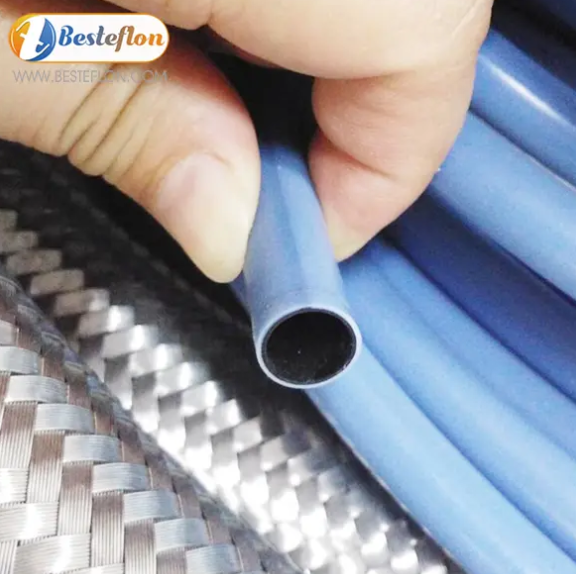
Reliable conductivity in PTFE hoses requires precise material modification during the manufacturing process. The Besteflon utilizes a specialized extrusion method that blends 100% virgin PTFE with high-purity carbon black. This creates a permanent conductive inner liner, often referred to as a "black core." Unlike surface coatings that can wear off or contaminate the fluid, this integrated network of carbon particles ensures consistent electrical performance throughout the lifespan of the hose.
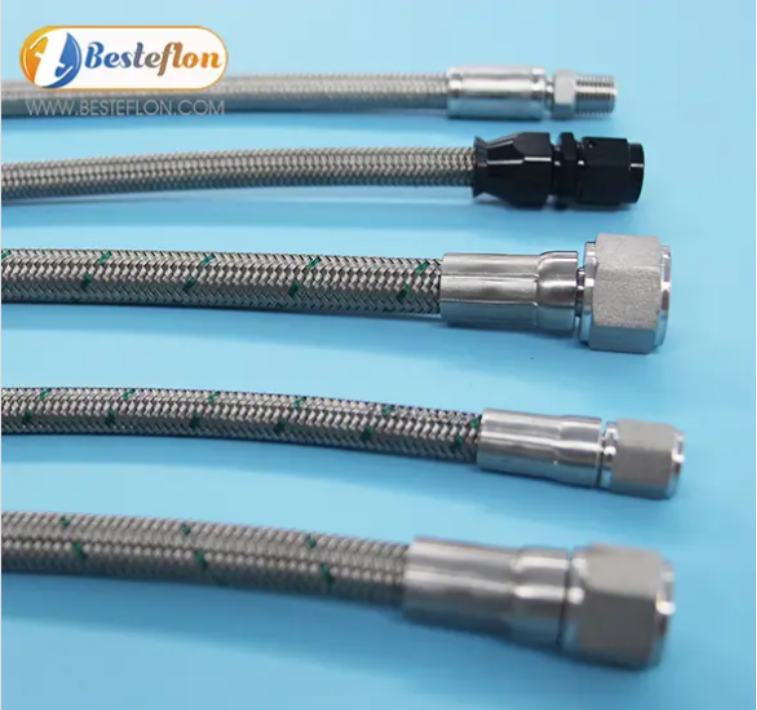
The conductive liner functions by forming a continuous electronic channel, allowing static charges to move toward the metal end fittings safely. When the hose assembly is properly coupled with 304 or 316L stainless steel braiding, the charge migrates to the grounding point of the machine or vehicle. To accommodate different flow dynamics, such as fuel injection or vapor recovery, these conductive solutions are available in both smooth bore and convoluted structures.
Strategic Selection Criteria for Anti-Static Hoses
Engineers must determine when to prioritize anti-static versions over standard PTFE hoses based on specific operational variables. The nature of the media is the first criterion. Non-polar fluids with low electrical conductivity, such as hydrocarbons and dry solvents, are the most prone to generating static. Furthermore, systems involving two-phase flows, such as gases carrying fine powders or droplets, significantly increase the rate of charge accumulation.
Operational conditions also dictate the need for conductivity. Flow velocities exceeding 1 meter per second or systems characterized by frequent start-stop pulses create higher friction levels. Environments with low humidity further exacerbate static risks because moisture in the air cannot help dissipate surface charges. Even when local regulations do not strictly mandate it, many original equipment manufacturers (OEMs) adopt conductive hoses as a "fail-safe" strategy. This redundancy ensures that the system remains protected under unforeseen environmental or operational stressors.
Validation and Installation Integrity
The transition from technical parameters to actual site safety requires a closed-loop validation process. High-quality conductive hoses undergo rigorous end-to-end resistance testing to confirm that the electrical resistance remains within safe limits, typically below 10^6 ohms. These tests ensure that the hose performs its dissipative function from one fitting to the other without interruption.
However, the hose itself is only one part of a safe system. The effectiveness of a conductive liner depends entirely on the integrity of the grounding. The assembly must use compatible metal fittings that maintain a secure connection with the internal carbon-rich layer. If the grounding path is broken at the installation point, the static charge will remain trapped despite the conductivity of the liner. Professional installation must always verify that the entire fluid circuit is bonded to a common ground to prevent potential differences.
Industrial Capability and Quality Sourcing
Since its founding in 2005, Besteflon has specialized in the research, development, and production of high-technology PTFE solutions. The company maintains a strict focus on raw material quality, sourcing resins from established global providers such as Chemours (formerly DuPont) and Daikin. This commitment to material traceability is essential for maintaining the performance of the anti-static products.
The production of these hoses involves complex engineering to balance chemical inertness with electrical dissipation. By providing comprehensive documentation and traceability from the raw material to the final assembly, the manufacturer supports the compliance needs of global markets including the United States, United Kingdom, and Australia. These anti-static systems represent a critical intersection of material science and industrial safety, ensuring that high-speed fluid transfer remains efficient and secure.
For more information regarding technical specifications and custom fluid solutions, please visit the official website: https://www.besteflon.com/
Media Contact
Huizhou Zhongxin Besteflon Industrial Co., Ltd sales07@zx-ptfe.com Sijiaolou Industrial Zone, Boluo, Huizhou, Guangdong, China http://www.besteflon.com