Xian, Shaanxi Oct 22, 2026 (Issuewire.com) - Can choosing between a soft starter and a variable frequency drive actually determine whether heavy-duty industrial machinery operates smoothly or faces unnecessary operational expenses? Heavy industrial applications such as rock crushers, ball mills, long-distance conveyor belts, and large displacement water pumps present complex electrical and mechanical demands during startup. Plant engineers and procurement managers often struggle to select the most cost-effective and technically appropriate motor control strategy. Selecting equipment from a reliable soft start motor control vendor ensures that facilities balance starting torque requirements, grid stability, and long-term operating costs. Making the correct choice requires a thorough understanding of how silicon-controlled rectifier soft starters and variable frequency drives manage heavy-duty industrial loads differently.
Functional Boundaries Under Heavy-Duty Operating Conditions
In heavy industrial operations, motor control equipment must match the distinct torque and velocity requirements of the driven load. The fundamental distinction between a soft starter and a variable frequency drive lies in continuous velocity control versus transient acceleration management.
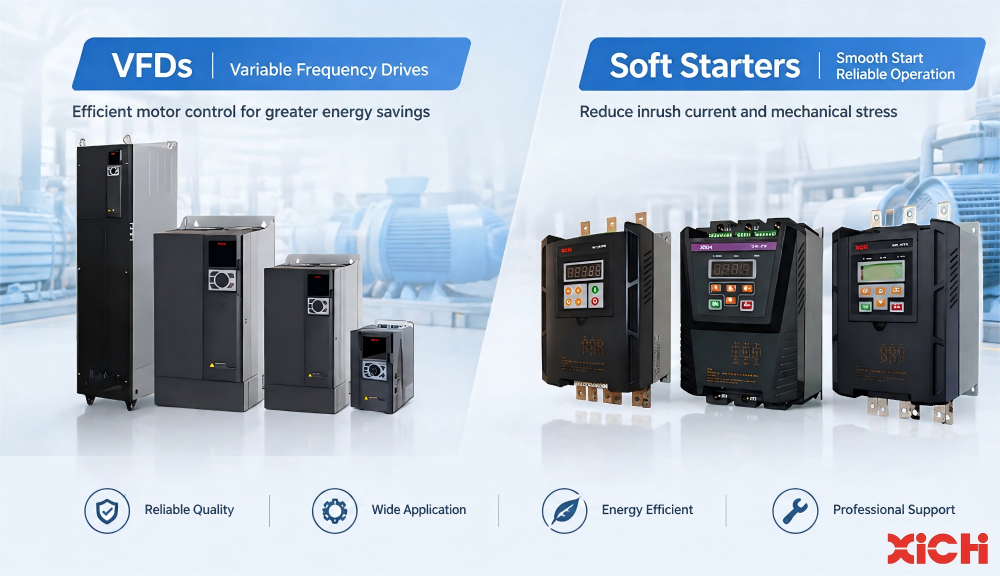
A solid-state soft starter relies on anti-parallel silicon-controlled rectifiers to gradually increase the RMS voltage supplied to an AC induction motor during startup. Equipment such as the XST260 smart low-voltage soft starter and the CMC-MX series from Xi'an XICHI Electric Co., Ltd. controls the voltage ramp to limit inrush current and minimize mechanical shock on power lines and couplings. Once the motor reaches full operating speed, an internal or external bypass contactor engages. This bypass action takes the power electronics out of the primary conduction circuit during normal operation. As a result, thermal dissipation remains minimal, harmonic distortion drops to zero, and operating efficiency approaches maximum levels. Soft starters are ideally suited for constant-speed heavy-duty applications like jaw crushers, ball mills, and fixed conveyor belts. These applications require controlled acceleration to reduce mechanical strain, but they run at a constant frequency once operating speed is attained.
Conversely, a variable frequency drive, such as the XFC550 or XFC500 vector control drive from XICHI, converts incoming AC power into DC via a rectifier before converting it back to a variable frequency and variable voltage AC output using insulated-gate bipolar transistors. This double-conversion architecture enables precise speed regulation across the entire operating cycle. For variable-torque or dynamic-load machinery like automated intake fans, multi-stage water pump stations, and variable-speed processing lines, continuous speed adjustment is essential for process control and energy efficiency. However, deploying a variable frequency drive on a fixed-speed heavy-duty crusher often introduces unnecessary structural complexity without providing operational advantages during steady-state run periods.
Long-Term Cost Analysis and Thermal Lifetime Considerations
Capital expenditure and ongoing lifecycle maintenance dictate the total cost of ownership for motor control installations. Evaluating these devices requires a clear comparison of initial procurement costs, enclosure footprints, thermal management requirements, and power quality factors.
Soft starters offer a lower initial investment, typically costing one-third to one-half as much as a variable frequency drive of equivalent power rating. Because thyristors only conduct heavily during the starting phase, soft starters generate minimal heat during steady-state operation with bypass contactors engaged. Compact units like the CMC-MX and XST260 series soft starter from Xi'an XICHI Electric Co., Ltd. integrate internal current transformers and control electronics, reducing panel space requirements and simplifying cabinet ventilation. Furthermore, because soft starters do not chop voltage waveforms during full-speed operation, they do not introduce high-frequency harmonics into the plant electrical network. This eliminates the need for bulky input line reactors or output sine-wave filters in constant-speed installations.
In contrast, variable frequency drives require higher initial capital outlay and additional panel space to accommodate cooling heat sinks and air channels. Because power transistors switch continuously throughout operation, thermal loss remains constant, demanding active cabinet cooling or dedicated air-conditioned electrical rooms. In variable-torque applications, the ability to reduce motor speed in accordance with affinity laws yields exponential power savings, easily offsetting the initial equipment price difference within a short operating window. However, on constant-speed heavy-duty loads, a drive running continuously at 50 Hz or 60 Hz yields no process energy savings while incurring ongoing semiconductor heat losses and introducing harmonic distortion. For facilities seeking an optimized start motor control vendor, evaluating the actual need for continuous speed regulation remains the primary step in preventing capital misallocation.
Verifiable Vendor Evaluation Criteria for Procurement Teams
Selecting the proper motor control hardware requires working with a technical manufacturer capable of assessing application demand without bias toward a single technology platform.
A primary indicator of supplier reliability is whether the vendor designs and manufactures both soft starters and variable frequency drives in-house. A start motor control vendor that produces a comprehensive spectrum of motor starting solutions—such as medium-voltage CMV solid-state soft starters alongside MaxWell series high-voltage variable speed drives—is uniquely positioned to recommend equipment based purely on engineering fit rather than sales bias.
Procurement teams should also verify that the supplier provides detailed technical documentation, including comprehensive load-curve selection guides, verified factory test reports, and English instruction manuals. Facilities operating in demanding environments benefit from vendor-supplied waveform analysis and thermal rating tables, which ensure that selected soft starters or drives handle heavy-duty start currents without tripping on thermal overload. Partnering with a manufacturer established in 2002 with extensive international project experience provides plant operators with reliable, long-term technical support and field-proven hardware designs.
Selecting the Right Motor Control Strategy
Determining whether to install a soft starter or a variable frequency drive comes down to one clear operational question: Does the heavy-duty machinery require continuous speed adjustment during normal operation?
If the application runs continuously at full line speed, a high-torque soft starter—such as the XST260 series or CMC series manufactured by XICHI—delivers smooth acceleration, protects mechanical drive trains, and safeguards power quality at a fraction of the cost. If the process demands dynamic flow regulation or automated velocity profiling, a vector-controlled variable frequency drive provides the necessary control. Consulting an experienced, reliable soft start motor control vendor allows industrial operations to implement robust, cost-effective motor control strategies tailored to heavy-duty industrial demands.
Learn more about industrial soft starters and variable frequency drive solutions by visiting Xi'an XICHI Electric Co., Ltd. at: https://www.xichielectric.com/
Media Contact
XI'AN XICHI ELECTRIC CO., LTD. *****@xichielectric.com https://www.xichielectric.com/