Baoji, Shaanxi Jul 26, 2026 (Issuewire.com) - Buyer’s Guide: Navigating Industrial Demand and Exhibition Trends
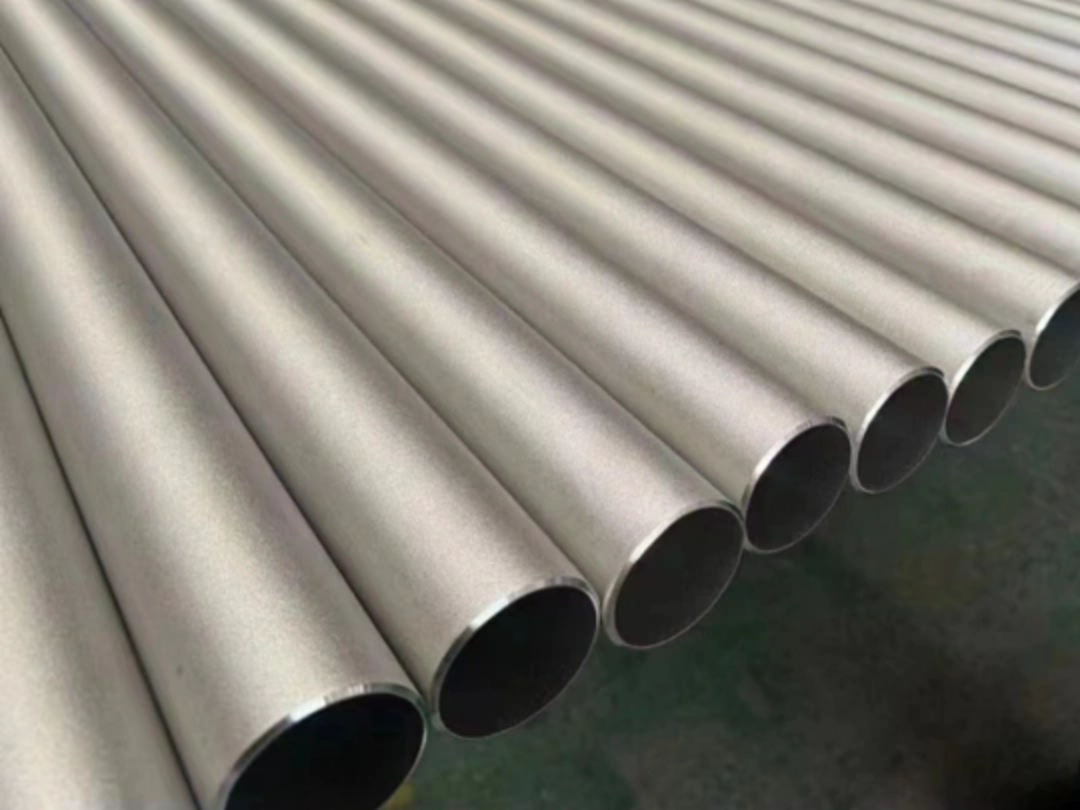
Selecting a Reliable Nickel Pipe Manufacturer In the Field requires a clear understanding of both current industry standards and technical manufacturing capabilities. Recent insights from major pipe and wire materials exhibitions highlight a growing demand for high-performance nickel alloys capable of withstanding extreme pressure, highly corrosive chemicals, and severe thermal fluctuation. Sectors such as chemical processing, marine engineering, aerospace, and energy production are moving toward stringent specifications that leave zero margin for material failure.
Exhibition trends reveal that modern engineering teams no longer evaluate suppliers based solely on initial cost. Instead, industry professionals prioritize complete quality verification, precision execution, and end-to-end process control. Manufacturers must demonstrate mastery across every production phase—from raw material melting and piercing to precision rolling and non-destructive testing. As an established developer in specialized metallurgy, TGTY has aligned its manufacturing framework with these evolving trends, introducing advanced metallurgical practices and strict quality assurance loops to address complex industrial requirements.
Manufacturing Process Control and Technical Execution
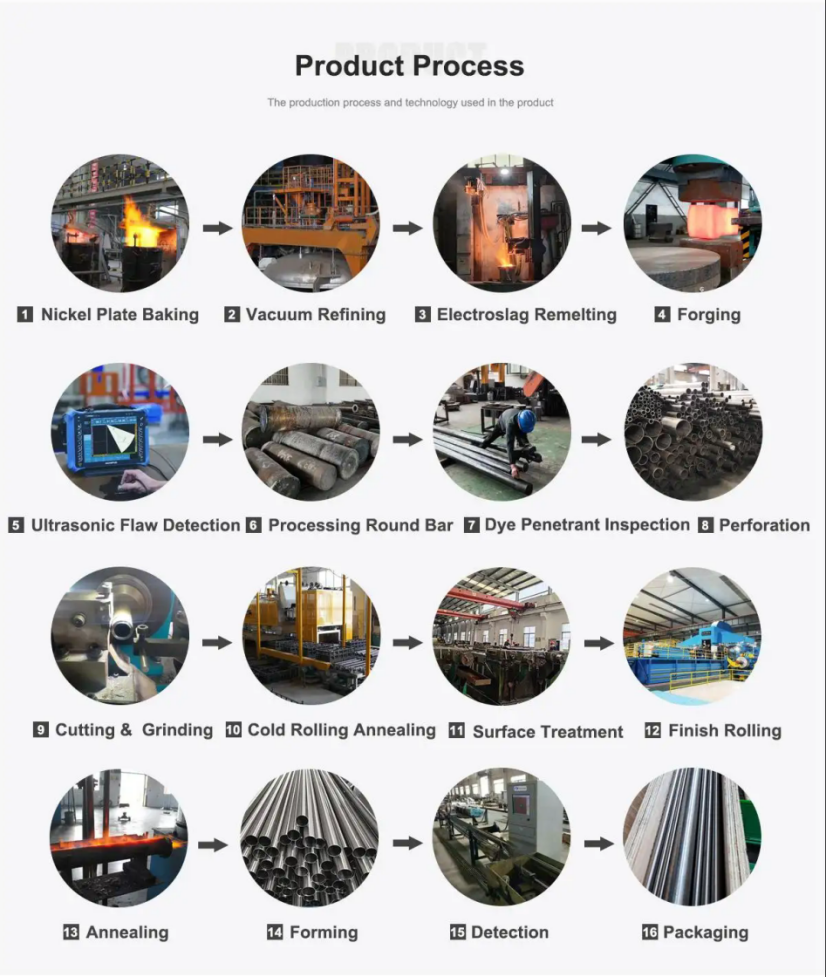
To maintain structural integrity under harsh operational conditions, nickel pipe manufacturing must follow a rigorously controlled, multi-stage production sequence. The process integrates precise thermal management, continuous mechanical monitoring, and comprehensive analytical checks at every step.
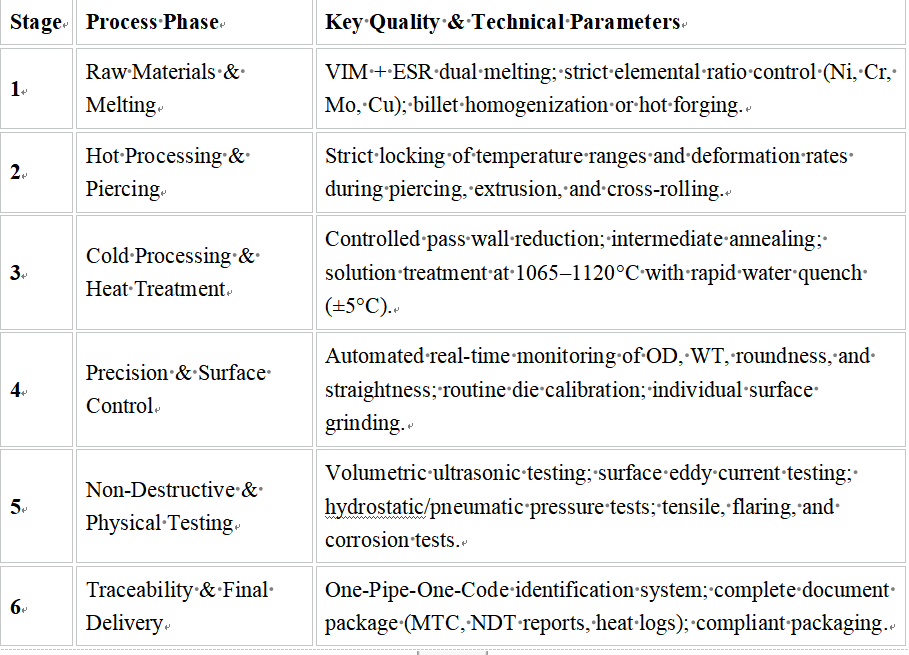
I. Source Control: Raw Materials and Melting Operations
Consistency begins at the atomic level. For commercially pure nickel pipes, chemistry control focuses on keeping elements like Nickel, Carbon, Sulfur, and Phosphorus within tight specification windows. For nickel-base alloy pipes, the balance extends to critical alloying elements including Chromium, Molybdenum, and Copper.
To prevent elemental segregation and eliminate microscopic impurities, dual-melting technology—combining Vacuum Induction Melting (VIM) with Electroslag Remelting (ESR)—is employed. Following solidification, billets undergo homogenization or hot forging to ensure isotropic mechanical properties throughout the material matrix before entering the primary forming stages.
II. Process Locking: Processing and Heat Treatment Management
Transforming solid billets into high-integrity seamless pipes requires strict parameter control during hot piercing, extrusion, and cross-rolling. Thermal ranges and deformation speeds are locked to prevent internal tearing or micro-cracking.
During subsequent cold rolling or cold drawing cycles, wall reduction per pass is precisely regulated to avoid introducing residual stress. Intermediate annealing cycles eliminate work hardening, allowing the metal to regain ductility. To finalize mechanical performance, solution heat treatment is executed between 1065°C and 1120°C, followed by rapid water quenching. Maintaining temperature uniformity within ±5°C ensures complete carbide dissolution and yields a uniform austenitic grain structure.
III. Precision Closed-Loop: Dimensional and Surface Integrity
Dimensional stability directly affects installation accuracy and field performance. Automated in-line monitoring systems continuously check outer diameter, wall thickness, roundness, and straightness along the entire pipe length. Forming dies undergo routine calibration checks to eliminate tooling wear that could amplify minor geometric deviations.
Surface quality is addressed through individual inspection routines. Both inner and outer pipe surfaces undergo manual and mechanical conditioning, including spot grinding and polishing, to eliminate laps, seams, or surface folds. Eliminating surface irregularities before final processing prevents crack propagation during service.
IV. Limit Inspection: Non-Destructive and Physical Testing
Quality assurance concludes with non-destructive examination (NDE) and destructive laboratory verification. Ultrasonic testing scans the full volume of the pipe wall to detect subsurface inclusions, voids, or lack of fusion. Complementing this, eddy current testing inspects the surface and near-surface zones for fine cracks or micro-defects.
Structural tightness and pressure resistance are confirmed through hydrostatic or pneumatic pressure testing. In the laboratory, samples undergo mechanical and metallurgical evaluations, including tensile strength, flattening, flaring, grain size, and intergranular corrosion tests, verifying full compliance with global standards.
V. Data Backing: Traceability and Delivery Management
Complete product verification requires transparent documentation. A unique identification code is assigned to each individual pipe, establishing a digital link to its specific heat number, processing history, and inspection logs. This "One-Pipe-One-Code" system guarantees full traceability across the entire supply chain.
Shipments are accompanied by comprehensive documentation packages, including Material Test Certificates (MTC), heat treatment charts, and non-destructive examination reports. Secure, compliant packaging ensures that all products reach project sites in optimal condition, fully matching technical specifications and contractual requirements.
Engineering Applications and Industrial Implementations
High-performance nickel alloy products manufactured through these rigorous controls find widespread application in critical industrial environments. In addition to seamless piping systems, solid alloy profiles like high-quality nickel rods serve as essential raw materials for manufacturing valve stems, high-strength fasteners, pump shafts, and downhole components in oil and gas extraction.
Whether deployed in offshore seawater systems, power generation heat exchangers, or severe chemical synthesis plants, standardized process control ensures reliable service life. By integrating advanced melting technology, strict thermal control, non-destructive verification, and full data traceability, modern metallurgical engineering continues to meet the evolving demands of critical global industries.
For detailed technical specifications, product catalogs, and engineering consultation, visit the official website: https://www.tgtiindustrial.com/
Media Contact
Bao Ji Special Steel Titanium Industry Co.,Ltd. btgty@vip.163.com