
Hangzhou, Zhejiang Sep 9, 2026 (Issuewire.com) - Navigating the stringent safety regulations and corporate social responsibility requirements of the European and North American industrial sectors requires a structured procurement evaluation framework. For international buyers operating in Nordic countries such as Denmark, Norway, Sweden, and Finland, as well as across North America, sourcing certified protective garments is essential to minimize operational liability and safeguard workforce health. A trusted High Quality Multinorm Workwear Supplier provides gear engineered to withstand complex multi-hazard environments—including thermal exposure, electric arc, static discharge, chemical splash, and low-visibility conditions. Beyond technical compliance, modern supply chains demand strict ethical governance. Adherence to Business Social Compliance Initiative (BSCI) guidelines ensures that high-performance garments are produced under verified, humane working conditions. As a specialized manufacturing enterprise backed by decades of textile engineering expertise, Huahao integrates rigorous international testing parameters with comprehensive OEM/ODM customization capabilities to deliver protective solutions tailored to demanding industrial applications.
Technical Standards Defining Multinorm Workwear Safety
Multinorm workwear refers to protective clothing engineered to meet multiple international safety standards within a single, integrated garment structure. Industrial workers in utilities, petrochemical processing, offshore oil and gas, heavy equipment manufacturing, and electrical grid maintenance frequently face overlapping physical hazards. Selecting appropriate protective clothing requires evaluating specific European (EN ISO) and North American (ANSI/NFPA) standard criteria:
- High Visibility (EN ISO 20471 / ANSI/ISEA 107):Mandates specific background fabric surface areas and retro-reflective strip placement to ensure workers remain clearly visible under low-light and high-risk operational environments.
- Thermal and Flame Protection (EN ISO 11612 / NFPA 2112): Evaluates flame spread, heat transmission (convective and radiant heat resistance), and structural integrity when exposed to extreme thermal risks.
- Welding Protection (EN ISO 11611): Classifies garment resistance against small molten metal splashes and short-term accidental contact with electric arcs.
- Electrostatic Properties (EN 1149-5): Specifies material performance and design constraints to prevent incendiary static discharges in explosive atmospheres (ATEX zones).
- Electric Arc Hazards (IEC 61482-2 / NFPA 70E): Measures fabric resistance to the thermal effects of electric arc flashes, determined through Open Arc (ATPV/ELIM) or Box Test methods.
- Chemical Splash Protection (EN 13034 Type PB[6]): Assesses fabric resistance to liquid chemical penetration and repellency against light chemical sprays and aerosols.
Integrating these performance metrics into a lightweight, ergonomic garment requires careful selection of fiber blends, functional membranes, and specialized finishing treatments.
The Operational Value of BSCI Compliance and Technical Certifications
For procurement officers in Northern Europe and North America, technical fabric testing represents only one half of the supplier evaluation process. Social compliance auditing has become equally critical to managing brand risk and securing sustainable supply chains.
Understanding BSCI Social Audits
The Business Social Compliance Initiative (BSCI) provides a standardized framework that monitors and improves working conditions across global supply networks. Grounded in International Labour Organization (ILO) standards, a BSCI audit evaluates manufacturing facilities across eleven core principles, including workplace health and safety, fair remuneration, reasonable working hours, prohibition of child labor, and environmental protection. Sourcing from a BSCI-compliant factory guarantees that protective garments are produced ethically without compromising worker rights or workplace standards.
Environmental and Chemical Safety via OEKO-TEX Standard 100
In addition to social accountability, industrial garments worn directly against the skin must be free from harmful substances. The OEKO-TEX Standard 100 certification verifies that raw textiles, thread, zippers, and trimmings undergo testing for hazardous chemicals, regulated heavy metals, and allergenic dyes. For Nordic buyers who adhere to strict environmental standards, combining BSCI ethical manufacturing with OEKO-TEX Standard 100 chemical safety establishes a fully compliant supply base.
Core Manufacturing Competencies and Customized OEM/ODM Engineering
High-performance protective apparel relies on structural durability, precise pattern drafting, and precise material selection. Hangzhou Huahao Import & Export Co., Ltd., established in 2008 as a subsidiary of Zhejiang Huaxing Group, brings over 30 years of industrial garment experience, operating within an 80,000 m² modern manufacturing footprint and producing 1 million garments annually.
Through comprehensive OEM/ODM customization services, the company develops tailored protective solutions based on specific regional requirements, climate conditions, and worker ergonomics.
Material Engineering and Structural Construction
Standard workwear often faces trade-offs between durability, weight, and mobility. Advanced multinorm garments resolve these challenges by combining engineered fabric blends with targeted structural reinforcements:
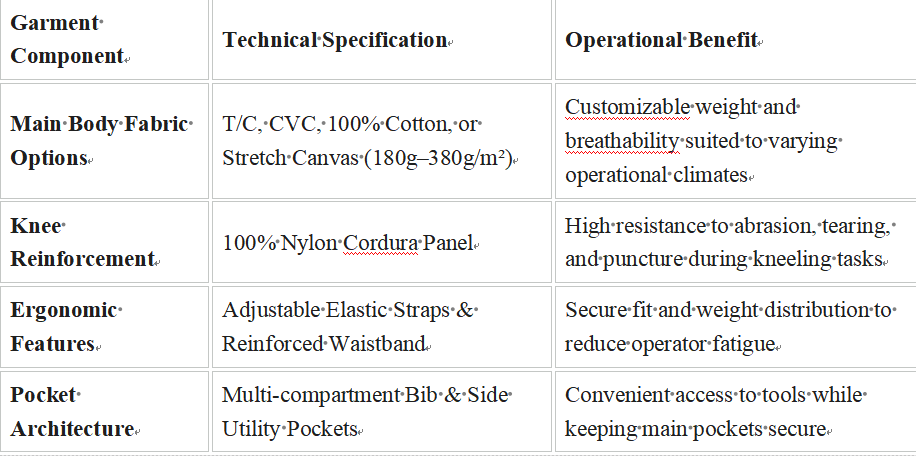
- Fabric Matrix Diversity: Utilizing poly/cotton (T/C) twills, high-density canvases, ripstop weaves, cotton-rich (CVC) blends, and 97% cotton / 3% spandex elastic canvases ranging from 180g/m² to 380g/m² to optimize comfort, breathability, and tensile strength.
- Strategic Abrasion Resistance: Integrating 100% Nylon Cordura reinforcements at high-wear zones—such as knees, elbows, tool pockets, and hem cuffs—to significantly extend garment life in rugged working environments.
- Functional Ergonomics: Incorporating triple-stitched main seams, reinforced stress points, adjustable shoulder straps with heavy-duty buckles, and expandable utility pockets for industrial tools and mobile devices.
Industrial Product Case: Technical Bib Pants Construction
A representative example of practical workwear design is found in the HH19001 ergonomic bib pants model. Engineered for demanding physical work, this style illustrates how material selection directly supports functional safety and durability: (PIC)
For specialized technical requirements, such configurations can be upgraded with flame-retardant (FR) treatments, anti-static grid yarns, or high-visibility fluorescent dyes and reflective striping to achieve comprehensive multinorm certification.
Evaluating Suppliers for Nordic and North American Operations
Selecting an industrial workwear partner requires assessing manufacturing capacity, international regulatory familiarity, and quality control systems.
When establishing procurement pipelines for European or North American operations, trade partners benefit from suppliers with verified export experience. With products distributed across more than 50 countries and regions—including Denmark, Norway, Sweden, Finland, Germany, France, Italy, and the United States—established manufacturers maintain strict alignment with global logistics, labeling, and technical documentation protocols.
By balancing protective performance, ergonomic comfort, BSCI ethical production, and certified material safety, industrial organizations can confidently equip their workforce with durable, fully compliant workwear built for demanding environments.
For complete product catalogs, technical specifications, and custom OEM/ODM consultations, visit the official company platform at https://www.huahao-garments.com/.
Frequently Asked Questions (FAQ)
Q: "How does BSCI compliance add value to multinorm workwear procurement for Nordic and North American enterprise buyers?"
A: BSCI certification provides independent verification that Huahao's manufacturing facilities adhere to strict ethical labor standards, safe workplace conditions, and fair compensation policies. For corporate procurement directors in Northern Europe and North America, sourcing BSCI-audited workwear mitigates supply chain social risk and ensures alignment with corporate social responsibility (CSR) mandates.
Q: "Can Huahao configure multinorm workwear to satisfy both European EN ISO and North American NFPA / ANSI safety standards simultaneously?"
A: Yes. Through specialized fabric engineering and OEM/ODM customization, Huahao integrates inherent flame-retardant fibers, anti-static grid yarns, and retro-reflective tape placements. This allows garments like the HH19001 series to meet dual certification criteria—such as EN ISO 11612 / NFPA 2112 for flame resistance and EN ISO 20471 / ANSI/ISEA 107 (Type R, Class 3) for high visibility.
Media Contact
Hangzhou Huahao Import & Export Co., Ltd. melody@huaxingfz.com