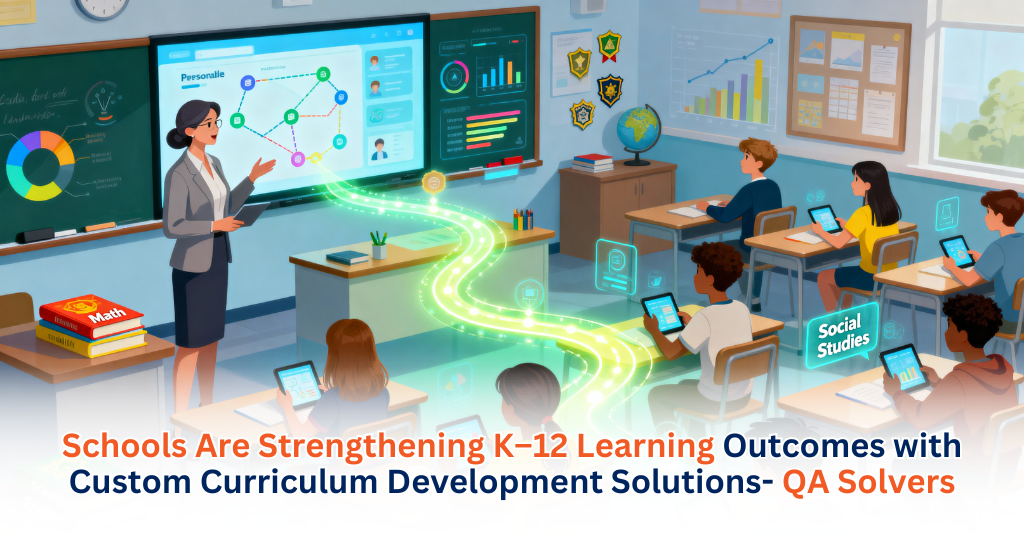
Sheridan, Wyoming Dec 2, 2025 (Issuewire.com) - School districts across the country are turning to custom curriculum development because they need something that actually lifts K–12 achievement without pushing teachers to the edge. These solutions come in ready—aligned to state standards, packed with lesson plans teachers can use right away, built for any LMS, and fully accessible so no student gets left out.
This shift isn’t random. After the pandemic, U.S. students were still months behind in math and reading by fall 2021, and the surge in ed-tech only raised the pressure to fix learning fast. Districts want material that works, scales, and doesn’t fall apart when classrooms get chaotic.
QA Solvers steps in with curriculum development services built for this exact moment and the growing demands schools can’t ignore.
Schools Face Growing Pressure to Improve K–12 Learning Outcomes
The need for custom curriculum development has shot up because districts are trying to close stubborn learning gaps while the ground under instruction keeps shifting. Pandemic shocks didn’t fade quietly—students walked back into schools unevenly prepared, and by fall 2021, national estimates showed about four months lost in math and three in reading.
The U.S. Department of Education pushed out more than $190 billion in ESSER funds to help schools rebuild, yet many districts still lean on materials that don’t match current state frameworks. RAND’s surveys make it clear: only about 35% of teachers in ELA and around 51% in math use fully aligned materials, and that cracks the coherence teachers need at each grade.
Teacher workload only tightens the grip. Research from ERIC and the National Academies shows educators spend 7–12 hours each week hunting for or making their own materials, cutting into planning and intervention time they don’t have to spare.
Digital expectations keep rising, too. LearnPlatform data show students bounce between many digital tools during the year, which means the curriculum has to work cleanly across LMS platforms and devices. And districts are under pressure to meet equity and accessibility needs, with materials that support multilingual learners, fit local contexts, and meet WCAG and ADA requirements.
National Trends Driving the Demand for Custom Curriculum
Several major shifts are pushing U.S. K–12 schools straight toward custom curriculum development, and the pace feels intense. Districts want personalized learning that actually adapts to how each student moves, so a flexible, modular setup is no longer a nice idea—it’s the only thing that makes sense. EdTech Magazine and PowerSchool have already pointed to this demand for pathways that match different readiness levels without slowing whole classrooms down.
Then comes the digital push. Students jump between so many tools each year that districts can’t risk content breaking on a random device. LearnPlatform and EdWeek Market Brief show why LMS-ready, SCORM-compliant, mobile-steady curriculum is turning into a must-have, not a wish list item.
Data-driven instruction is also taking over. RAND and other national studies make it clear: schools want content with assessments built in, something that gives real-time signals the moment a student starts slipping, so teachers can act fast.
Teacher retention adds even more weight. ERIC and EdElements show how many hours teachers lose every week fixing or rewriting materials. When districts bring in ready-to-teach content, that load drops, lessons stay consistent, and teachers don’t burn out at the same pace.
And there’s the equity and accessibility layer—another force schools can’t ignore. ADA, WCAG, Section 508, multilingual access, local cultural relevance—UNESCO GEM and accessibility frameworks make it obvious that districts need materials that support every learner, not only the ones who find school easy.
All these trends collide and push districts toward custom curriculum solutions that offer flexibility, inclusivity, and sharper instructional control.
How Custom Curriculum Development Strengthens K–12 Learning
Custom curriculum development offers districts a structured way to strengthen instruction, reduce classroom variability, and deliver materials that match today’s academic, digital, and accessibility expectations.
Standards-Aligned Curriculum
Custom curriculum development locks every unit into the right U.S. frameworks—CCSS, NGSS, TEKS, Florida B.E.S.T., and the International Baccalaureate. When each lesson hits the exact grade-level expectations, districts stop dealing with those messy standards gaps that show up when teachers pull from mixed or half-aligned resources.
RAND’s findings on how few schools use a fully aligned curriculum shake the system for a reason. Districts want material built straight from the standards, not patched together. With a clear progression across grades, students move through content in a steady, logical path that cuts confusion and builds real mastery over time.
Instructional Design and Learning Outcomes Mapping
A structured design process pulls the whole curriculum into shape. It starts with a needs assessment that cuts straight to what a district wants to achieve. Then come the learning outcomes—the anchor that holds everything steady.
After that, lesson sequences and pacing maps lay out the year so teachers aren’t guessing their way through. Each concept builds with intent, not chance, and the instruction hits with more accuracy. The entire curriculum feels direct, steady, and built for real progress.
Ready-to-Teach Teacher Materials
Custom curriculum solutions take a real load off teachers because they walk in with resources ready to teach. Guides, rubrics, checklists, answer keys, all of it cuts hours of prep. ERIC and HQIM show teachers burn 7–12 hours a week just shaping lessons.
When everything is already set, they can finally focus on delivery, intervention, and keeping students engaged instead of scrambling to build content from scratch.
Integrated Assessments and Data Insights
Custom curriculum builds the assessments right into the unit, so you feel the impact the moment you teach it. Those formative checks, auto-graded quizzes, and performance tasks hit fast and tell teachers exactly what’s slipping and what’s landing. It feeds the demand for data-driven decisions and keeps progress under a sharp, steady watch all year.
Digital-Ready and Accessible Resources
Schools feel the difference when the curriculum actually clicks with today’s digital world. SCORM-compliant LMS packages, interactive worksheets, and mobile-first layouts cut the friction and let everything move.
And with students jumping between dozens of digital tools each year—LearnPlatform and EdWeek make that clear—the need for clean integration hits hard. The materials follow WCAG, ADA, and Section 508, so students with disabilities don’t get stuck behind barriers.
Inclusive and Localized Content
Custom curriculum gives districts room to breathe and actually teach what their communities live every day. They can pull in local examples, culturally relevant scenarios, and leveled texts that help multilingual learners feel seen. Scaffolded tasks steady students at different readiness levels and push real equity across classrooms. All of this makes the materials land with purpose while staying aligned with accessibility requirements.
Scalable, Multi-Region Project Management
Large curriculum initiatives require strong coordination. Custom development teams use structured workflows and scalable staffing to manage district-wide or multi-state rollouts. Experience working across frameworks in the U.S., UK, UAE, Australia, and India helps ensure the curriculum remains accurate, consistent, and adaptable across varied educational contexts.
Impact on Teachers and Students
Custom curriculum development changes the daily rhythm of teaching. It gives educators steady, predictable tools that calm the chaos. Teachers finally breathe because ready-to-use lessons and pacing guides cut the heavy planning load that ERIC says can eat 7–12 hours each week. With clearer paths, class time feels easier to steer, the flow stays intact, and stress doesn’t spike every time the schedule gets tight.
Students feel the shift, too. When lessons line up in a clear sequence, engagement rises, and confusion drops fast. Built-in assessments catch learning gaps before they grow, so support reaches students when they need it. A consistent structure across subjects and grades keeps skill growth steady and expectations obvious.
Districts get the same relief. Shared resources make professional development smoother because everyone works from the same playbook. Standardized templates and reporting help leaders track progress without guesswork, and unified pacing makes new standards easier to roll out. All of it comes together to lift learning outcomes and build teaching environments that feel far more supportive.
Industry Outlook: Custom Curriculum as the Future of K-12 Instruction
The K-12 space is moving so fast toward digital-first curriculum systems that you can almost feel the shift in the air. Districts want stability across in-person, hybrid, and online learning, and they’re done gambling with short-term fixes.
They’re reaching for long-term partners who can hold up real, scalable, future-ready instruction. Modular, data-ready models are climbing because they let schools adjust units on the fly, personalize learning paths, and respond when priorities change.
Accessibility stays at the center as districts try to meet diverse student needs and stay compliant. And with federal moves like the $190 billion in ESSER funds pushing schools to fix pandemic learning gaps, the pressure to modernize is real. All of this shows one thing: districts need structured, adaptable curriculum solutions that hold steady and deliver outcomes they can measure.
About QA Solvers
QA Solvers works across borders, and it shows in the way the team handles curriculum development, K–12 content, instructional design, assessments, workbooks, editorial work, eBooks, accessibility, and localization.
They’ve built programs across the U.S., U.K., U.A.E., Australia, and India with workflows so tight they keep schools, publishers, EdTech teams, and corporate training groups from wobbling even for a second. After 100+ curriculum projects and a 95% satisfaction rate, their intent feels obvious—support that scales, execution that doesn’t flinch, and content that stands firm no matter what hits it.
Media Contact
QA Solvers Inc digital@qasolvers.com 30 N, Gould St Ste R Sheridan, WY, United States https://qasolvers.com/




