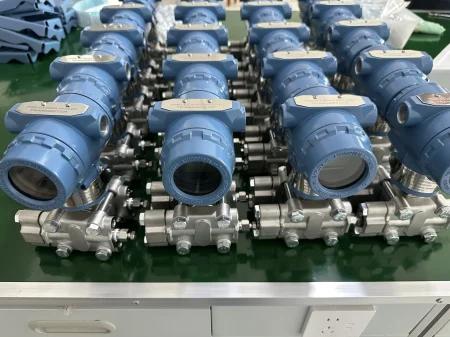

Shenzhen, Guangdong Nov 9, 2026 (Issuewire.com) - How to Select a Sanitary Pressure Transmitter for Hygienic Processing Applications
Riboflavin testing reveals a common problem in hygienic processing equipment: cleaning solutions cannot always reach recessed cavities, threaded connections, or poorly designed branches. Even a highly accurate pressure instrument can contribute to contamination if its product-contact surfaces retain residue.
A sanitary pressure transmitter addresses this challenge through hygienic mechanical design. Unlike conventional instruments, it minimizes product-contact cavities and supports effective cleaning in food, beverage, pharmaceutical, and biotechnology applications.
Although sanitary and industrial pressure transmitters may offer similar measurement accuracy, their wetted geometry, materials, and cleaning performance differ significantly. Selecting the right instrument therefore requires more than comparing accuracy and price.
1. Why Conventional Pressure Transmitters Can Fail Hygienic Requirements
Conventional pressure transmitters often use threaded process connections. Product can enter narrow bores and internal chambers, creating dead legs where cleaning solutions cannot circulate effectively.
In applications involving milk, syrup, fermentation broth, or pharmaceutical products, retained residues may support bacterial growth and compromise subsequent batches.
Hygienic design standards commonly recommend a dead-leg ratio (L/D) of two or less for product-contact branches. Short, wide connections allow cleaning fluids to reach internal surfaces more effectively than long, narrow branches.
Two methods help verify cleaning performance:
-
Riboflavin testing: Fluorescent dye identifies areas that cleaning solutions fail to reach.
-
ATP and microbiological swabs: These tests evaluate remaining biological contamination after cleaning.
These inspections demonstrate why installation geometry matters as much as instrument accuracy.
2. How Flush Diaphragm Design Improves Hygiene
A sanitary pressure transmitter typically uses a front-flush diaphragm positioned directly against the inner surface of a pipe or vessel.
The diaphragm eliminates traditional threaded cavities and reduces locations where product can accumulate. Pressure causes the membrane to deflect, while an internal fill fluid transfers this movement to a piezoresistive or capacitive sensing element.
Several design factors influence measurement performance:
-
Diaphragm size and thickness: Larger, thinner diaphragms support low-pressure measurements, while thicker membranes offer better resistance to overpressure.
-
Fill fluid: Temperature changes can cause expansion and measurement drift.
-
Thermal recovery: The instrument must return to its normal measurement range after cleaning and sterilisation.
-
Vacuum resistance: Steam sterilisation followed by cooling can create negative pressure inside vessels, requiring an appropriate vacuum rating.
For vessels exposed to steam-in-place (SIP), buyers should verify whether a gauge transmitter can withstand negative pressure or whether an absolute pressure transmitter is more appropriate.
3. Selecting the Appropriate Process Connection
Process connections should match existing piping standards, gasket inventories, clamps, and cleaning equipment.
Common connection options include:
-
Tri-Clamp: Widely used in North American food, dairy, and beverage facilities. Gasket materials and clamp installation must match the system.
-
DIN 11851: Common in older European dairy installations, although threaded connections may create residue-retaining areas.
-
Varivent: Used in European brewing and industrial processing systems. Adapter availability should be considered.
-
DIN 11864: Designed for aseptic applications, with connection geometry intended to support hygienic sealing.
For sterile applications, connection design is particularly important because even small gasket cavities can compromise cleaning and sterilisation.
Standardising instrument connections across a production line can also simplify maintenance and reduce cleaning-related problems.
4. Understanding Surface Finish Requirements
Surface roughness directly affects the cleanability of product-contact components. It is commonly expressed as Ra, measured in micrometres.
Typical requirements include:
-
Food and beverage applications: Ra at or below 0.8 µm.
-
Bioprocessing and pharmaceutical applications: Ra of 0.5 µm or better.
ASME BPE provides additional surface-finish classifications for hygienic processing equipment.
Weld quality is equally important. Continuous orbital welds that are properly ground and passivated provide cleaner surfaces than uneven seams or unfinished joints.
ASTM A967 describes passivation treatments that help restore the protective chromium oxide layer on stainless steel after machining and welding. Electropolishing can further improve surface quality.
Buyers should request roughness reports for the completed welded assembly rather than relying solely on certificates covering raw diaphragm materials.
5. Understanding 3-A, EHEDG, and ASME BPE Standards
Three major frameworks frequently appear in hygienic equipment specifications.
3-A Sanitary Standards
Primarily used in the United States, 3-A focuses on hygienic equipment design for dairy and food processing. A 3-A symbol indicates that a specific configuration has received certification against the relevant standard.
EHEDG
The European Hygienic Engineering and Design Group provides hygienic design guidance and cleanability testing methods. Its protocols help demonstrate whether equipment can be effectively cleaned in place.
ASME BPE
ASME BPE addresses bioprocessing equipment, including materials, surface finishes, connections, seals, and sterile boundaries. It is particularly relevant to pharmaceutical and biotechnology manufacturing.
Food-contact regulations must also be considered. These include FDA 21 CFR 177 in the United States and EU Regulations 1935/2004 and 10/2011.
Buyers should verify the scope and validity of each certificate rather than assuming that a manufacturer's general compliance statement covers every component.
6. Evaluating CIP and SIP Compatibility
Clean-in-place (CIP) and steam-in-place (SIP) procedures expose sanitary pressure transmitters to temperatures and chemicals that may exceed normal operating conditions.
A typical CIP process includes:
-
Pre-rinsing with water, sometimes at temperatures up to 50°C.
-
Alkaline cleaning using approximately 1%–2% sodium hydroxide at 65°C–80°C.
-
Acid cleaning to remove mineral deposits.
-
Final rinsing until the required conductivity endpoint is reached.
-
Sanitisation.
SIP commonly involves saturated steam near 121°C for a validated holding period.
Repeated temperature changes can cause zero-point drift because the diaphragm and internal sensing components heat and cool at different rates. Buyers should therefore evaluate temperature compensation, recovery time, and thermal isolation.
Material compatibility is another important consideration:
-
316L stainless steel: Commonly used for hygienic wetted components.
-
Hastelloy C-276: Suitable for applications involving aggressive chloride-containing cleaning chemicals.
-
EPDM: Generally performs well with hot caustic solutions and steam.
-
FKM: Offers good resistance to oils and fats but is less suitable for repeated strong alkali and steam exposure.
-
PTFE: Provides broad chemical resistance but can creep under mechanical loading.
There is no universally suitable gasket material. Selection should reflect the actual cleaning chemicals, temperatures, and operating conditions.
7. Choosing Wetted Materials and Ensuring Traceability
316L stainless steel, also identified as 1.4404 or UNS S31603, is widely used because its low carbon content helps reduce weld sensitisation.
However, buyers should evaluate the complete wetted path, not just the diaphragm. This includes:
-
Diaphragm and weld collar.
-
Process adapter.
-
Gasket and sealing materials.
-
Internal fill fluid.
Food-grade fill fluids should have appropriate documentation for their intended application.
Material traceability is equally important. EN 10204 3.1 inspection certificates connect supplied materials with their heat numbers and chemical composition. Weld procedures, inspection records, and passivation documentation should also be available where required.
Overpressure and pulsation resistance must be evaluated alongside material selection. Homogenisers, positive-displacement pumps, and CIP systems can generate pressure spikes significantly above normal operating levels.
The transmitter's proof-pressure and burst-pressure ratings should therefore reflect credible operating disturbances rather than only the normal measuring range.
8. Selecting Gauge, Absolute, or Differential Pressure Measurement
The correct pressure reference depends on the process application.
Gauge pressure
Suitable for monitoring fermenter headspace pressure relative to atmospheric pressure. However, the transmitter must also withstand negative pressure during post-SIP cooling.
Absolute pressure
Measures pressure relative to a vacuum reference and is useful when atmospheric pressure changes affect the process measurement.
Differential pressure
Used to monitor pressure differences across sterile filters and other process equipment. Hygienic isolation diaphragms should be installed on both sides.
For hydrostatic tank-level measurement, pressure is calculated using:
p = ρgh
Where:
-
p represents hydrostatic pressure.
-
ρ represents fluid density.
-
g represents gravitational acceleration.
-
h represents liquid height.
Changes in fluid density can introduce significant level-measurement errors. For example, a 2% density variation produces approximately a 2% error in inferred level if density is assumed constant.
This is particularly relevant to milk, syrup, wort, and fermentation broth applications.
Total measurement uncertainty should include reference accuracy, temperature effects, long-term drift, and fill-fluid behaviour. Recovery time after sterilisation should also be considered.
For more information, see LONNMETER's articles on automated milk density measurement and density measurement in pharmaceutical manufacturing.
9. Output Signals, Housing, and Washdown Protection
Most industrial process applications use 4–20 mA output with HART communication because it is widely supported and relatively easy to maintain.
A 4–20 mA pressure transmitter provides a familiar interface for industrial control systems.
However, hygienic applications require additional attention to housing protection.
Important considerations include:
-
Downward-facing cable entries to reduce water accumulation.
-
Enclosures without upward-facing surfaces that retain cleaning liquids.
-
Cable glands matched to the installed cable diameter.
-
Appropriate IP ratings for the actual washdown procedure.
IP66 and IP67 under IEC 60529 cover different levels of protection against water jets and immersion. IP69K under DIN 40050-9 addresses high-pressure, high-temperature jet cleaning.
The selected protection rating should match the facility's cleaning equipment and procedures.
10. Installation Geometry and Drainability
Even a properly designed sanitary pressure transmitter can create contamination risks if installed incorrectly.
The diaphragm should remain flush with the internal pipe or vessel wall. Weld-in adapters should be properly finished and passivated.
Installers should avoid:
-
Extended mounting bosses.
-
Multiple stacked adapters.
-
Threaded cavities.
-
Upward-facing branches that retain liquids.
-
Locations where sediment or cleaning water accumulates.
Horizontal pipelines should maintain appropriate slopes to support drainage.
Gaskets must also be installed correctly. Excessive clamp pressure can distort fittings, while reused gaskets may lose their sealing performance.
After installation, riboflavin testing should be repeated to verify the cleaning performance of the complete assembly.
11. Three Typical Applications and Their Requirements
Different industries place different demands on sanitary pressure transmitters.
Fermenter headspace monitoring
Biotechnology fermenters may operate between 0 bar and 2 bar gauge and undergo repeated SIP cycles near 121°C.
The transmitter should feature a hygienic flush diaphragm, suitable vacuum resistance, steam-compatible sealing materials, and rapid thermal recovery.
Sterile filter differential pressure monitoring
Pharmaceutical filling systems use differential pressure measurements to monitor filter loading.
Both sides require hygienic isolation. Remote-seal capillaries should have matching lengths and similar temperature exposure to minimise measurement errors.
Homogeniser and UHT dairy processing
Dairy processing equipment experiences high pressure, dynamic pulsation, and repeated hot alkaline cleaning.
Mechanical strength, overpressure resistance, fatigue performance, and chemical compatibility are more important than headline accuracy alone.
12. Commissioning, Calibration, and Qualification
A sanitary pressure transmitter must be verified after installation before it becomes part of a qualified production system.
Installation qualification (IQ) documents the delivered configuration, materials, welds, passivation, and surface finish.
Operational qualification (OQ) verifies measurement performance using appropriate calibration equipment, such as loop calibrators, HART communicators, deadweight testers, or pneumatic pressure standards.
Both as-found and as-left calibration results should be recorded.
Calibration should be traceable to national standards through an ISO/IEC 17025-accredited calibration process.
Cleaning qualification should include relevant evidence such as:
-
Riboflavin coverage testing.
-
ATP and microbiological swab results.
-
CIP cleaning recipes.
-
SIP temperature and holding records.
Together, these records demonstrate that the instrument meets both measurement and hygienic requirements.
13. Essential Information for a Sanitary Pressure Transmitter Specification
A detailed enquiry helps suppliers recommend an instrument that matches actual operating conditions.
Buyers should provide:
-
Process medium and solids content.
-
CIP chemicals, concentrations, and temperatures.
-
SIP temperature and holding duration.
-
Process connection standard and fitting size.
-
Required surface roughness.
-
Wetted materials and gasket requirements.
-
Measuring range and potential pressure spikes.
-
Vacuum exposure and pressure reference type.
-
Output signal and communication protocol.
-
Housing protection and washdown requirements.
-
Applicable hygienic standards and documentation requirements.
The cleaning recipe is particularly important. Without it, suppliers cannot accurately evaluate diaphragm materials, elastomer compatibility, fill fluids, and thermal performance.
14. LONNMETER's Approach to Sanitary Pressure Transmitter Manufacturing
LONNMETER GROUP develops, manufactures, and supplies process instrumentation for industrial measurement applications.
Its LONN-PT-S sanitary pressure transmitter family is developed using existing mechanical platforms, including the LONN-3051 coplanar platform and LONN-2088 gauge and absolute pressure models.
The product design focuses on front-flush process interfaces, 316L wetted components, and 4–20 mA output with HART communication.
Manufacturing and verification procedures include hydrostatic proof-pressure testing, helium leak testing of welded assemblies, and comparison against reference equipment through an ISO/IEC 17025-traceable calibration process.
The exact connection standards, surface roughness, elastomer compatibility, temperature ratings, and measurement performance depend on the selected configuration and its technical documentation.
For buyers comparing conventional and hygienic pressure transmitters, the key difference is not simply measurement accuracy. Wetted geometry, material traceability, cleaning compatibility, and post-sterilisation performance ultimately determine whether an instrument is suitable for a validated production line.
Providing the process medium, cleaning recipe, SIP conditions, connection standard, and pressure range at the beginning of a supplier enquiry helps establish the correct technical specification.
For further product information, visit the official website:
https://www.lonnmeter.com/
Media Contact
SHENZHEN LONNMETER GROUP anna@xalonn.com +86 18092114467 https://www.lonnmeter.com/