Delray Beach, Florida Jul 21, 2026 (Issuewire.com) - Runtime Authority Control (RAC)™, the pre-execution authorization layer for machine-initiated actions in enterprise systems, is live in production as the Article 50 transparency obligations of the EU AI Act take effect on August 2, 2026.
Much of the market absorbed one headline from this spring's amendment cycle: the AI Act was delayed. The record is narrower. The Digital Omnibus on AI, finalized in June 2026, moved high-risk system obligations to a fixed date of December 2, 2027. It did not defer the Article 50 transparency requirements arriving August 2, and it expanded the supervisory powers of the EU AI Office. Enforcement was not cancelled. It was scheduled.
Inside enterprises, the risk surface has already moved past the regulation. AI systems no longer stop at producing text and recommendations. They initiate actions: triggering workflows, calling APIs, modifying records of consequence, moving money. The runtime authorization gap is the distance between the controls enterprises built for AI output and the controls that govern AI action. Nearly every governance investment of the past two years sits on the wrong side of it.
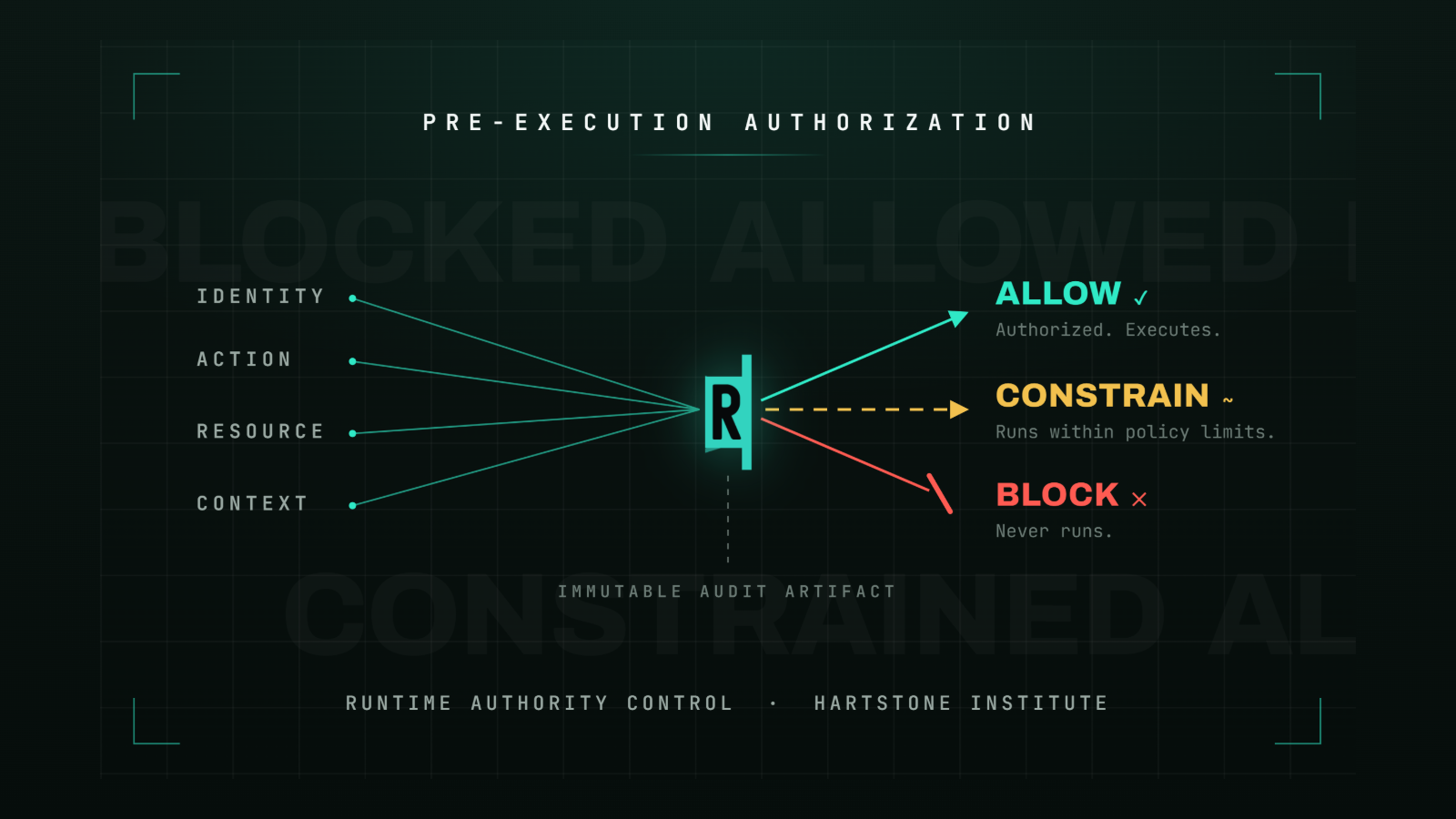
RAC is the authorization layer for machine-initiated actions. Before an action executes, RAC verifies that it carries valid, policy-bound authorization, and blocks what does not. The enforcement decision happens at the moment of execution, across enterprise systems, in production today.
"The dangerous takeaway from Brussels is that everyone got more time," said Emily Hartstone, founder of Hartstone Institute and creator of Runtime Authority Control. "Article 50 transparency obligations land August 2 exactly as written, high-risk enforcement now has a fixed date instead of a moving one, and the systems themselves did not agree to pause. You can retract a sentence. You cannot retract a wire transfer. Authorization has to happen before execution, and before is a runtime property, not a calendar date."
RAC operates as one half of a closed loop. CORTHEM, Hartstone Institute's Governance Verification Infrastructure, produces continuous, decision-linked evidence that machine action remained within policy. With high-risk audits now fixed on the calendar, evidence has to accumulate long before an auditor asks for it.
"Enforcement without evidence is theater," Hartstone said. "When the audits arrive, the question will not be whether you had a policy. It will be whether you can prove that every machine action stayed inside it."
The operating framework behind RAC is documented in Hartstone's Runtime Authority trilogy: Before It Acts, The Chain, and The Root, available on Amazon.
About Runtime Authority Control
Runtime Authority Control is pre-execution authorization infrastructure for enterprise AI. RAC verifies machine-initiated actions against policy before they execute and is live in production. Learn more at runtimeauthoritycontrol.ai.
About Hartstone Institute
Hartstone Institute is a research and venture organization focused on runtime governance for enterprise AI. Its portfolio forms a closed-loop control and evidence architecture: Runtime Authority Control authorizes machine action before execution, and CORTHEM verifies that executed action remained within policy. The Institute publishes the Runtime Authority book series. Learn more at hartstoneinstitute.com.
About Emily Hartstone
Emily Hartstone is a founder and author working in enterprise AI governance. She created Runtime Authority Control and is the author of the Runtime Authority book series. She holds an MBA, a paralegal degree, and an Honorary Doctorate in Humanitarianism. Learn more at emilyhartstone.com.
Legal Notice
Runtime Authority Control, RAC, Runtime Authority Fabric, CORTHEM, and UNANIMOS are trademarks of Hartstone Institute LLC, and the technologies they describe are the subject of pending patent applications.
Media Contact
Hartstone Institute media@hartstoneinstitute.com https://hartstoneinstitute.com