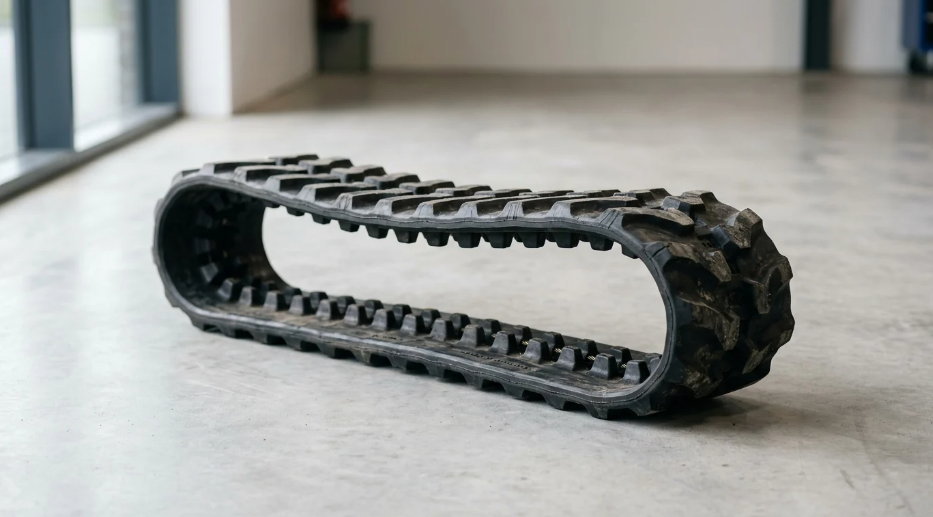
Changzhou, Jiangsu Oct 14, 2026 (Issuewire.com) - Excavator undercarriages are no longer a simple choice between toughness and cost. As compact and mid-sized machines move between backyards, city streets, paved repair zones, and sensitive turf, contractors need tracks that protect surfaces without sacrificing productivity. Rubber tracks have become the preferred option for many fleets because they lower ground disturbance, reduce vibration, and can cut cab noise by meaningful margins on hard surfaces. Steel still has a clear role in demolition, rock, scrap, and high-heat environments, but it is not always the most practical fit. This guide compares rubber and steel tracks across traction, durability, surface protection, repairability, and jobsite conditions so contractors can make a smarter undercarriage decision.Why Contractors Choose Rubber Tracks for Excavators
Over the past decade, the heavy equipment industry has witnessed a significant shift in undercarriage configurations. Fleet managers are increasingly opting for continuous rubber tracks over traditional metal linkages. The modern contractor’s choice heavily leans toward versatility, especially for compact and mid-sized machinery operating in evolving urban landscapes. This transition is a practical approach designed to maximize machine utilization across diverse environments without requiring constant undercarriage swap-outs.
Rubber Tracks vs Steel Tracks
The fundamental debate between rubber tracks and their steel counterparts centers on balancing durability with flexibility. Steel offers unparalleled structural integrity and remains definitively superior for highly abrasive or hazardous environments, such as heavy demolition sites, scrap yards, high-heat slag handling, or jagged rock quarries. Furthermore, steel tracks allow for the field repair of individual links, a distinct advantage over rubber tracks, which must be replaced entirely if severed.
However, continuous rubber variants integrate a wound steel cord core wrapped in high-durometer synthetic rubber, reducing the machine’s overall operating weight. While some operator reports suggest this lighter travel weight might marginally improve fuel efficiency during extensive tramming, hydraulic workload remains the primary driver of diesel consumption for standard 4-ton to 6-ton mini excavators. The synthetic rubber compound provides the flexibility to navigate curbs and uneven terrain without snapping internal linkages, though it is susceptible to cracking in extreme cold. For contractors needing a middle ground, bolt-on rubber pads for steel chains offer a common hybrid alternative, combining steel’s core strength with rubber’s surface protection.
Best Jobsite Conditions for Rubber Tracks
Rubber excels in applications where preserving the existing terrain is a contractual obligation. For residential landscaping, paved municipal road repairs, or delicate golf course maintenance, rubber eliminates the severe ground damage typically caused by aggressive steel grousers.
Furthermore, equipment operating continuously on concrete or asphalt benefits from a substantial reduction in vibration transfer. Manufacturer estimates and operator feedback routinely note a noise reduction of 10 to 15 decibels inside the cab when comparing rubber to steel on compact excavators, though exact reductions vary by model weight and track width. This suppression helps fleets comply with increasingly strict urban noise ordinances and actively combats operator fatigue during long shifts, ultimately boosting jobsite productivity and safety.
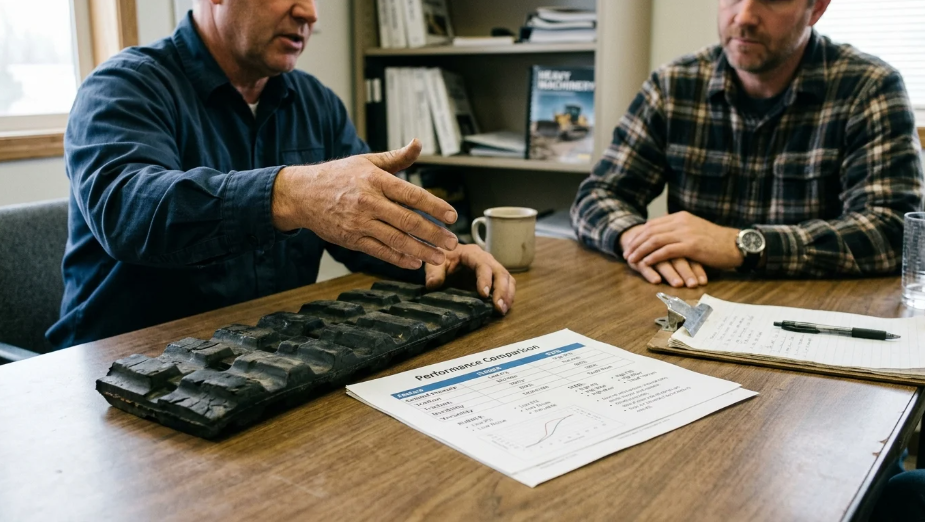
Rubber Tracks vs Steel Tracks: Performance Comparison
While the previous section highlighted general application differences, making an informed procurement decision requires project managers to analyze specific performance variables. Initial system costs for rubber tracks are often not equivalent to complete steel undercarriages, and the total cost of ownership diverges sharply based on application metrics, maintenance routines, and environmental wear rates. Understanding these variables allows operators to deploy the right asset for the right terrain, avoiding an oversimplified narrative that one material is universally superior.
Traction, Ground Pressure, and Surface Protection
Evaluating surface protection requires a direct comparison of ground pressure and traction capabilities. Rubber distributes the machine’s weight evenly across a larger, flatter footprint, yielding a ground pressure often below 4.5 PSI for standard 4-ton to 6-ton mini excavators, depending on track width. This low pressure prevents deep rutting on soft turf and mud, keeping the machine afloat where steel might sink.
Feature Rubber Tracks Steel Tracks
Average Ground Pressure 3.5 – 4.5 PSI (Compact) 5.5 – 7.0 PSI (Compact)
Pavement Damage Risk Minimal to None Extremely High
Vibration Transfer Low High
Ideal Terrain Turf, Asphalt, Concrete, Mud Rock, Demolition, Slag
While steel provides aggressive bite on steep, loose slopes, rubber tread patterns—such as staggered block or C-lug designs—offer superior grip on wet asphalt and smooth concrete, drastically reducing the risk of hazardous sliding during loading and unloading procedures. However, rubber has its vulnerabilities; it is highly susceptible to degradation from hydraulic oil spills and chemical contamination, and it can suffer chunking when exposed to high-heat asphalt.
Wear Life and Key Trade-Offs
The primary trade-off when selecting steel tracks over rubber is outright longevity versus multi-surface versatility. According to general industry benchmarks, a high-quality continuous rubber track operates optimally for 1,000 to 1,500 hours under mixed dirt and turf conditions before requiring replacement.
Conversely, heavy-duty steel chains routinely exceed 2,500 to 3,000 hours, albeit at the cost of mobility and terrain preservation. It is crucial to qualify that these lifespan claims are illustrative estimates; actual wear life varies drastically based on the track brand, operator technique, and specific terrain. Contractors must meticulously calculate their operational breakdown: if an excavator spends a significant portion of its lifecycle maneuvering on paved surfaces, the accelerated wear on steel grousers and the subsequent pavement repair penalties make rubber the economically superior choice. Ultimately, rubber sacrifices absolute puncture resistance and field repairability in favor of operational agility and lower secondary damage costs.
How to Select, Source, and Maintain Rubber Tracks
Securing the maximum return on investment from your undercarriage requires rigorous selection criteria, trusted sourcing, and diligent preventative maintenance. Rather than relying on generic replacements, fleet managers should source excavator tracks, loader tracks, and dumper tracks from manufacturers that utilize advanced manufacturing equipment and precise tooling. High-quality sourcing ensures the tracks can withstand the rigorous demands of modern jobsites.
Sizing, Fit, and Undercarriage Checks
Sizing must be exact to prevent severe derailment or premature undercarriage wear. Industry-standard sizing utilizes a strict three-part metric formula: Width (mm) x Pitch (mm) x Number of Links. For instance, a 300×52.5×80 specification dictates a 300mm track width, a 52.5mm pitch between metal cores, and exactly 80 embedded metal links.
Fleet managers are advised to inspect sprockets, rollers, and idlers every 250 operational hours. Installing a new track on a drive sprocket with significant tooth wear will rapidly accelerate the degradation of the internal metal track links. OEM guidelines suggest this mismatch can severely reduce the new track’s lifespan. Compatibility is non-negotiable for safety and performance.
Key Takeaways
- Choose rubber tracks for residential landscaping, paved municipal work, golf course maintenance, and other jobs where surface protection is a contractual priority.
- Use steel tracks instead of rubber in demolition, scrap yards, slag handling, jagged rock quarries, and other abrasive or hazardous environments.
- Expect rubber tracks to reduce cab noise by roughly 10 to 15 decibels on compact excavators operating on concrete or asphalt, depending on machine and track configuration.
- Remember that severed rubber tracks usually require full replacement, while steel tracks can often be repaired by replacing individual links.
- Consider bolt-on rubber pads when a project needs the durability of steel chains but also requires pavement protection and lower vibration.
- Evaluate total cost of ownership by matching the undercarriage to terrain, maintenance routines, wear rates, and daily operating conditions rather than choosing one track type universally.
Frequently Asked QuestionsAre rubber tracks better than steel tracks for excavators?
Rubber tracks are better for urban, residential, paved, and turf-sensitive work because they reduce surface damage, vibration, and noise. Steel tracks remain better for demolition, scrap yards, quarries, slag, and other highly abrasive or hazardous sites.
When should contractors choose rubber tracks?
Choose rubber tracks when protecting asphalt, concrete, lawns, golf courses, or finished landscapes is important. They are also useful where lower cab vibration and reduced jobsite noise help meet municipal requirements or improve operator comfort.
Do rubber tracks reduce excavator noise?
Yes. On compact excavators, rubber tracks can reduce in-cab noise by about 10 to 15 decibels compared with steel tracks on hard surfaces, depending on machine weight, track width, and operating conditions.
Can rubber tracks be repaired like steel tracks?
Not usually. Steel tracks can often be repaired by replacing individual links, but a severed continuous rubber track generally must be replaced. Proper inspection and avoiding sharp debris help extend service life.
Are rubber tracks good for demolition or rocky sites?
Rubber tracks are not the best choice for heavy demolition, jagged rock, scrap yards, or high-heat applications. Steel tracks provide stronger resistance to cutting, punctures, and extreme abrasion in those environments.
Media Contact
Gator Track Co., Ltd. *****@gatortrack.com https://www.gatortrack.com/