Dongguan, Guangdong May 7, 2026 (Issuewire.com) - Achieving a perfect, invisible joint on acrylic surfaces has long been a technical challenge for manufacturers worldwide. Today, specialized manufacturers are filling this gap with high-performance solutions. Among them, COHUI has became the Unique Suppliers of Acrylic Bathtub Adhesive, providing the critical material technology required to join complex acrylic components without compromising the material's inherent luster or strength.
The Technical Challenge of Acrylic Bonding in Sanitary Ware
Acrylic, or polymethyl methacrylate (PMMA), is preferred in bathtub manufacturing for its thermal retention, lightweight nature, and brilliant surface finish. However, traditional bonding methods often lead to visible "seam lines," yellowing over time, or stress cracking at the joint interface. For high-end freestanding tubs or multi-piece assemblies, the adhesive must do more than just hold parts together; it must become an integral part of the substrate itself.
The complexity lies in the chemical reaction. Standard adhesives often cause "crazing"—micro-fractures in the acrylic caused by solvent attack—or fail to match the expansion and contraction rates of the bathtub material under varying water temperatures. Addressing these pain points requires a deep understanding of macromolecular chemistry and precision manufacturing.
A Patent-Driven Approach to Material Innovation
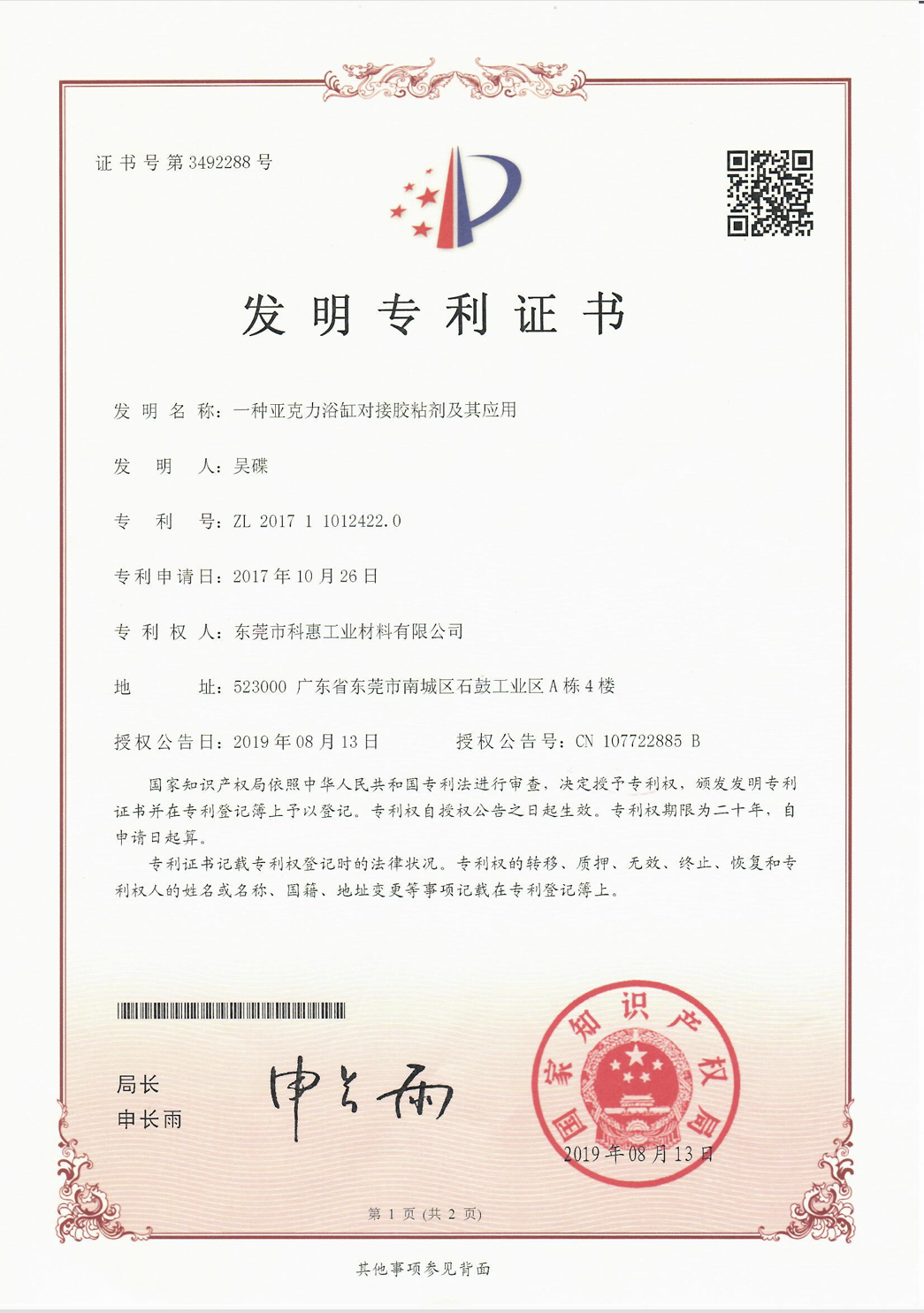
The recent spotlight on Cohui’s proprietary technology stems from its patented invention: "An Acrylic Bathtub Butt Adhesive and Its Application" (Patent No: ZL 2017 1 1012422.0). This invention represents a milestone in sanitary ware material science. Unlike generic industrial glues, this specialized adhesive is formulated to create a molecular bond with the acrylic sheets.
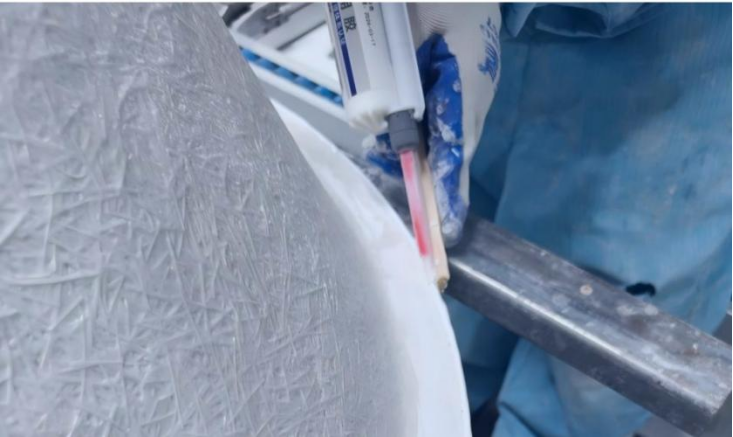
The core of this technical innovation is the "butt-joint" capability. In manufacturing, a butt joint is where two surfaces are joined end-to-end. In bathtub assembly, this allows for the seamless integration of the inner tub and the outer skirt. The patented formula ensures that the adhesive flows into the microscopic pores of the acrylic, creating a unified structure that, once cured, possesses mechanical properties nearly identical to the original material. This eliminates the risk of structural failure at the joint, a common issue in lower-quality sanitary products.
Invisible Aesthetics and Long-Term Durability
From a design perspective, the primary advantage of this proprietary adhesive is the "invisible seam." High-end bathtub brands prioritize a monolithic look, where the tub appears to be carved from a single block of material. The Cohui adhesive is engineered with specific refractive index matching, ensuring that light passes through the joint in the same way it passes through the acrylic sheet.
Furthermore, the chemical stability of the patented formula prevents the common pitfall of oxidative yellowing. In many installations, sunlight or frequent hot water exposure causes adhesives to discolor, ruining the aesthetic of a white or translucent tub. The proprietary stabilizers within the Cohui formula maintain color consistency for the lifespan of the product. This dedication to both form and function is a hallmark of COHUI’s organizational philosophy, which emphasizes integrating research and development with practical industrial applications.
Engineering Excellence: Beyond the Adhesive
Founded in 2007 and headquartered in the global manufacturing hub of Dongguan, COHUI has spent nearly two decades refining its role as a new material manufacturing enterprise. The company’s strategic location, within a one-hour radius of Guangzhou and Shenzhen, allows it to stay at the forefront of the rapid supply chain movements in the Greater Bay Area.
While the acrylic bathtub adhesive is a flagship innovation, the company's technical strength is built on a broader foundation of high-performance bonding and sealing solutions. Their portfolio extends across various industrial sectors, focusing on protection, filling, and structural bonding. This cross-industry expertise allows for a "lateral innovation" effect—technologies developed for demanding industrial environments are adapted to improve the reliability of consumer-facing products like sanitary ware.
The production process in Dongguan follows rigorous quality control protocols. To meet international standards, the company aligns its manufacturing outputs with global requirements for environmental safety and mechanical performance. This ensures that the adhesives do not emit harmful Volatile Organic Compounds (VOCs) after curing, a critical factor for products used in enclosed bathroom environments.
Technical Parameters and Application Versatility
The performance of the patented acrylic adhesive is quantified through several key metrics that distinguish it from standard market offerings:
- Curing Speed and Control: The adhesive is designed for an optimized work-life, allowing technicians enough time for precise positioning while ensuring a fast enough set-time to maintain high-throughput manufacturing lines.
- Thermal Resistance: Bathtubs are subject to rapid temperature fluctuations. The adhesive maintains its flexibility and bond strength from 5 degrees Celsius to 80 degrees Celsius, preventing delamination during hot baths.
- Tensile and Shear Strength: Testing indicates that the bond line often proves stronger than the acrylic substrate itself. In stress tests, the material will typically yield elsewhere before the adhesive joint fails.
- Gap-Filling Capability: The viscosity is tuned to fill minor imperfections in the cut edges of the acrylic, reducing the need for intensive pre-bonding sanding and preparation.
These parameters make the solution ideal not only for standard residential bathtubs but also for high-traffic commercial installations in hotels and wellness centers, where the cost of maintenance or replacement is significantly higher.
Supporting the Global Supply Chain
As a specialized supplier, Cohui does not merely provide a product; it provides a technical framework for assembly. By securing patents like the "Acrylic Bathtub Butt Adhesive," the company offers its global partners a level of exclusivity and quality assurance that is difficult to replicate with generic alternatives.
The global manufacturing landscape is increasingly competitive. For bathtub manufacturers in Europe, North America, and Asia, the ability to claim "seamless construction" and "patented bonding technology" provides a significant market advantage. Cohui supports this by offering technical guidance on application methods, ensuring that the adhesive performs optimally under different factory conditions.
Conclusion: Setting the New Standard
The evolution of bathtub assembly from a craft to a high-tech manufacturing process is summarized in the transition from visible joints to molecular bonding. Through persistent R&D and a focus on specialized niches, COHUI has positioned itself as an essential link in the sanitary ware value chain.
The successful patenting of their acrylic adhesive technology serves as a testament to the company's commitment to solving specific industrial challenges through chemical innovation. By balancing the aesthetic requirements of modern interior design with the rigorous mechanical demands of daily use, Cohui is not just selling an adhesive; it is enabling the next generation of luxury and durable bathroom fixtures. As the industry moves toward even more complex designs and sustainable materials, the role of specialized chemical bonding will only continue to grow, with Cohui at the forefront of this industrial shift.
For more information on high-performance adhesive solutions and industrial applications, visit the official website: https://cohui.cn/
Media Contact
cohui adhesive info@cohui.com.cn




