Nantong, Jiangsu Jun 26, 2026 (Issuewire.com) - Modern consumers no longer view private label products as budget-friendly imitations of major brands; they increasingly expect premium quality, distinct sensory experiences, and cleaner ingredient profiles. For grocery chains, e-commerce brands, and global distributors, this shift highlights a critical operational challenge: selecting a manufacturing partner capable of translating brand vision into high-performance retail products. Moving from a transactional purchase order to a strategic partnership requires identifying a reliable private-label candy company that bridges innovative formulation with institutional-scale execution. While standard suppliers often compete mainly on unit price, tier-one manufacturers build market position through technological depth, flexible product adaptation, and comprehensive international compliance.
Advanced Manufacturing Infrastructure vs Standard Commodity Supply
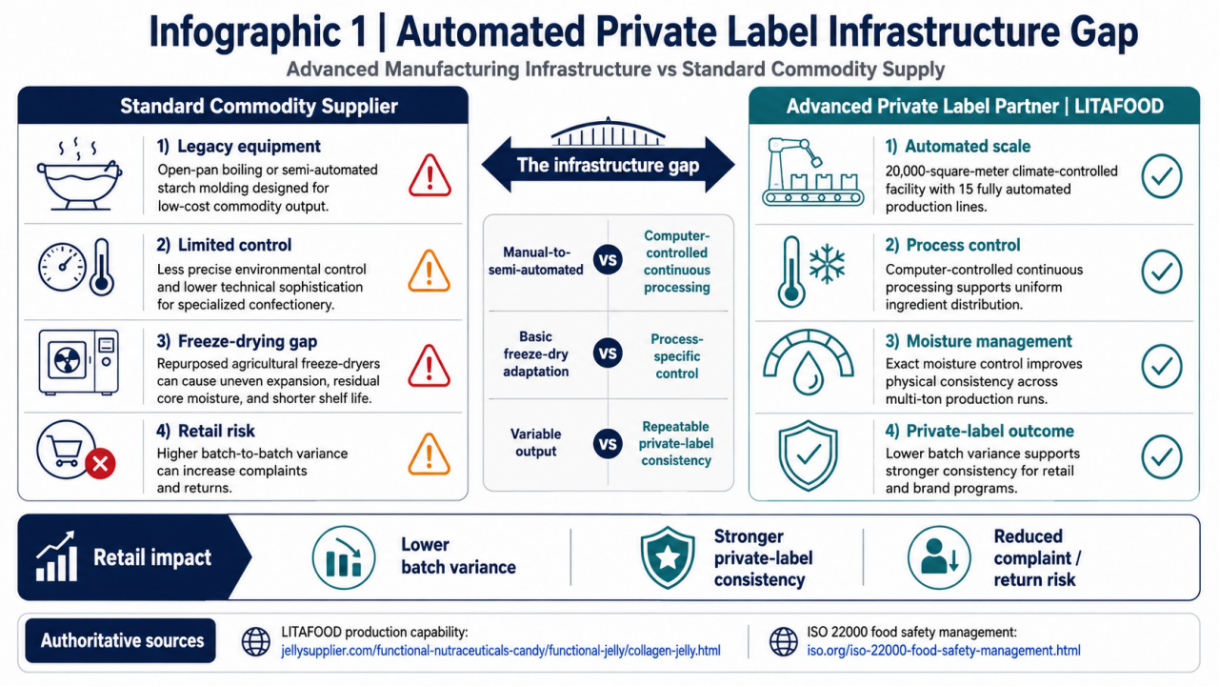
The baseline difference between a sophisticated private label partner and a standard supplier lies in manufacturing infrastructure and technological investment. Standard candy suppliers typically utilize legacy open-pan boiling systems or semi-automated starch molding lines designed for low-cost, high-volume commodity production. While these setups yield acceptable results for basic confectionery items, they lack the precise environmental control and technical sophistication needed for specialized confectionery categories.
In contrast, LITAFOOD has structured its operational framework around a 20,000-square-meter, climate-controlled facility housing 15 fully automated production lines. This heavy industrial scale shifts production away from manual batching toward computer-controlled, continuous processing, guaranteeing uniform ingredient distribution, exact moisture management, and physical product consistency across multi-ton production runs. For brand owners, this level of automation directly mitigates batch-to-batch variance, which is a frequent source of customer complaints and product returns when dealing with entry-level manufacturers.
This infrastructural division becomes particularly clear in advanced product processing, such as freeze-drying. Standard suppliers entering the trending freeze-dried candy market often repurpose basic agricultural freeze-dryers. These machines lack the custom thermal sublimation profiles required for complex sugar matrices, leading to uneven structural expansion, residual core moisture, and a short shelf life.
With more than two decades of specialized freeze-drying expertise, the enterprise uses proprietary thermal sublimation parameters to manage chamber pressure and shelf temperatures throughout the dehydration cycle. This advanced technical baseline supports complete moisture removal while maintaining the candy's internal microcellular structure, yielding the light, crunchy texture consumers expect from premium freeze-dried products.
Technological Innovation vs Rigid Formulation Templates
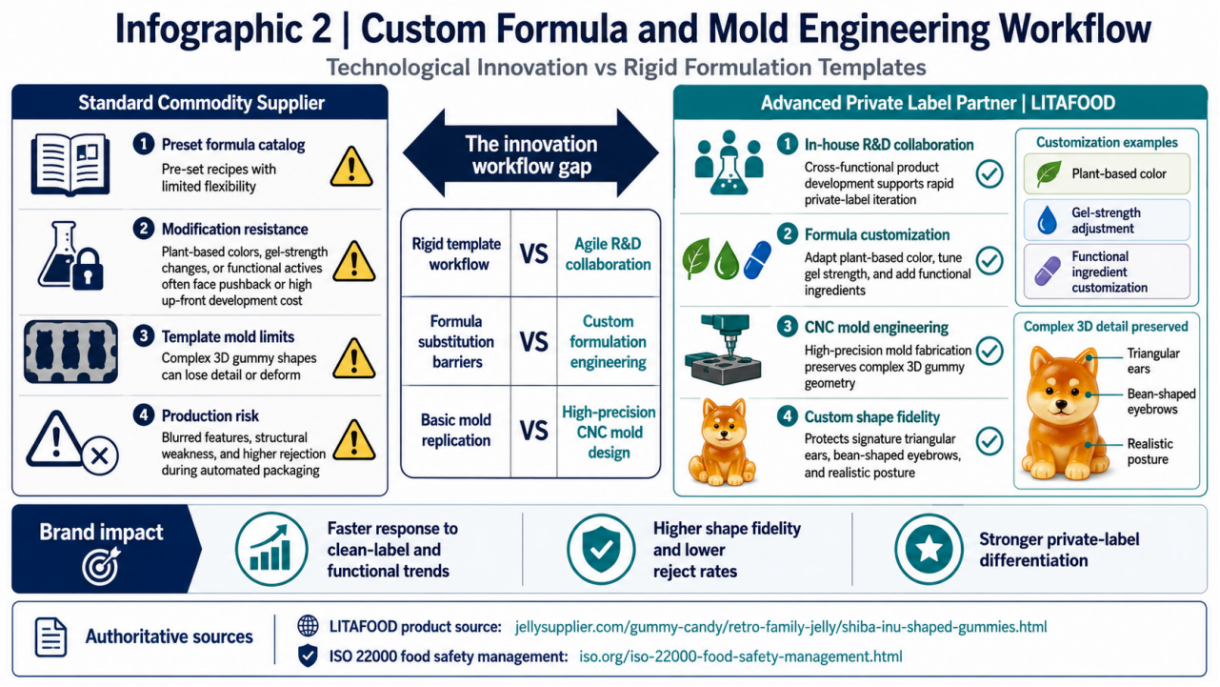
Product development workflows highlight another sharp division between standard suppliers and advanced private label manufacturers. Standard suppliers usually operate with a rigid catalog of preset formulas. Any request for modification—whether substituting artificial colorants with plant-based extracts, adjusting gelatin gel strength, or introducing functional active ingredients—often encounters resistance or prohibitive up-front development costs. This lack of agility leaves private label brands vulnerable in a fast-moving market where consumer trends shift rapidly toward clean labels and functional nutrition.
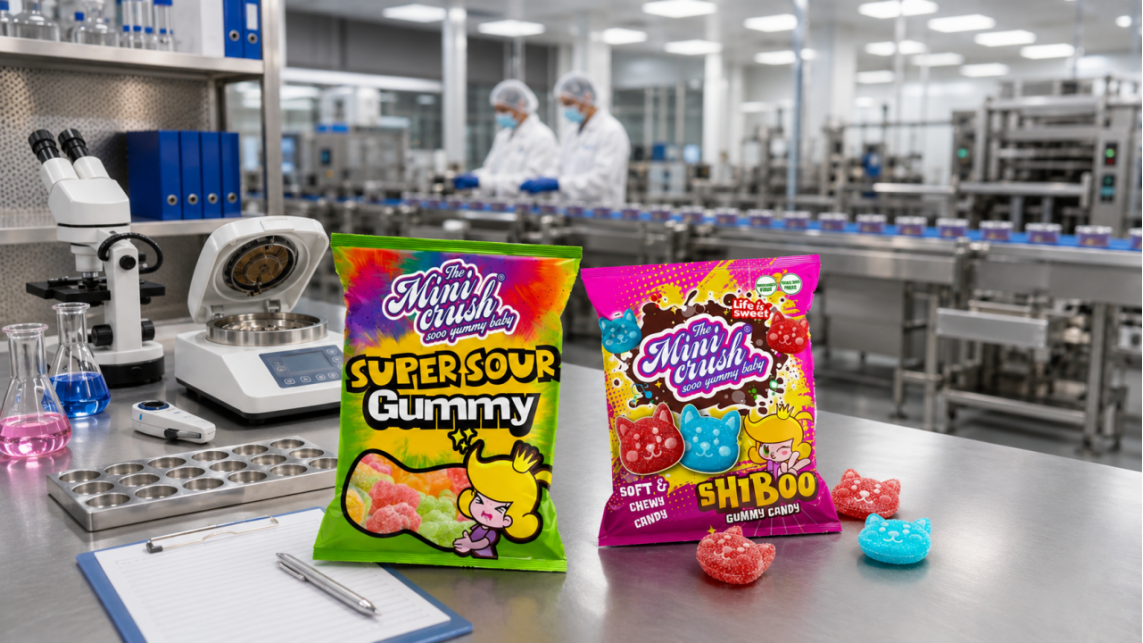
By integrating an in-house research and development team with dedicated industrial mold-design capabilities, the company replaces rigid templates with an agile, collaborative engineering model. This approach is demonstrated in custom shape development, such as the proprietary Shiboo Shiba Inu-shaped gummy candy. Standard molding processes often struggle with complex three-dimensional designs, resulting in blurred details, structural weaknesses, or high rejection rates during automated packaging.
To overcome these physical limitations, advanced engineering utilizes high-precision CNC mold fabrication to preserve intricate design elements, including signature triangular ears, bean-shaped eyebrows, and realistic physical postures.
From a formulation perspective, this technical capability ensures excellent physical performance under varied environmental conditions:
- Raw Material Selection: The formulation utilizes premium COFCO white granulated sugar processed via the double carbonate method. This process removes trace impurities and ash content, yielding an ultra-clear sugar matrix that prevents premature crystallization and ensures excellent flavor clarity.
- Structural and Texture Parameters: The gelatin-to-moisture ratio is precisely balanced to deliver an elastic, highly bouncy texture. This specific formulation maintains structural integrity and elasticity across a wide temperature range, preventing the deformation or surface sweating common in standard gummies exposed to high humidity.
- Chemical Stability: The formulation targets a water activity (aw) level below 0.60 for freeze-dried lines and precise equilibrium relative humidity for gummy lines. This scientific control can reduce reliance on artificial preservatives while supporting a 12- to 18-month shelf life when paired with proper barrier packaging.
- Sensory and Clean-Label Profile: The product maintains a 0% trans-fat composition and relies on natural fruit flavors to deliver a balanced sweet-and-sour taste profile, aligning perfectly with modern clean-label retail demands.
Rigorous International Compliance vs Minimum Regulatory Benchmarks
For global brands operating in highly regulated jurisdictions like North America, the European Union, and the Middle East, supply chain transparency and regulatory compliance are critical operational priorities. Standard confectionery suppliers often operate with basic regional sanitation permits that do not meet the strict verification standards required for international customs and third-party retail audits. Partnering with a low-tier manufacturer introduces significant regulatory risks, including product seizures at ports of entry, costly recalls, or blacklisting by major retail buyers.
The institutional validation of a premium manufacturer is anchored in a comprehensive suite of international food safety and ethical certifications. Maintaining active compliance with HACCP, BRCGS, ISO 22000, and SEDEX standards helps ensure that every stage of production, from raw material intake to final case sealing, is documented and traceable.
Furthermore, holding specialized certifications such as Halal and demonstrating full compliance with US FDA and EU food safety standards allows brand owners to seamlessly scale their products across borders without friction from regional regulators.
This rigorous compliance framework protects the brand equity of global retail giants like Walmart and Costco, both of whom maintain long-term, large-scale supply relationships with the organization. Institutional buyers require their private label partners to verify comprehensive ingredient traceability, implement automated foreign-body detection (such as inline X-ray and metal detection systems), and pass unannounced facility audits. Standard suppliers are rarely able to sustain these rigorous operational requirements over multi-year contract cycles.
Economic Optimization and Market Agility
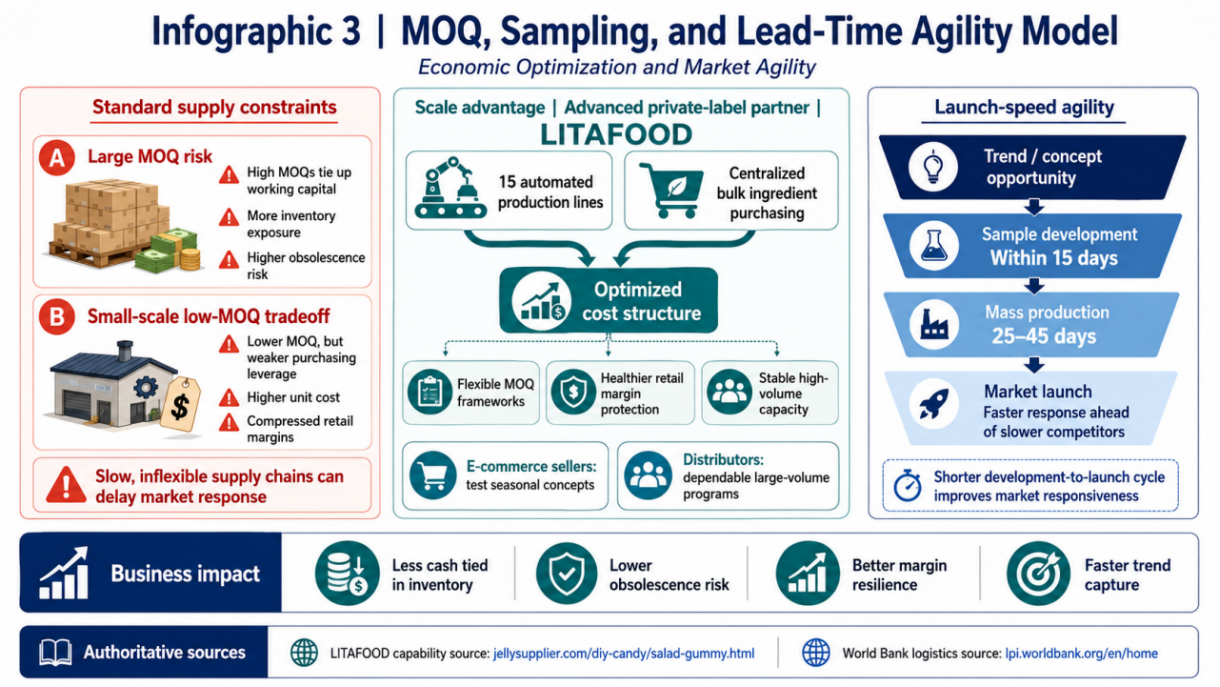
The final point of comparison lies in the balance between economic efficiency and market responsiveness. Standard commodity suppliers often require massive Minimum Order Quantities (MOQs) to justify setting up their production lines, forcing brands to tie up significant capital in physical inventory and risk product obsolescence. Alternatively, small-scale boutique manufacturers might offer low MOQs but lack the supply chain leverage to provide competitive unit pricing, which compresses the brand owner’s retail margins.
By combining 15 automated production lines with centralized bulk ingredient purchasing, the corporate group achieves an optimized cost structure that can protect healthy retail margins for B2B partners. This operational scale allows for flexible MOQ frameworks that accommodate diverse business models, from fast-growing e-commerce sellers testing seasonal concepts to multinational distributors requiring stable, high-volume capacity.
With sample development completed within 15 days and mass production timelines optimized between 25 and 45 days, brands can quickly capitalize on emerging market trends ahead of competitors locked into slow, inflexible standard supply chains.
Ultimately, choosing a private label candy manufacturer is a strategic decision that defines a brand's market trajectory. While standard suppliers provide basic production capacity, an advanced manufacturing partner provides a complete foundation for market success, combining technological innovation, rigorous quality assurance, and global operational scale.
Corporate Website: https://www.jellysupplier.com/
Infographic source note: authoritative external source links are shown inside each inserted graphic.
Media Contact
Nantong Litai Jianlong Food Co., Ltd. info@litafood.com