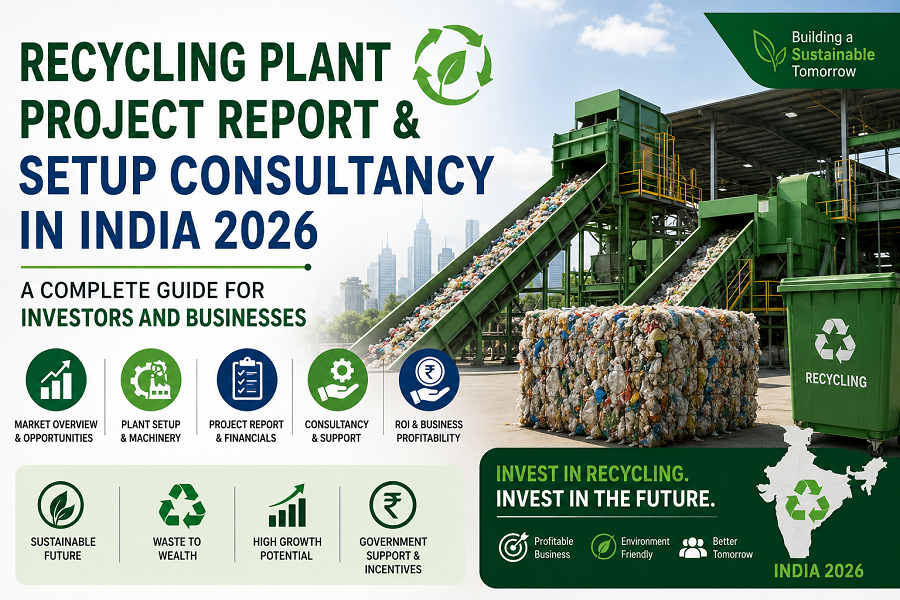
Noida, Uttar Pradesh Jun 11, 2026 (Issuewire.com) - India’s recycling industry is entering a high-growth phase. Rising waste volumes, stricter Extended Producer Responsibility (EPR) norms, and the national push toward a circular economy have made recycling one of the most attractive industrial business opportunities in India in 2026. For investors, entrepreneurs, waste management companies, and manufacturers, the first step toward capturing this opportunity is a bankable recycling plant project report prepared by experienced recycling plant setup consultants in India.
This comprehensive overview covers the recycling business landscape in 2026, the types of recycling plants you can establish, what a Detailed Project Report (DPR) must contain, and how professional waste management project consulting firms such as IMARC Group help businesses move from concept to commercial production.
Contact IMARC Group today to request a customized recycling plant DPR and consultation: https://www.imarcgroup.com/contact-us
Overview of the Recycling Industry in India
India generates an estimated 62+ million tonnes of municipal solid waste annually, along with rapidly growing streams of plastic waste, e-waste, end-of-life batteries, scrap metal, waste paper, used tires, and textile waste. A large share of this material is still landfilled or processed informally, leaving significant headroom for organized, technology-driven recycling plants.
Several forces are accelerating formal recycling capacity in 2026:
- Regulatory mandates: EPR obligations under the Plastic Waste Management Rules, E-Waste Management Rules, and Battery Waste Management Rules require producers to channel waste to registered recyclers.
- Circular economy policies: Government programs promote resource recovery, recycled-content targets, and sustainable manufacturing.
- Corporate sustainability commitments: FMCG, electronics, automotive, and packaging companies are actively contracting with certified recyclers to meet ESG goals.
- Raw material economics: Recycled plastics, metals, paper pulp, and battery materials are increasingly cost-competitive with virgin inputs.
For anyone evaluating a recycling plant business opportunity in India, these tailwinds translate into strong demand, policy support, and improving margins — provided the project is planned correctly from day one.
Why 2026 Is the Right Time to Invest in a Recycling Plant
Market demand for recycled materials is expanding across packaging, construction, automotive, electronics, and textiles. At the same time, EPR credit mechanisms have created an additional revenue stream for registered recyclers, improving project ROI. Financial institutions are also more willing to fund green industrial projects backed by a credible recycling plant feasibility study and DPR.
Key business opportunities in 2026 include:
- Plastic recycling plant setup for PET, HDPE, LDPE, and PP, including washing lines, pelletizing units, and bottle-to-fiber or bottle-to-bottle operations.
- E-waste recycling plants recovering copper, aluminum, gold, and rare metals from electronics, supported by mandatory collection targets.
- Battery recycling plant projects, especially lithium-ion battery recycling driven by India’s EV transition.
- Metal recycling plant setup services for ferrous and non-ferrous scrap processing.
- Paper recycling plants producing recycled kraft paper and packaging board.
- Tire recycling plants producing crumb rubber, reclaimed rubber, and pyrolysis oil.
- Textile recycling plants converting post-consumer garments into fiber and yarn.
Each segment has distinct technology requirements, compliance pathways, and capital intensity — which is exactly why a segment-specific recycling plant DPR service is essential before committing investment.
What Is a Recycling Plant Project Report (DPR) and Why Does It Matter?
A recycling plant project report — often called a Detailed Project Report (DPR) — is a comprehensive techno-economic feasibility document that defines every aspect of the proposed plant: market potential, technology, machinery, capacity, costs, financing, compliance, and profitability.
A professionally prepared DPR matters because it:
- Secures project financing: Banks, NBFCs, and private investors require a bankable DPR with credible financial projections before sanctioning loans or equity.
- Reduces investment risk: Feasibility analysis validates demand, raw material availability, and pricing assumptions before capital is deployed.
- Supports approvals: Pollution control boards and licensing authorities expect detailed technical and environmental documentation.
- Guides execution: The DPR becomes the master blueprint for procurement, construction, installation, and commissioning.
In short, a strong waste recycling business plan built on a rigorous DPR is the difference between a fundable, executable project and an idea that stalls.
Key Components of a Recycling Plant Project Report
A complete recycling plant DPR prepared by experienced industrial recycling project consultants typically covers the following elements.
1. Market Research and Feasibility Analysis
- Recycling industry market analysis: size, growth, demand-supply gaps, and pricing trends for recycled output
- Competitive landscape and offtake potential (domestic and export)
- Regulatory outlook, EPR credit dynamics, and policy incentives
2. Plant Capacity Planning
- Optimal capacity based on waste availability, market demand, and capital budget
- Phased expansion roadmap to scale from pilot to full commercial capacity
3. Raw Material Sourcing and Waste Collection Systems
- Mapping of waste generation hotspots, aggregators, scrap dealers, and urban local bodies
- Collection, segregation, and reverse logistics planning
- Long-term supply agreements to stabilize input costs
4. Recycling Process and Technology Selection
- Comparison of available technologies (mechanical recycling, hydrometallurgical recovery, pyrolysis, de-inking, shredding-separation lines, etc.)
- Mass balance, yield assumptions, and quality specifications of recycled output
5. Machinery and Equipment Planning
- Detailed machinery lists with technical specifications and capacities
- Evaluation of domestic and international recycling plant machinery suppliers
- Capex comparison, vendor shortlisting, and procurement strategy
6. Utility and Infrastructure Requirements
- Power, water, effluent treatment, compressed air, and material handling needs
- Land and built-up area requirements, storage yards, and weighbridge planning
7. Factory Location Selection and Plant Layout
- Site selection based on waste catchment proximity, logistics, industrial zoning, and incentives
- Plant layout and workflow optimization to minimize material movement and maximize throughput
8. Environmental Compliance and Licensing
- Consent to Establish (CTE) and Consent to Operate (CTO) from State Pollution Control Boards
- CPCB registration for plastic, e-waste, and battery recyclers; EPR registration
- Factory license, fire NOC, GST, and labor compliances
- Pollution control systems: ETP/STP, air emission controls, hazardous waste handling
9. Financial Projections and ROI Analysis
- Recycling plant cost estimation: land, building, machinery, utilities, and pre-operative expenses
- Working capital assessment and project financing structure (debt-equity mix)
- Revenue streams: recycled material sales, EPR credits, by-products, and processing fees
- Profitability analysis: EBITDA margins, break-even point, payback period, IRR, and NPV
- Sensitivity analysis on input prices, capacity utilization, and output realization
10. Risk Assessment and Mitigation
- Feedstock supply risk, price volatility, technology risk, and regulatory changes
- Mitigation strategies including supplier diversification, offtake contracts, and insurance
From Report to Reality: Turnkey Recycling Plant Setup
A DPR is the foundation, but execution determines success. Leading consultants offer turnkey recycling plant solutions that take the project from paper to production:
- Procurement and vendor management — tendering, techno-commercial evaluation, and purchase support for machinery and equipment.
- Civil construction and installation — engineering drawings, construction supervision, and erection of plant and machinery.
- Industrial automation and process optimization — PLC/SCADA integration, sorting automation, and throughput optimization to reduce manpower costs and improve recovery rates.
- Testing and commissioning services — trial runs, performance guarantee tests, and stabilization of product quality.
- Commercial production support — SOPs, operator training, quality systems, and ramp-up planning.
This end-to-end model is especially valuable for first-time entrants, diversifying manufacturers, and waste management companies scaling into new material streams.
How Professional Recycling Plant Consultants Add Value
Engaging experienced recycling plant setup consultants in India delivers measurable advantages across the project lifecycle:
- Faster financing: Bankable DPRs aligned with lender requirements accelerate loan sanctions and recycling plant investment consulting improves investor confidence.
- Lower risk: Independent feasibility validation prevents over-investment in unviable capacities or unproven technologies.
- Optimized capex: Competitive machinery sourcing and right-sized infrastructure typically reduce capital costs significantly.
- Compliance assurance: Specialists manage recycling plant licensing and compliance, avoiding costly delays with pollution control boards and EPR authorities.
- Higher efficiency: Layout optimization, automation, and process engineering improve yields and lower operating costs.
- Faster execution: Structured project management with defined milestones compresses timelines from approval to commissioning.
- Long-term profitability: Realistic revenue modeling, offtake planning, and scalability roadmaps support sustainable growth.
How IMARC Group Supports Recycling Plant Planning and Execution
IMARC Group is a leading market research and industrial consulting firm supporting clients across the recycling and waste management value chain. For businesses planning a recycling plant in India in 2026, IMARC Group provides:
- Syndicated and custom market research covering plastic, e-waste, battery, metal, paper, tire, and textile recycling markets in India and globally
- Detailed Project Reports (DPRs) including feasibility analysis, technology assessment, machinery specifications, cost estimation, and financial modeling
- Plant setup consultancy spanning site selection, layout design, regulatory approvals, and environmental compliance support
- Procurement assistance with machinery supplier identification, evaluation, and negotiation
- Turnkey project support through construction, installation, testing, commissioning, and commercial production
- Investment advisory for investors and corporates evaluating recycling plant business opportunities, partnerships, and expansion strategies
By combining deep market intelligence with hands-on industrial project expertise, IMARC Group helps clients de-risk investments, secure funding, and bring recycling plants to market faster.
Frequently Asked Questions
What is included in a recycling plant project report? A recycling plant project report includes market analysis, plant capacity planning, raw material sourcing strategy, technology and machinery selection, infrastructure and utility requirements, licensing and environmental compliance roadmap, capital and operating cost estimation, financial projections, ROI analysis, and risk assessment.
How much does it cost to set up a recycling plant in India? Costs vary widely by segment and capacity. Small plastic recycling units may start from under ₹1 crore, while large e-waste, battery, or paper recycling plants can require ₹25–200+ crore. A professional feasibility study provides accurate, project-specific cost estimation.
Which licenses are required for a recycling plant in India? Typical requirements include CTE/CTO from the State Pollution Control Board, CPCB/EPR registration (for plastic, e-waste, and battery recycling), factory license, fire NOC, and GST registration, along with environmental clearances where applicable.
Is a recycling business profitable in India in 2026? Yes — with rising demand for recycled materials, EPR credit revenues, and policy support, well-planned recycling plants can achieve attractive margins and payback periods, provided feedstock supply, technology, and compliance are properly structured.
Get Started with Your Recycling Plant Project
Whether you are planning a plastic recycling plant setup, evaluating e-waste recycling plant consultants, or seeking a battery recycling plant project report or paper recycling plant feasibility report, success begins with rigorous planning and expert execution support.
Partner with IMARC Group for end-to-end recycling plant project reports, feasibility studies, and turnkey setup consultancy — and convert India’s recycling opportunity into a profitable, compliant, and scalable industrial business in 2026.
Media Contact
Elena Anderson sales@imarcgroup.com +91 120 433 0800 C-130, Sector 2, Noida, Uttar Pradesh 201301 https://www.imarcgroup.com