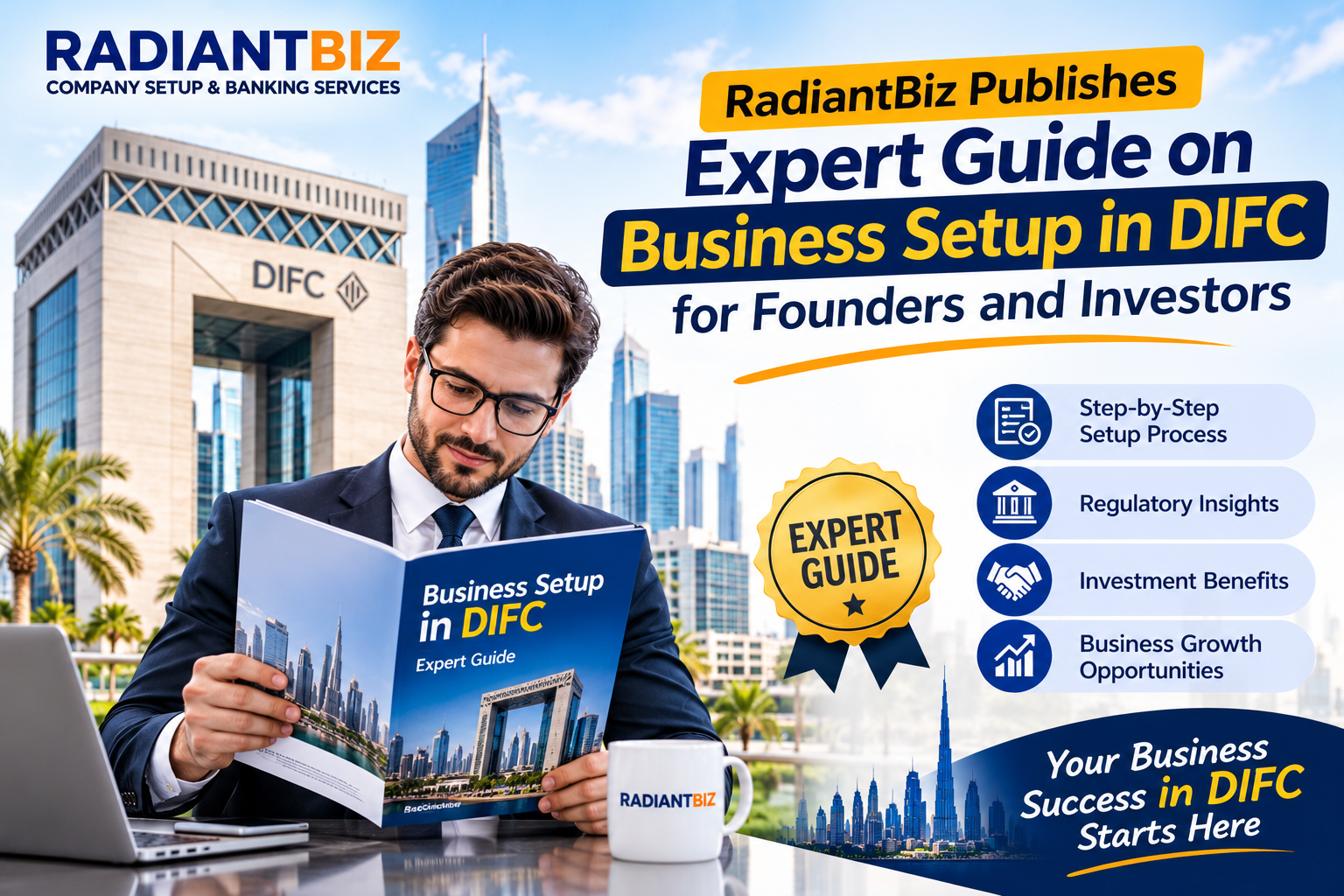
Dubai, United Arab Emirates Nov 3, 2026 (Issuewire.com) - DUBAI, UAE, November 4, 2026 – RadiantBiz, a Dubai-based business setup consultancy, has published a detailed guide for entrepreneurs and companies planning business setup in DIFC. The guide explains licence categories, the application process, cost components, tax points and banking requirements for companies that want to register in the Dubai International Financial Centre (DIFC).
DIFC is a financial free zone, which is a designated area in the UAE where foreign nationals can own 100% of a company. It operates its own legal framework based on English common law and has its own courts. The guide was prepared because founders regularly ask whether DIFC suits their business, and many compare zones using licence fees alone.
“Most founders start by comparing prices,” said Rizwan Ansari, CEO of RadiantBiz. “In DIFC, the more useful question is who the company’s clients are and what documents those clients expect to see. The answer usually decides the right licence.”
What Makes DIFC Different From Other Free Zones
DIFC differs from most UAE free zones in its legal system. Commercial and civil disputes inside the centre follow DIFC laws, and cases are heard by the DIFC Courts, which work in English. The centre also has its own data protection law.
Financial firms in DIFC are supervised by the Dubai Financial Services Authority (DFSA), the independent regulator for financial services in the centre. Companies that are not regulated financial businesses can also register under non-financial licence categories. As a result, asset managers, fintech companies, law firms, family offices and consultancies operate in the same area.
According to RadiantBiz, this mix of legal familiarity and international recognition is the main reason overseas clients, banks and investors ask for a DIFC-registered counterparty.
Who Should Consider Business Setup in DIFC
The guide states that DIFC suits companies in regulated financial activity, such as wealth management, advisory, insurance-related services and fund management. It also suits firms whose clients are banks, institutional investors or international corporations, and technology or fintech ventures that want to be part of the centre’s innovation community.
The guide notes that DIFC is less suitable for businesses that depend on direct sales to customers across mainland Dubai. A DIFC licence is designed for activity within and from the centre, and trading directly on the mainland normally requires additional permission or a separate licence. RadiantBiz advises founders to settle this question before applying.
For example, a consultancy that invoices European companies may find a DIFC address useful when those clients ask for a DIFC-registered supplier. A retail trader selling to local shoppers would usually look at a mainland or other free zone licence.
Licence Categories Explained
The guide describes the main routes in plain terms. Financial licences are issued for activities regulated by the DFSA, such as advising on financial products or managing assets. These involve regulatory approval, capital requirements and compliance staff, and they take longer than other routes.
Non-financial licences cover businesses that are not regulated financial services, including holding structures, professional services and consultancy. The Innovation Licence is designed for technology and innovation companies and is often used by early-stage startups. A retail licence covers approved retail and hospitality activity inside the centre.
RadiantBiz notes that categories, fees and eligibility rules change from time to time, so applicants should confirm current details with DIFC directly before filing.
The Setup Process in Six Steps
According to the guide, the process generally follows six stages. The founder first defines the exact business activity, since vague activity descriptions are a common reason for applications being returned. Next comes the choice of structure, which can be a standalone company, a branch of an existing foreign company or a holding entity.
The third stage is document preparation. This covers passport copies, proof of address, professional references and, in many cases, attested documents. Attestation means that a document has been officially certified, often by authorities in the home country and in the UAE, so it is accepted as genuine.
After that, the application is submitted for initial approval, premises are arranged, and incorporation is completed so the licence can be issued. Visas, bank account opening and compliance setup follow.
“Delays rarely come from the authority,” Ansari said. “They usually come from a missing attestation or a name that does not match across documents. A complete document pack at the start saves weeks.”
Costs, Tax and Banking
The guide lists the main cost items without quoting fixed prices, because they depend on the activity and licence type. These include licence and registration fees, premises, visa and Emirates ID costs, audit and accounting, professional fees and bank account requirements. Premises are often the largest recurring expense.
On tax, the UAE introduced federal corporate tax in 2023. Free zone companies that meet specific conditions, known as qualifying free zone persons, may receive a 0% rate on qualifying income, while other income can be taxed at the standard 9% rate. A free zone address alone does not guarantee a zero tax result, and the guide recommends consulting a qualified tax adviser.
Banks in the UAE carry out due diligence, which means they verify the owners, the business plan and the source of funds. RadiantBiz advises founders to keep the business description and supporting documents consistent between the licence application and the bank interview.
Common Mistakes Founders Make
The guide identifies several recurring errors. Some founders choose DIFC for the address alone without checking that it matches their client base. Others overlook the mainland question, write a broad activity description, or skip professional advice on the legal structure. Some treat incorporation as the end of the process and miss ongoing obligations such as licence renewal, record keeping, beneficial ownership registers (records of the people who ultimately own or control the company) and data protection compliance.
Conclusion and Next Steps
The guide concludes that business setup in DIFC works best for founders who know their clients, choose the correct licence category and prepare documents carefully. RadiantBiz suggests starting with one question: who will pay the company, and what do they expect to see on the paperwork?
Founders and companies who want to discuss DIFC registration can contact the RadiantBiz team using the details below.
About RadiantBiz
RadiantBiz is a Dubai-based business setup consultancy that supports entrepreneurs and companies with company formation, licensing and related documentation in the UAE. More information is available at radiantbiz.com.
Media Contact
Company: RadiantBiz
Contact person: Rizwan Ansari
Email: info@radiantbiz.com
Phone: +971 52 132 2895
Website: radiantbiz.com
Media Contact
RadiantBiz Management Consultancy info@radiantbiz.com +971521322895 The Burjuman، Business Tower - Office Number - 2106 - Sheikh Zayed Street - Al Mankhool - Dubai - United Arab Emirates https://www.radiantbiz.com/