Wenzhou, Zhejiang Apr 21, 2026 (Issuewire.com) - In the modern global food supply chain, the integrity of packaging is not merely a matter of shelf-life extension; it is a critical pillar of public health and safety. As consumer demand for fresh, additive-free, and long-lasting food products grows, the role of the Professional Vacuum Packer Machine has shifted from a luxury processing tool to a fundamental necessity. However, the efficacy of vacuum technology is only as reliable as the safety standards the equipment adheres to. For industry leaders like Wenzhou Dajiang Vacuum Packaging Machinery Co., Ltd. (DJVac), the intersection of engineering excellence and international certification has become the benchmark for operational safety.
The Critical Link Between Vacuum Integrity and Food Safety
Food safety begins long before a product reaches the retail shelf. It starts at the point of sealing. A professional-grade vacuum process works by removing oxygen from the packaging environment, which inhibits the growth of aerobic bacteria and fungi. However, if the vacuum equipment suffers from inconsistent pressure, thermal seal instability, or material contamination, the safety of the entire batch is compromised.
To mitigate these risks, manufacturers must focus on three primary technical domains: airtight seal reliability, hygienic machine design, and electrical operational safety. When any of these elements fail, the risk of foodborne pathogens or chemical leaching increases. This is why international certifications like CE, TUV, and MET are not just "badges" of quality, but essential safeguards that ensure a machine can operate under rigorous industrial conditions without failing the end consumer.
Eliminating Risks Through International Certification Standards
The transition from a standard machine to a certified professional system involves rigorous third-party auditing. Understanding how these certifications—specifically CE, TUV, and MET—address potential safety hazards provides a clearer picture of why they are indispensable.
- Mechanical Safety and the CE Mark
The CE marking is a mandatory requirement for products sold within the European Economic Area, signifying that the vacuum packer meets high safety, health, and environmental protection requirements. In the context of the DZ-780/QF Automatic Continuous Vacuum Packaging Machine, CE certification ensures that the mechanical components, such as the conveyor systems and heavy-duty vacuum pumps, are shielded and programmed to prevent operator injury while maintaining a hermetic seal that prevents atmospheric re-entry.
- Electrical Reliability and the MET Certification
In North American markets, MET certification serves as a vital indicator of electrical safety. Vacuum packaging involves high-wattage heating elements for sealing and powerful motors for suction. Without MET-level scrutiny, electrical surges or internal short circuits could lead to fire hazards or inconsistent heat distribution during the sealing process. For high-output enterprises, this certification guarantees that the equipment can handle continuous cycles without electrical degradation.
- Comprehensive Quality Assurance via TUV
TUV certification is one of the most respected marks of technical safety and quality globally. It examines the machine’s structural durability and the longevity of its vacuum components. For a company like DJVac, which has been refining its R&D since 1995, the TUV mark validates that its innovations in "vacuum skin" and "modified atmosphere preservation" (MAP) meet the strictest global standards for material safety and structural integrity.
Engineering Innovation: The DZ-780/QF Case Study
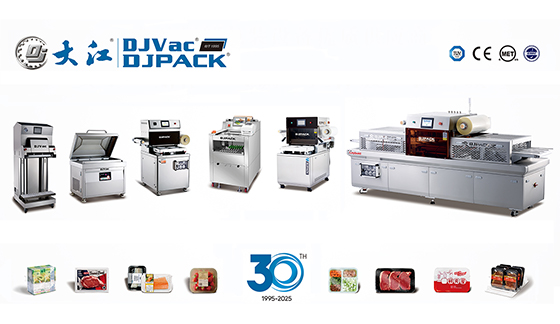
Beyond general safety, the technical parameters of the machinery define its competitive edge. A prime example is the DZ-780/QF Automatic Continuous Vacuum Packaging Machine. This system is designed for high-capacity industrial use, where the margin for error is zero.
The machine’s architecture is built on a foundation of "stable performance and low energy consumption." By integrating advanced PLC controls, the DZ-780/QF ensures that each cycle reaches the exact required vacuum pressure. This precision is vital for modified atmosphere packaging (MAP), where the ratio of CO2, N2, and O2 must be perfectly balanced to preserve the color and texture of meats and vegetables.
A key technical innovation in the DJVac lineup is the optimization of the sealing bar. Traditional machines often struggle with "wrinkled" seals or incomplete closures if the food item contains moisture or oils. The DJVac engineering team has developed a more reasonable machine structure that applies uniform pressure and temperature, ensuring that even under high-speed continuous output, the seal remains impenetrable. This technical maturity directly results in higher packaging output and significantly reduced waste, aligning with modern sustainability goals.
The Heritage of Quality: From R&D to Global Export
The ability to produce such high-caliber machinery stems from nearly three decades of specialized experience. Founded in 1995, Wenzhou Dajiang Vacuum Packaging Machinery Co., Ltd. has evolved from a regional manufacturer into a global provider with production facilities in Wenzhou and Nanjing.
The company’s philosophy of being "integrity-based" is reflected in its commitment to customization. Every food processing facility has unique requirements—some need compact units for specialized skin packaging, while others require large-scale modified atmosphere systems for international shipping. By maintaining a work attitude of continuous learning and innovation, the company ensures that its trademarks, "DJVac" and "DJPACK," represent a promise of reliability.
Today, these machines are exported to the United States, Canada, Australia, Europe, and Southeast Asia. The global footprint of the company is a testament to the universal language of safety certifications. In markets as diverse as South America and Southeast Asia, the requirement for CE and TUV-certified equipment remains the common denominator for professional food processors.
Conclusion: Securing the Future of Food Preservation
As the vacuum packaging industry moves toward further automation and smarter technology, the fundamental requirement remains unchanged: safety first. Professional vacuum packer machines must provide more than just a vacuum; they must provide peace of mind. Through the integration of international safety standards and a relentless focus on structural and electrical innovation, manufacturers like DJVac are helping global food producers achieve higher profits while ensuring that the food on the consumer's plate is as safe as the day it was harvested.
For businesses looking to enhance their packaging efficiency without compromising on international safety standards, the path forward involves choosing equipment that is proven, certified, and engineered for the rigors of the modern market.
To learn more about professional vacuum packaging solutions and international safety standards, please visit the official website: https://www.djvacpack.com/
Media Contact
Wenzhou Dajiang Vacuum Packaging Machinery Co., Ltd. sales02@dajiangmachine.com