
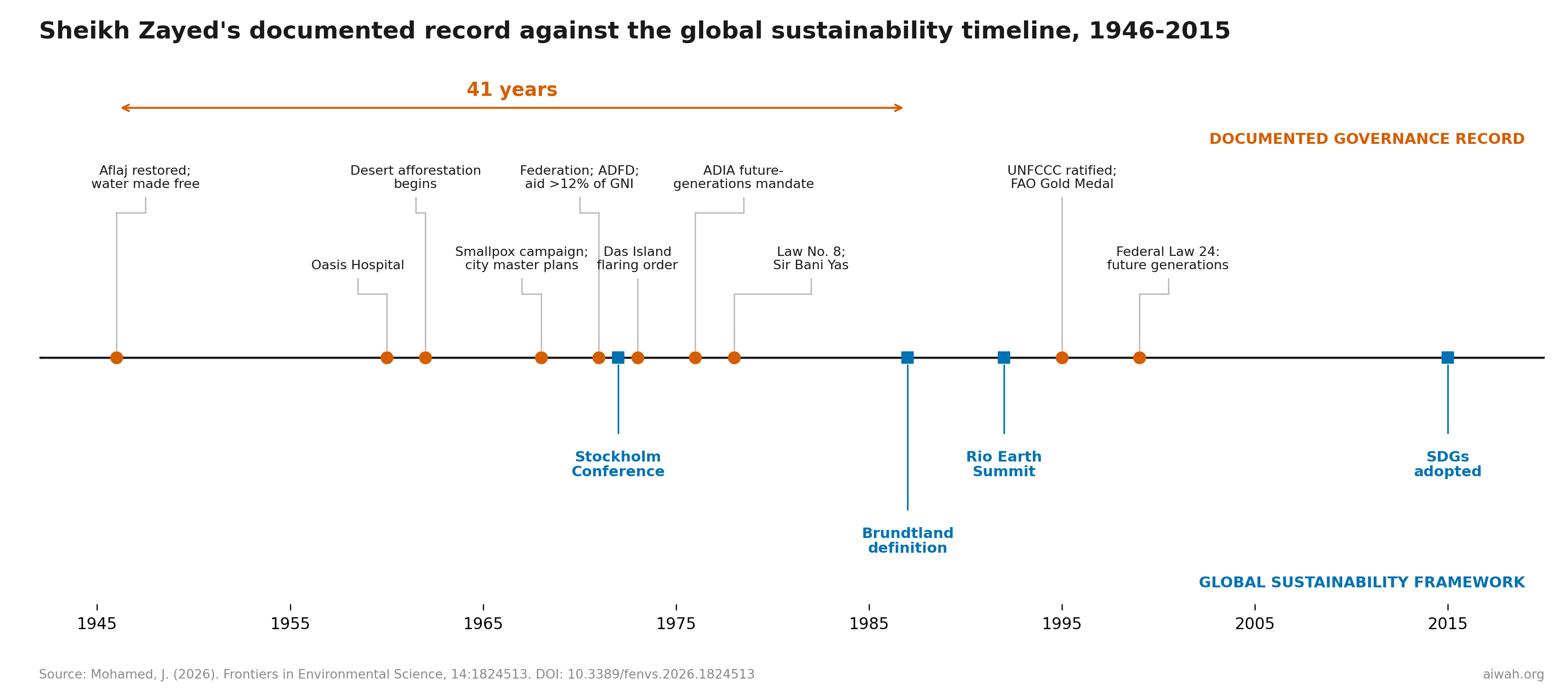
Geneva, Geneve Jul 23, 2026 (Issuewire.com) - Forty-one years before the Brundtland Commission gave sustainable development its defining formulation, Sheikh Zayed bin Sultan Al Nahyan ordered the restoration of the ancestral aflaj irrigation systems in Al Ain and declared their water free for every resident. That 1946 decision, 69 years before the United Nations adopted the Goals, is the starting point of a new peer-reviewed study examining nearly six decades of governance through the lens of today's 17 United Nations Sustainable Development Goals.
THE BASELINE OF GLOBAL SUSTAINABILITY HISTORY
For the institutions that steward Sheikh Zayed's legacy, one gap has persisted for decades. The record lives in national memory, in Arabic sources, in the trees and the oryx and the law books. But the international scholarly literature, the literature the world's universities teach from, begins its sustainability story at Stockholm in 1972 and Brundtland in 1987. The founder's record was heritage. It was not yet evidence. As of this month, it is evidence.
Published in Frontiers in Environmental Science, a Web of Science-indexed journal with a 4.4 impact factor, the study, "Pre-Framework Sustainability Governance: A Retrospective SDG Mapping of Sheikh Zayed bin Sultan Al Nahyan's Governance Record, 1946-2004" (DOI: 10.3389/fenvs.2026.1824513), is the first systematic mapping of a head of state's complete governance record against the SDG framework. It documents 31 actions across 58 years, drawn from primary legal instruments, treaty records, and United Nations system documentation, and applies four published criteria, precedence, scale, persistence, and living legacy, to an illustrative group of pre-1987 heads of state: Indira Gandhi, Julius Nyerere, Lee Kuan Yew, Thomas Sankara, and Bhutan's King Jigme Singye Wangchuck. Within that comparator set, Sheikh Zayed's record is the only one documented to span all 17 Goals, and its 1946 starting point is the earliest.
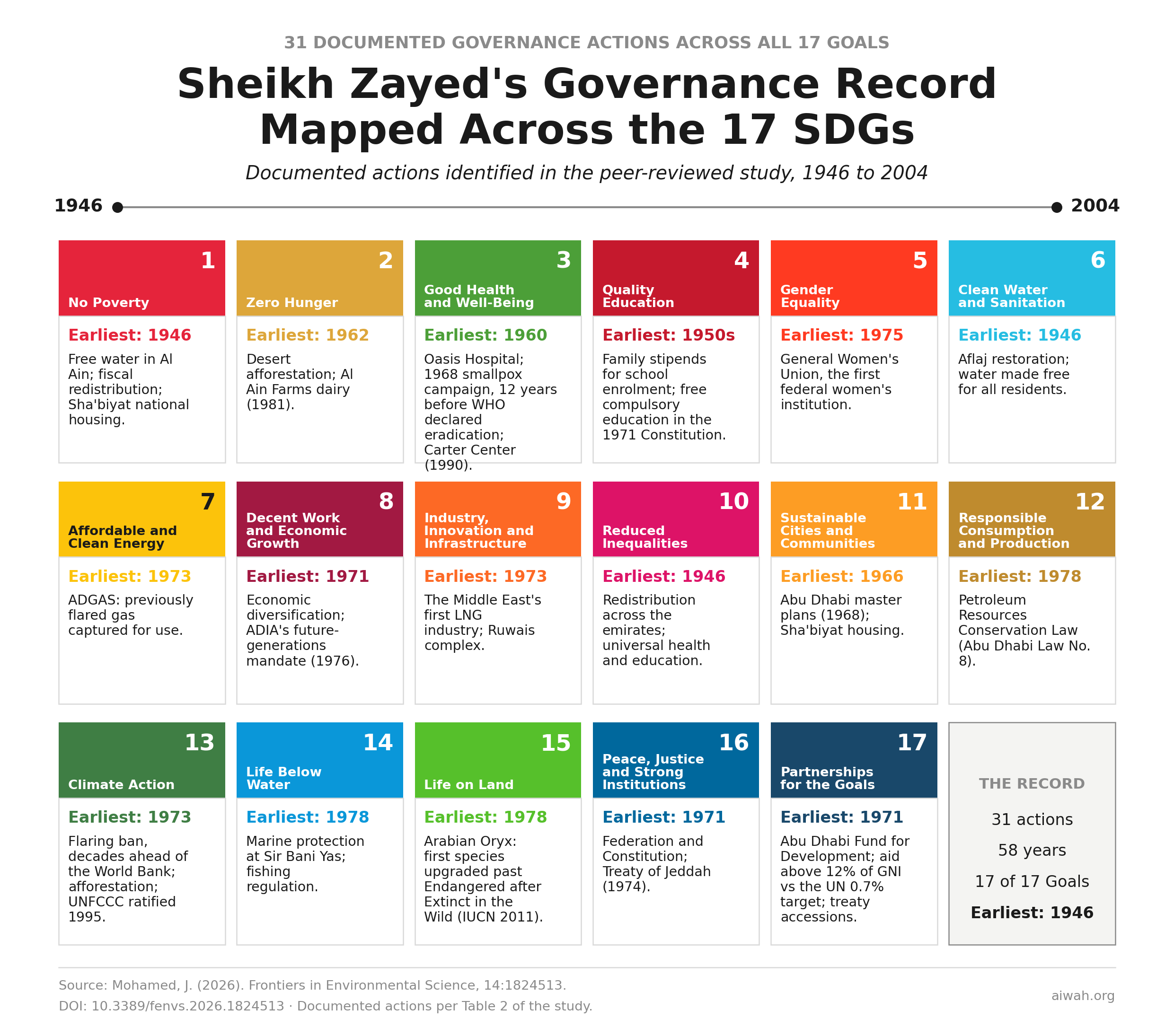
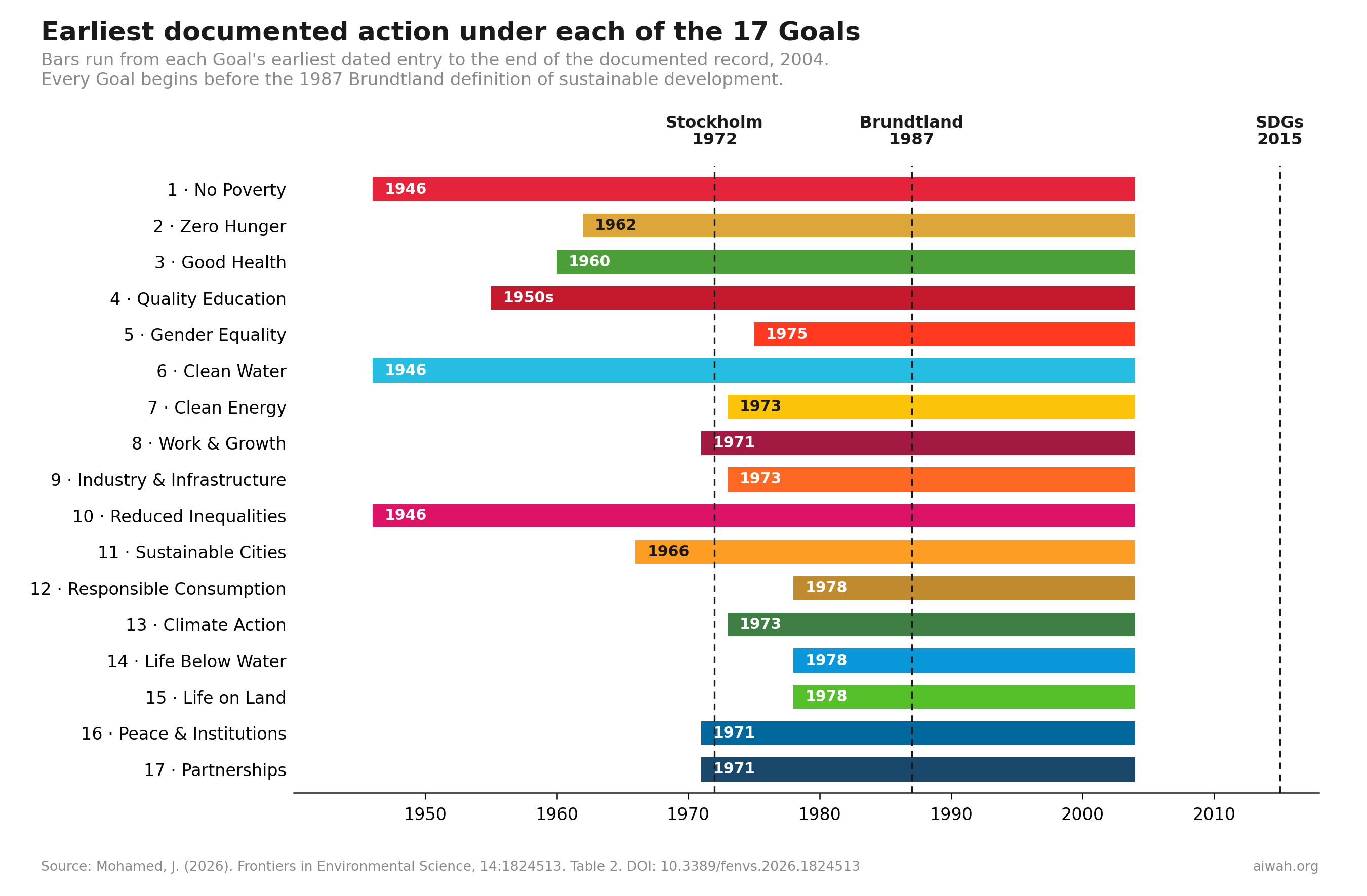
The record moves through all 17 Goals, decade by decade. It opens in 1946 with water and poverty: the aflaj restored, water made free, wealth redistributed. The 1950s and 1960s bring family stipends for schooling, the Emirate's first modern hospital in 1960, desert afforestation from 1962, the city master plans of 1968, a national housing programme, and the 1968 mass smallpox vaccination campaign, twelve years before the World Health Organization declared global eradication. The 1970s turn practice into law and institutions: the 1971 federation with constitutional guarantees of free education and equality, the Treaty of Jeddah with Saudi Arabia, the first federal women's institution in 1975, the Abu Dhabi Investment Authority's future-generations mandate in 1976, development assistance above 12 per cent of national income against a United Nations target of 0.7, the Das Island flaring ban codified in Abu Dhabi Law No. 8 of 1978, decades ahead of the World Bank's Zero Routine Flaring initiative, the Middle East's first LNG industry, and marine protection at Sir Bani Yas. The later decades add the Emirates Red Crescent, the Carter Center disease-eradication partnership, ratification of the climate and biodiversity conventions, and Federal Law No. 24 of 1999, written for present and future generations. And the captive-breeding programme begun on Sir Bani Yas led the IUCN in 2011 to make the Arabian Oryx the first species upgraded past Endangered after being Extinct in the Wild.
DOCUMENTED ACTION ACROSS ALL 17 GOALS
Goal 1 · No Poverty (1946): Free water access in Al Ain, structured fiscal redistribution, and Sha'biyat national housing.
Goal 2 · Zero Hunger (1962): Large-scale desert afforestation, followed by the founding of Al Ain Farms dairy in 1981.
Goal 3 · Good Health (1960): The Oasis Hospital, and a 1968 mass smallpox campaign executed 12 years before the WHO declared global eradication.
Goal 4 · Quality Education (1950s): Family stipends for school enrolment, later codified as free compulsory education in the 1971 Constitution.
Goal 5 · Gender Equality (1975): The General Women's Union, the first federal women's institution.
Goal 6 · Clean Water and Sanitation (1946): Ancestral aflaj restoration, making clean water free for all residents.
Goal 7 · Affordable and Clean Energy (1973): ADGAS, capturing and utilising previously flared natural gas.
Goal 8 · Decent Work and Economic Growth (1971): Economic diversification, alongside ADIA's future-generations investment mandate in 1976.
Goal 9 · Industry, Innovation and Infrastructure (1973): The Ruwais complex and the Middle East's first LNG industry.
Goal 10 · Reduced Inequalities (1946): Resource redistribution across the emirates, with universal health and educational access.
Goal 11 · Sustainable Cities and Communities (1966): The early Abu Dhabi master plans (1968) and Sha'biyat housing.
Goal 12 · Responsible Consumption and Production (1978): Environmental standards codified in the Petroleum Resources Conservation Law.
Goal 13 · Climate Action (1973): A routine-flaring ban decades ahead of global initiatives, alongside rapid afforestation.
Goal 14 · Life Below Water (1978): Fishing regulation and marine protection at Sir Bani Yas.
Goal 15 · Life on Land (1978): The Arabian Oryx programme, the first species upgraded past Endangered after being Extinct in the Wild.
Goal 16 · Peace, Justice and Strong Institutions (1971): The Federation, the Constitution, and the 1974 Treaty of Jeddah.
Goal 17 · Partnerships for the Goals (1971): The Abu Dhabi Fund for Development, with aid above 12% of GNI against the UN's 0.7% target.
The record was recognised while it was being written: the Food and Agriculture Organization's Gold Medal in 1995; the WWF Gold Panda Award in 1997, the first conferred on a head of state; and the United Nations Environment Programme's Champions of the Earth award in 2005, in its inaugural year.
SCIENTIFIC RIGOUR AND DELIBERATE LIMITS
The study describes its mapping as retrospective and analytical. It does not claim that a leader governing in 1946 was intentionally pursuing targets adopted in 2015, and it openly addresses the apparent contradiction of sustainability leadership emerging from a petroleum-producing state, treating that tension as a legitimate question for further scholarship. It makes no causal claims, and its criteria are published for any nation's record to be tested; what it documents is a case in which development and environmental stewardship advanced together across six decades, a reference point for countries navigating rapid urban growth. The article underwent open peer review by scholars at the National Institute of Technology of Mexico and the Federal University of Minas Gerais in Brazil; its methodology, limitations, evidence register, and editorial history are publicly available. The research is independent scholarship: it was not commissioned by, and neither represents nor implies affiliation with, any government body, ruling family, or institution.
"We do not need to exaggerate this record for it to be extraordinary," said Jasim Mohamed, the study's author and founder of AIWAH. "Stockholm was 1972. Brundtland was 1987. The Sustainable Development Goals were 2015. The documented record examined in this study begins in 1946. History honoured the environmentalist; the record documents a statesman of sustainability. On the documented evidence, Sheikh Zayed may be the strongest candidate for the title of 'Father of Sustainability'."
WHY THE FINDING MATTERS NOW
The publication arrives days after the United Arab Emirates presented its third Voluntary National Review at the 2026 United Nations High-Level Political Forum in New York. According to The Sustainable Development Goals Report 2026, only 36 per cent of assessable targets are on track or making moderate progress, and 15 per cent have regressed below their 2015 baselines, a trajectory the Secretary-General has described as a development emergency. The study also arrives in the UAE's Year of the Family, weeks before 6 August 2026, the diamond anniversary, sixty years to the day, of Sheikh Zayed's accession as Ruler of Abu Dhabi.
"Sustainability entered Arab identity decades before any framework existed, and identity is why it endured," Mohamed said. "That is what this record offers 480 million Arabic speakers: sustainability not as an imported vocabulary but as part of the region's own story. Campaigns die; culture multiplies. From the new academic year, the record begins its journey to Arabic-speaking classrooms as inheritance rather than instruction. The record now belongs to scholarship; its custodians are warmly invited to shape the journey."
FROM ACADEMIC EVIDENCE TO CULTURAL INHERITANCE
AIWAH operates under nonprofit mandates to advance sustainability and SDG education through cultural, community-led initiatives. Its work in the UAE is rooted in a clear belief: sustainability was foundational to Sheikh Zayed's leadership, and it remains the compass of the nation's direction today. In a society of more than 200 nationalities, that inheritance becomes an unparalleled platform for translating sovereign values into bottom-up engagement with global priorities.
Building on the study, AIWAH is expanding Sustainability as Culture, a long-term programme combining continued peer-reviewed research, sustainability-education workshops, and cultural initiatives that move documented sustainability history beyond academic publication and into education, language, memory, and public participation:
- Academic Arabic Edition: On 6 August 2026, AIWAH will dedicate the certified academic Arabic edition of the research for wider regional access.
- Cultural Work: AIWAH's Dunya Mahla initiative, "How beautiful is the world", set an environmental poem by Sheikh Zayed, in the Nabati tradition whose Emirati chanted form, Al-Taghrooda, UNESCO inscribed as Intangible Cultural Heritage in 2012, to an original composition written for multinational singability and inclusive performance, matched to World Environment Day 2026, whose official theme, "Inspired by Nature", echoes the poem's own premise almost word for word.
- Youth Participation: Schools across Dubai mobilised their students for the pilot. Participating schools included The Winchester School Jebel Ali, GEMS Legacy School, GEMS World Academy Dubai, Al Diyafah High School, The Millennium School Dubai, GEMS Modern Academy, and American International School Dubai, together serving some 30,000 students. Student submissions spanned nationalities from India, Pakistan, and the Philippines to the United States and South Korea: the multinational chorus the composition was written for. UNEP's World Environment Day team in Geneva formally recognised the initiative's alignment with the #NowForClimate campaign, calling it "highly impressive".
- Formative-Years Education: To carry sustainability into the years when identity forms, AIWAH is developing a fully illustrated Arabic-English children's series spanning all 17 Goals under the AIWAH Books imprint, with its first public milestone planned for World Children's Day.
AIWAH has delivered the study and its supporting evidence register to the national institutions responsible for safeguarding Sheikh Zayed's historical record, including the Zayed National Museum, the Founder's Office, and the National Library and Archives.
AN INVITATION TO PARTNERS
"A paper can establish the evidence, but partnership determines whether that evidence reaches a generation," Mohamed said. AIWAH welcomes dialogue with museums, archives, universities, educators, cultural institutions, philanthropic partners, publishers, and responsible businesses seeking to advance the scholarship, educational access, and cultural transmission of this record. "Our purpose is not to retrofit intention. It is to ensure that the Arab world's documented contribution is present in the history the world researches, teaches, and remembers."
ABOUT THE AUTHOR
Jasim Mohamed is the founder of AIWAH and sole author of the study. In 2012, he was selected by His Highness Sheikh Mohammed bin Rashid Al Maktoum as an Expo Ambassador for the country's campaign to host Expo 2020 Dubai, then led by Her Excellency Reem Al Hashimy as Managing Director of the Bid Committee. He holds Duke University's Fuqua School certification in Impact Measurement and Management for the SDGs. His cultural work includes the plenary cultural activation at the World Economic Forum's Global Future Councils Annual Meeting 2023 in Dubai, and the re-orchestration of the UAE National Anthem for the Expo 2020 Opening Ceremony.
ABOUT AIWAH
AIWAH is an independent cultural sustainability institution dedicated to documenting and translating historical governance knowledge into contemporary scholarship, education, and cultural participation. Its work is organised across three functions: create, distribute, prove. Its research arm, the AIWAH Sustainability Institute, operates through Fondation AIWAH Genève in Switzerland (UID CHE-483.489.764), AIWAH Foundation Inc. in New York, a 501(c)(3) public charity with Candid Platinum Transparency, and AIWAH Media LLC in Delaware. AIWAH Foundation Inc. is registered in the UN DESA Civil Society database and participates as an observer entity at the United Nations Committee of Experts on Global Geospatial Information Management (UN-GGIM), under ECOSOC. AIWAH contributes formal stakeholder inputs to United Nations processes including Beyond GDP and the Global Sustainable Development Report 2027. Programme outcomes are measured through the Aiwah Index, AIWAH's proprietary nine-dimension behavioural instrument, registered on OSF (osf.io/hzv9x) and protected under Swiss trademark No. 845528. AIWAH's Honorary Strategic Advisor is Alexandre Caldas, former Director at the United Nations Environment Programme and Chair of the United Nations Geospatial Network from 2019 to 2025.
The study is available open access at: https://doi.org/10.3389/fenvs.2026.1824513
Media Contact
AIWAH Foundation hello@aiwah.org +19298226629 228 Park Ave S https://aiwah.org




