Foshan, Guangdong Jul 29, 2026 (Issuewire.com) - Managing thermal loads in modern data centers requires balancing increased cooling demand against strict facility space constraints. Data center operators face the urgent task of upgrading thermal infrastructure to handle these extreme thermal profiles without incurring massive operational downtime. Integrating high-density cooling into existing white spaces requires balancing increased cooling capacity against physical facility limits. In this environment, choosing a premium data center rear door cooling solution provider like EXTRCOOL offers a clear route forward. Rear door heat exchangers present a direct answer to this tension by capturing thermal energy right at the rack exhaust, keeping high-density equipment cool without disrupting the surrounding facility.
The Cooling Dilemma in Modern Hyperscale Facilities
Operating a hyperscale facility means walking a tightrope between expanding compute capability and managing physical space. Legacy air-cooling arrangements often hit a hard limit when rack power densities climb above traditional thresholds. Standard containment setups or row-based fan units can struggle to manage local hot spots, which leads to thermal throttling and higher fan energy usage.
Replacing an entire cooling infrastructure, however, carries major operational risks. Halting server operations for structural overhauls creates unacceptable downtime windows and demands large capital outlay. Facility managers need targeted retrofits that address extreme heat at its source while preserving existing room architectures. Rear door heat exchanger technology bridges this gap by attaching directly to standard server racks. It absorbs heat before warm air enters the hot aisle, allowing operators to increase power density cabinet by cabinet without altering main room airflow.
Core Components and Working Logic of Rear Door Systems
The EXTRCOOL rear door system operates as a closed-loop thermal transfer mechanism designed to isolate and eliminate rack-level heat. The primary architecture pairs a rear door heat exchanger directly with a dedicated fluid chiller module, creating a self-contained cooling loop that operates independently of the broader facility air. This arrangement integrates four primary elements:
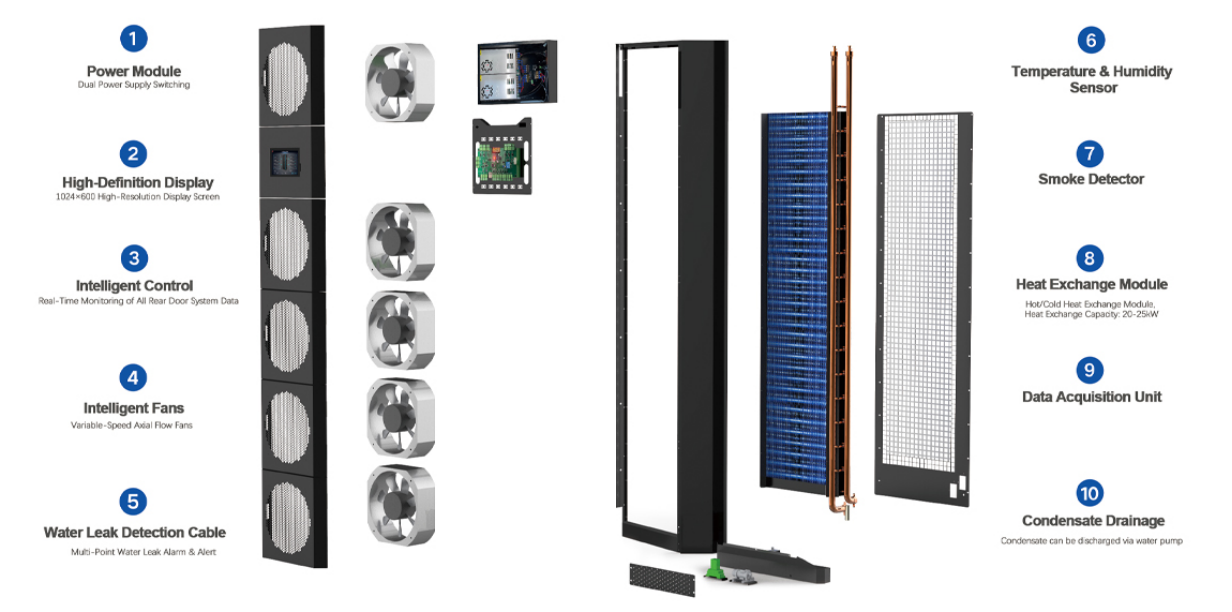
- Rear door heat exchanger unit: Replaces the standard rear rack door, featuring internal fans and high-efficiency copper coils that draw hot exhaust air across the fluid circuit.
- Coolant buffer tank: Maintains consistent fluid volume, dampens thermal spikes, and balances pressure throughout the rack circuit.
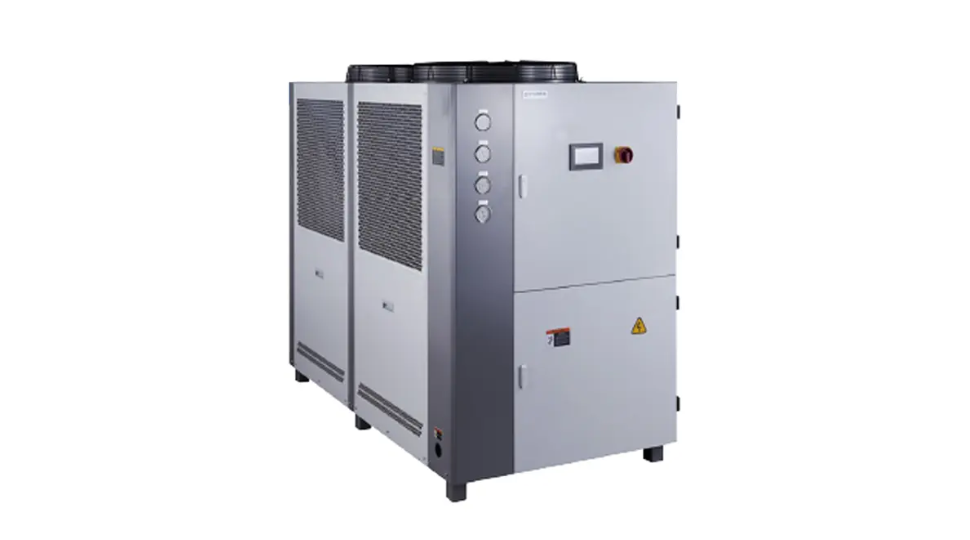
- Dedicated chiller module: Regulates the secondary fluid loop temperature, delivering precise supply water temperatures to the door coils.
- Dry cooler: Sits outdoors to reject heat into the ambient air, utilizing economizer modes during cooler outdoor weather to save energy.
When servers generate heat, internal rack fans push the warm air through the rear door coil. Cold fluid flowing through the coil absorbs this thermal energy, turning hot exhaust into neutral room-temperature air before it enters the aisle. The warm fluid travels to the dedicated chiller unit, transfers its heat load, and loops back to the rack. By handling heat directly at the server outlet, the system keeps the surrounding hall at a steady temperature and prevents hot air from recirculating.
Retrofit Integration and Scalable Deployment
Upgrading a live data center requires minimal disruption to ongoing server workloads. Because Extrcool Industry Limited designs its rear door heat exchangers to match standard frame dimensions, the units mount onto existing 19-inch cabinet configurations without structural modification or major floor layout adjustments.
This physical compatibility allows for a phased, step-by-step rollout. Operators can install rear door units on high-density racks first while leaving low-density cabinets on standard air cooling. As server hardware refreshes, facility teams can expand the liquid loop row by row or zone by zone. As a reliable rear door cooling solution provider, EXTRCOOL supplies independent fluid circuits and modular chilled-water connections that allow teams to perform hot-swappable maintenance on individual racks without shutting down neighboring servers. This step-by-step path lowers initial capital risk, avoids long maintenance windows, and aligns cooling expenditure directly with actual compute growth.
Proven Energy Efficiency and Operational Reliability
Controlling operational expenses relies on reducing mechanical cooling overhead. Traditional air-cooled facilities often record Power Usage Effectiveness (PUE) ratings around 1.58 due to heavy fan usage and chillers working against mixed return air temperatures. Implementing rear door heat exchanger systems delivers a direct reduction in mechanical power draw, lowering facility PUE down to roughly 1.26 in retrofit scenarios. When paired with full-scale liquid infrastructure like Cooling Distribution Units (CDUs) and secondary manifold loops, facility PUE can drop below 1.05.
System reliability depends on coil construction and fluid control. Extrcool Industry Limited builds its coils with anti-corrosion treatments and leak-tested copper piping to handle continuous high-load operations. The closed-loop chiller configuration decouples the rack loop from the primary facility water, protecting sensitive IT equipment from pressure surges or water quality issues. Redundant fan arrays inside the rear door ensure continuous airflow even if a fan module needs replacing, maintaining steady thermal performance across variable compute loads.
Strategic Decision Checklist for Facility Operators
Selecting and deploying a rear door liquid cooling setup involves evaluating clear engineering criteria. Operators can follow a straightforward three-step decision framework to ensure proper system sizing and smooth integration:
- Verify physical and structural compatibility: Check existing rack door dimensions, hinge attachments, and rear clearance depths. Ensure floor loading capacity supports added piping runs and fluid weight.
- Calculate heat load and match chiller capacity: Determine peak kilowatt output per cabinet. Match these values against the door coil heat transfer rate and the capacity of the dedicated chiller module to maintain sufficient thermal headroom.
- Draft a phased deployment plan: Target high-heat server clusters for the initial installation phase. Establish clear fluid routing pathways, install manifold branch lines, and schedule rack-by-rack hookups during regular maintenance windows.
Through this structured approach, facility teams can scale their thermal management systems alongside growing computational demands. For detailed technical specifications or custom project design support, operators can review full system options directly through EXTRCOOL.
Company Profile & Contact
Extrcool Industry Limited is a high-tech innovative enterprise focused on the research, development, and production of advanced liquid cooling devices, including air-to-liquid CDUs, liquid-to-liquid CDUs, rear door heat exchangers, manifolds, and secondary piping systems. With installations across more than 100 countries and over 10GW of total project capacity, EXTRCOOL delivers thermal management solutions for AI cloud data centers, communication networks, energy storage systems, and commercial refrigeration fields.
To explore custom technical specifications or request a tailored thermal design for the facility, connect with our engineering team through the official website: https://www.extrcool.com/
Media Contact
Extrcool Industry Limited info@extrcool.com +86 13612558238 https://www.extrcool.com/