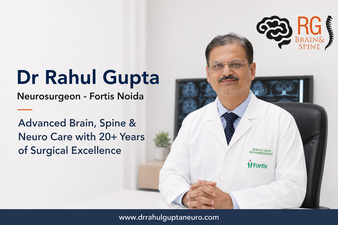
Noida, Uttar Pradesh Sep 18, 2026 (Issuewire.com) - At Fortis Hospital's neurosurgery department, patient files stack up differently than most. Some involve routine disc herniations. Others are brain tumors wrapped around blood vessels, or trauma cases arriving straight from an ICU transfer. Dr. Rahul Gupta, who heads the department as Senior Director, has spent the better part of 20 years working through that entire spectrum, and the number now attached to his surgical record — more than 11,000 procedures — reflects a practice built as much on volume as on range.
Gupta's clinical interests read like a checklist of the field's more technically demanding subspecialties: minimally invasive brain and spine surgery, endoscopic approaches to skull base tumors, endovascular neurosurgery for vascular conditions in the brain, and the surgical management of complex tumors that sit close to critical structures. He also takes on pediatric neurosurgery cases and manages trauma to the brain and spine, work that often leaves little room for delay or second opinions.
His training traces back to Government Medical College in Rohtak, followed by a stint at PGIMER Chandigarh — one of North India's more competitive postgraduate medical institutes. That combination shows up in how he approaches cases at Fortis Noida now: fewer open procedures where a minimally invasive route will do, and a stated preference for techniques that shorten hospital stays without compromising outcomes.
Neurosurgery, unlike some other surgical specialties, doesn't always offer a second attempt. A missed diagnosis or a delayed decision in a brain tumor case, or a spinal trauma patient losing function while doctors debate imaging, can change outcomes permanently. That reality shapes how departments like the one Gupta runs at Fortis are structured — imaging, anesthesia, ICU support, and surgical teams need to move in sync, particularly for endovascular cases where timing before a rupture or before permanent neurological damage sets in.
For patients researching a Best Neurosurgeon in Noida, the decision often comes down to understanding a surgeon's training, areas of expertise, surgical experience, and the type of neurosurgical care available at the hospital. These factors can be particularly relevant when a case involves a complex brain tumor, spinal condition, vascular problem, or traumatic injury.
Families dealing with a new brain tumor diagnosis, or patients referred in after a spinal injury elsewhere in Delhi NCR, make up a large share of who ends up at his OPD — Room 2118, in the OPD Block at Fortis Noida. The hospital's positioning in the NCR region means it draws referrals not just from Noida and Greater Noida but from parts of Delhi and western Uttar Pradesh as well, where access to a dedicated neurosurgery department with endovascular capability isn't always local.
Gupta's case log — pediatric cases, trauma, tumors, vascular work — doesn't fit neatly into a single specialty description, which is fairly typical for neurosurgeons running a department at a large multispecialty hospital rather than working a narrow referral practice. It's also, by most accounts in the field, part of why hospitals like Fortis staff department heads with that breadth of exposure in the first place.
About Dr. Rahul Gupta
Dr. Rahul Gupta serves as the Senior Director and Head of Neurosurgery at Fortis Hospital, Noida. With over two decades of experience, he has carried out more than 11,000 neurosurgical procedures. His areas of expertise include minimally invasive brain and spine surgery, endoscopic skull base procedures, endovascular neurosurgery, complex brain tumor and neurovascular surgery, and pediatric neurosurgery. He completed his medical training at Government Medical College, Rohtak, and PGIMER, Chandigarh.
Media Contact
Dr Rahul Gupta Neurosurgeon - Fortis Noida drrahulgupta.inin@gmail.com 09971700389 Department of Neuro Surgery, Room No. 2118, OPD Block, Fortis Hospital, Noida - 201301 - Uttar Pradesh - INDIA https://drrahulguptaneuro.com