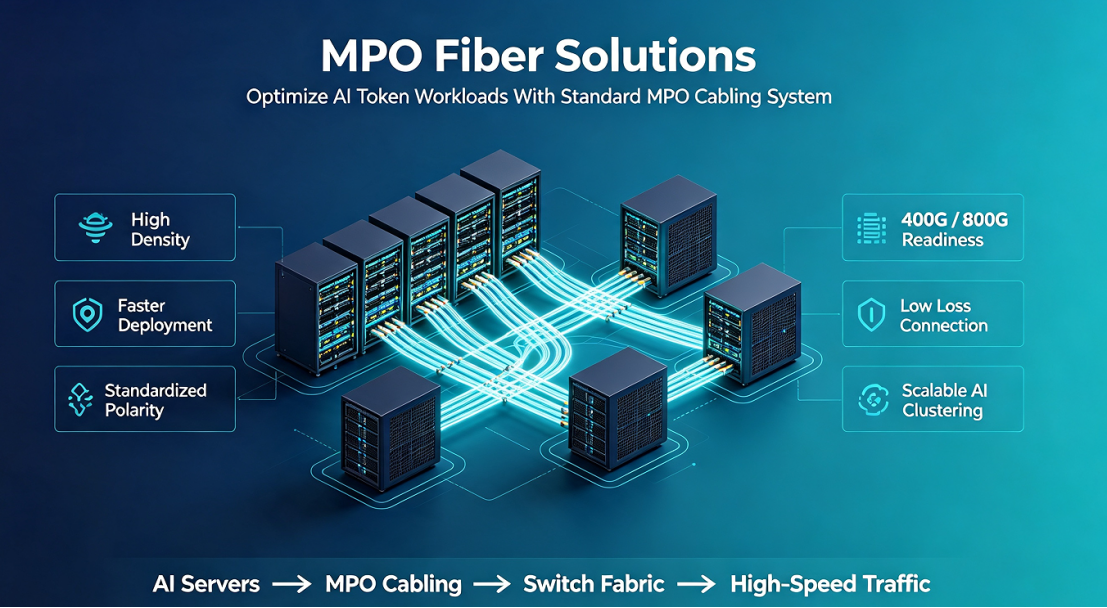
Shenzhen, Guangdong Aug 2, 2026 (Issuewire.com) - The rapid rise of large language models and distributed machine learning clusters has dramatically shifted the requirements of modern data center infrastructure. In AI token workloads, processing speed and training throughput depend heavily on real-time data synchronization across thousands of GPUs and high-performance computing nodes. When interconnect bandwidth fails to keep pace with compute capability, signal attenuation, cable congestion, and optical loss lead to severe latency spikes, causing GPU clusters to stall during token generation cycles. Overcoming these bottleneck challenges requires structured high-density optical cabling capable of sustaining high-speed, parallel data delivery. Working with a specialized Custom MPO Cable Factory from China enables infrastructure engineers to deploy tailored MPO Fiber Solutions built for ultra-low insertion loss and high mechanical durability. Standardized MPO cable assemblies—available in 8-fiber, 12-fiber, and 24-fiber configurations—provide the high-density backbone needed to eliminate connectivity friction, streamline cable management, and deliver uniform performance across high-throughput optical links.
Understanding the Bottlenecks in AI Token Workload Processing
AI token workloads operate on massively parallel architectures where nodes constantly exchange intermediate parameters and tensor operations across the fabric. Unlike traditional cloud traffic, which follows predictable north-south patterns, AI clusters generate intensive east-west data bursts. Traditional duplex optical cabling creates physical clutter, increases airflow resistance in high-density racks, and introduces cumulative insertion loss across multiple connection points.
When high insertion loss impairs signal integrity, high-speed optical transceivers experience bit error rate spikes, triggering re-transmissions that directly disrupt token throughput. MPO (Multi-Fiber Push-On) cabling systems address these structural limitations by consolidating multiple optical fibers into a single compact connector interface. By establishing structured parallel optical links between high-density switches, patch panels, and optical transceivers, standard MPO systems preserve optical margin, improve thermal management within racks, and maintain low latency across compute fabrics.
Architectural Principles of Standard MPO Cabling Systems in AI Networks
Optimizing AI workloads through standardized MPO cabling relies on precise optical link design, controlled polarity management, and rigorous physical layer end-face geometry.
Parallel Optical Transmission and High-Density Rack Layouts
High-speed optical transceivers—such as 400G QSFP-DD, 800G OSFP, and 1.6T OSFP-XD modules—rely on multi-channel parallel optics to achieve high aggregate throughput. Standard MPO trunk cables aggregate these parallel channels into structured multi-fiber runs. Replacing hundreds of individual duplex patch cords with high-density MPO trunk lines simplifies cable routing, minimizes physical footprint inside cable trays, and prevents thermal blockages in GPU server cabinets.
Low-Loss Ferrules and Signal Integrity Preservation
In ultra-high-speed optics, every fraction of a decibel matters. Standard MPO cabling systems utilize precision-molded ceramic ferrules, tight-tolerance alignment pins, and optimized end-face polishing (UPC or APC) to minimize optical insertion loss and back reflection. Lower attenuation across the passive physical channel ensures stable optical eye diagrams and maximizes link distance without compromising signal clarity.
Modular Breakout Architecture for Scalable Fabrics
Connecting high-density switch ports directly to server transceivers often requires transitioning multi-fiber interfaces into individual duplex connections. MPO breakout cables bridge this gap by converting multi-fiber trunk lines into discrete LC connectors. This modular topology allows network administrators to adapt backplane cabling as server density increases, providing a flexible framework for seamless infrastructure upgrades.
Practical Product Implementations for AI Data Center Infrastructure
To maintain link stability under continuous heavy workloads, network deployments depend on high-precision optical assemblies engineered to rigorous tolerance standards.
MPO Female to MPO Female Multimode Trunk Cable
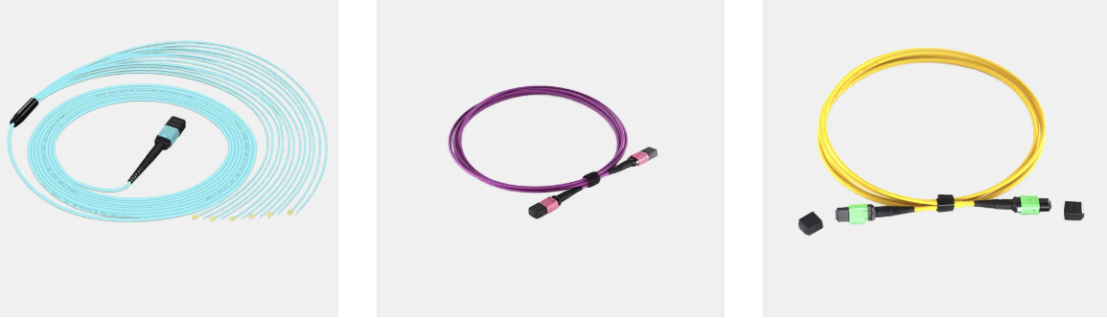
High-speed trunking across switch-to-switch interconnections requires uniform multi-fiber connectivity. The MPO Female to MPO Female 12-Fibers OM4/OM3 Multimode Trunk Cable delivers low-loss trunking designed for 40G, 100G, and 400G backbones. Engineered with high-bandwidth OM3/OM4 laser-optimized multimode fiber, this cable minimizes modal dispersion over short-to-medium reach data center runs. Its precision-molded female ferrules ensure precise pin alignment when mating with male switch modules, while its flame-retardant outer jacket ensures mechanical durability in high-density cable trays.
MPO to LC Breakout Cables for Direct Node Interconnects
When interfacing multi-fiber transceivers with legacy duplex equipment or high-density patch panels, breakout cables provide clean cable routing. The MPO Female to 6LC UPC OM3 Breakout Cable splits a multi-fiber MPO connection into six distinct LC duplex channels. Featuring ultra-polished UPC LC connectors and factory-tested fan-out legs, this cable configuration ensures consistent insertion loss across all channels, reducing cable clutter at the rack level and facilitating structured cable distribution inside AI compute rows.
Engineering Excellence and Technical Precision in Fiber Manufacturing
The operational reliability of MPO fiber assemblies in high-stress AI computing environments depends directly on manufacturing precision, material quality, and stringent quality control standards.
Precision Assembly and Polishing Integrity
Every optical connection point represents a potential source of signal reflection and insertion loss. High-quality MPO production utilizes automated polishing machinery and continuous 3D interferometric inspection to verify end-face geometry, including fiber height, radius of curvature, and apex offset. Precision pin alignment prevents fiber-to-fiber displacement, ensuring low-loss optical coupling even across thousands of mating cycles.
Flame-Retardant and Low-Smoke Construction
High-density AI server cabinets generate elevated operating temperatures. Standard MPO cables utilize Low Smoke Zero Halogen (LSZH) or Plenum-rated jacket materials that resist thermal degradation and limit toxic gas emissions in the event of fire, meeting stringent international safety requirements for critical enterprise data centers.
Comprehensive Factory Testing and Quality Assurance
Reliable optical networks demand zero-defect components. Advanced manufacturing protocols involve 100% optical testing for insertion loss and return loss, complemented by visual end-face inspection under high-magnification digital microscopes to eliminate microscopic contaminants prior to deployment.
Strategic Capabilities of HTF in Optical Infrastructure
Delivering robust connectivity for data-intensive applications requires both specialized manufacturing capabilities and systemic optical engineering expertise. As a leading vendor in optical communication solutions, HTF provides complete hardware platforms and customized cabling solutions tailored for modern data centers, telecommunications networks, and enterprise cloud facilities.
Founded by a team with over a decade of experience in optical communication product research, development, and manufacturing, HTF specializes in an extensive range of WDM systematic solutions and optical communication equipment. The company’s core portfolio encompasses DWDM and CWDM transmission systems, DCI-BOX platforms, Optical Line Protection (OLP), Erbium-Doped Fiber Amplifiers (EDFA), Semiconductor Optical Amplifiers (SOA), Dispersion Compensation Modules (DCM), OTDR monitoring equipment, and WSS devices. To meet the demands of AI networks, HTF also supplies high-speed transceivers—including 800G/400G QSFP-DD, OSFP, and 100G QSFP28 modules—alongside custom-engineered MPO fiber assemblies.
Operating under certified ISO9001 quality management standards with products compliant with CE, FCC, and RoHS certifications, HTF serves telecom operators, internet service providers, power utilities, education networks, broadcasting systems, and cloud service providers across more than 140 countries. Through flexible customization models and an advanced R&D center, HTF delivers tailored optical infrastructure designed to maintain operational stability across high-throughput data processing environments.
Conclusion and Strategic Infrastructure Planning
As AI token workloads scale, building a resilient physical layer becomes essential for maximizing GPU utilization and maintaining low-latency data flow. Standard MPO cabling systems provide the high density, low insertion loss, and structural flexibility required to support parallel optical architectures without bandwidth bottlenecks. By integrating high-precision MPO trunk lines, breakout assemblies, and high-speed transceivers, enterprise data centers can secure long-term scalability and operational efficiency.
To learn more about custom MPO cabling options and high-density optical network solutions, visit the official HTF platform at https://htfuture.com/.
Media Contact
Shenzhen HTFuture Co., Ltd. otn@htfuture.com