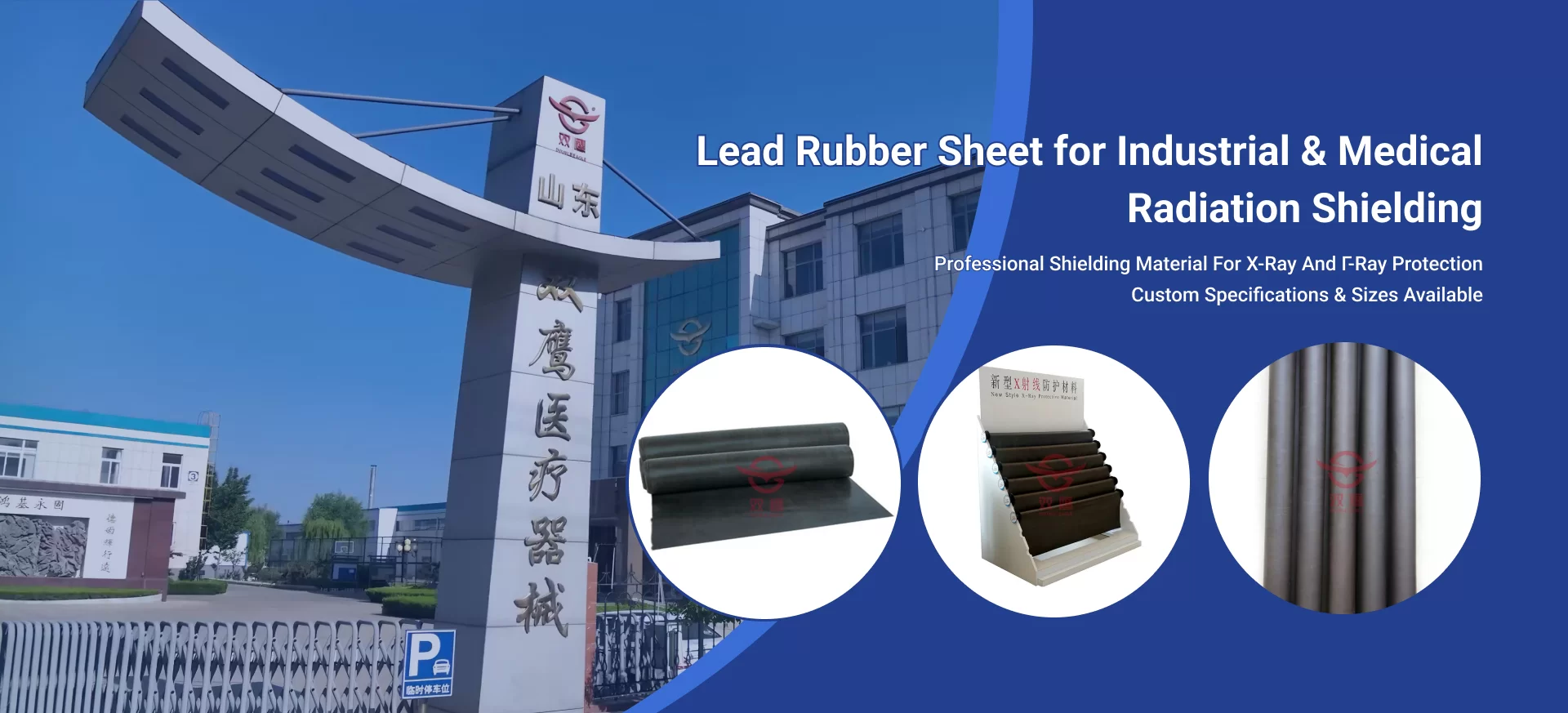
Longkou, Shandong Jun 14, 2026 (Issuewire.com) - Modern medical diagnostic environments rely heavily on advanced imaging technologies such as Computed Tomography (CT) scans, high-frequency digital radiography, and dental X-rays to ensure precise clinical assessments. While these technological innovations enable healthcare professionals to identify illnesses with exceptional accuracy, they simultaneously introduce the critical challenge of managing secondary ionizing radiation. In busy hospital settings, the necessity of establishing highly reliable shielding structures becomes paramount, not only to protect patients undergoing procedures but also to secure the long-term health of medical technicians and accompanying caregivers who remain in close proximity to radiation zones. To construct these defensive barriers, specialized healthcare facilities require materials engineered to rigorous attenuation standards. Selecting a China Leading Lead Rubber Sheet Factory provides institutions with access to high-grade foundational materials required for effective radiation containment. These specialized polymer matrices are embedded with high-purity lead particles, yielding a flexible, uniform fabric capable of attenuating industrial and medical X-ray and gamma-ray emissions while maintaining structural integrity over prolonged clinical use.
Deploying successful shielding systems across complex clinical environments demands an approach that spans far beyond standard material assembly. Healthcare procurement managers and facility engineers increasingly realize that raw production output represents only a fraction of what is required to secure a clinical space. A comprehensive architectural defense involves a detailed lifecycle containing four critical phases: design blueprints, precision manufacturing, targeted sales support, and rigorous post-purchase service. This integrated lifecycle approach ensures that shielding components conform perfectly to the unique layout configurations of modern diagnostics departments, ranging from dental operatories to high-capacity nuclear medicine wings.
Reason 1: Custom Architectural Blueprints Engineered for Specific Clinical Modalities
The first critical phase of a complete hospital shielding strategy resides in the initial design blueprint. Modern hospitals do not feature uniform radiation risks; a dental clinic operating localized panoramic X-rays requires completely different attenuation dynamics compared to a high-voltage multi-slice CT imaging room or a nuclear medicine department handling high-energy gamma emitters. A standard off-the-shelf shielding layout inevitably leads to either dangerous under-shielding or unnecessary, costly material over-engineering. An integrated manufacturer eliminates these systemic inefficiencies by offering custom engineering consultations before production begins.
Engineering teams collaborate directly with hospital architects and radiation safety officers to map precise attenuation requirements based on specific clinical modalities. Using advanced spatial mapping and exposure calculations, they determine the exact material dimensions and configurations necessary to secure the space. This ensures that every square meter of material installed is optimized for the exact kilovoltage peak and workload of the targeted medical equipment, laying a structurally sound foundation for the entire containment facility.
Reason 2: Advanced Polymer Synthesis and Precision Manufacturing Controls
Once the blueprint is finalized, the strategy transitions into the second phase: precision manufacturing. This stage highlights the core technical advantages of a leading producer, where advanced material science directly determines the safety of medical personnel. Raw lead sheet manufacturing often suffers from uneven material density, which can lead to microscopic radiation leaks under continuous exposure. Addressing this risk requires specialized manufacturing protocols that integrate raw lead into elastomeric compounds with absolute uniformity.
As an industry leader with over 45 years of specialized expertise in X-ray safety equipment, DOUBLE EAGLE has perfected the synthesis of protective polymers. Operating out of a modern 30,000-square-meter facility, the company utilizes advanced compounding and rolling technologies to create high-density flexible shielding materials. This specialized material is engineered for both industrial and medical X-ray and gamma-ray protection, acting as the critical protective barrier required across all modern healthcare facilities.
To meet diverse clinical requirements, the production lines maintain strict calibration standards to produce precise structural parameters. The material is manufactured in standardized thicknesses corresponding to verified protective values, including 0.25mmPb, 0.35mmPb, and 0.50mmPb lead equivalence. Dimensions are tightly controlled with standard options such as 1000mm x 600mm, 900mm x 600mm, and 850mm x 550mm, alongside fully customizable roll lengths and sheet widths tailored to unique project requirements. By employing automated multi-layer calendering processes, the internal distribution of lead particles remains entirely homogeneous, preventing any material variance or density degradation, thereby ensuring uncompromised, uniform attenuation across the entire surface of the sheet.
Reason 3: Strict Regulatory Compliance and Verified Certification Frameworks
The bridge between manufacturing excellence and global distribution represents a critical component of the sales phase. In the international medical device procurement landscape, safety claims must be validated by independent, recognized regulatory bodies. Hospital administrators and international distributors cannot rely on unverified compliance metrics when the health of clinical staff is on the line.
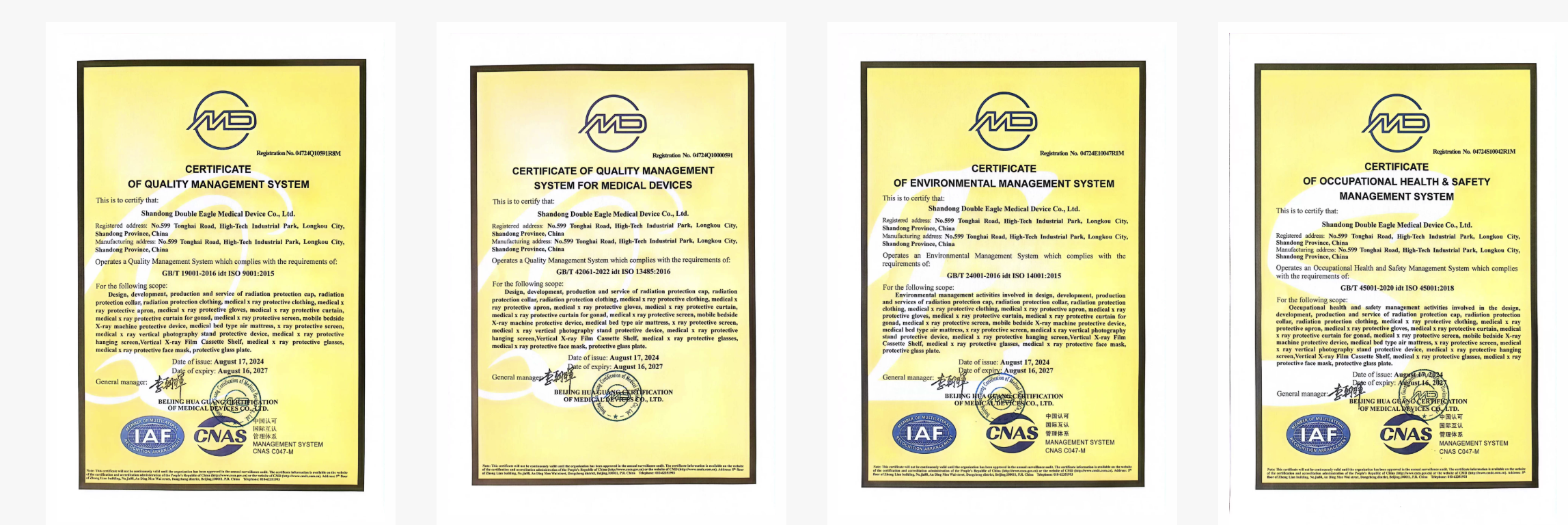
A premier factory differentiates itself by backing its product portfolio with comprehensive international certifications, ensuring smooth global distribution and seamless customs clearance. The manufacturing systems are fully audited and certified under ISO9001 and ISO13485 quality management systems, which are the definitive standards for medical device manufacturing. Furthermore, the entire radiation shielding product line carries the CE mark, proving compliance with European health, safety, and environmental protection legislation. These certifications provide objective, third-party validation that every batch of protective material leaving the factory floor adheres to the most stringent international safety thresholds, offering complete peace of mind to institutional buyers worldwide.
Reason 4: Tailored Procurement Solutions and Global Sales Integration
The sales phase involves more than simply processing orders; it requires building a reliable procurement framework that adapts to diverse regional logistics, varying language requirements, and distinct institutional budgets. A global leader must maintain an agile sales infrastructure that accommodates both large-scale hospital construction projects and boutique medical clinic upgrades.
This global accessibility is achieved through a multi-lingual sales network and robust OEM and ODM production capabilities. By supporting comprehensive custom-made requirements, international clients can request specific exterior backings, specialized dimensions, or distinct mounting configurations to match local installation practices. The factory integrates its manufacturing capacity with fast-response logistics, ensuring that high-volume orders are shipped securely and arrive on-site within tight hospital construction timelines. This minimizes project delays and ensures that critical safety infrastructure is deployed exactly when needed.
Reason 5: Full-Lifecycle Technical Support and Post-Purchase Service Reliability
The final phase of the medical shielding lifecycle is post-purchase service, a stage where traditional brokers and simple material processors typically fail to provide support. Shielding materials installed within hospital walls, doors, or diagnostic machinery are subjected to long-term environmental factors, structural shifting, and continuous operational wear. Without dedicated technical support, a facility cannot verify if its shielding assets remain fully effective over years of service.
Choosing a dedicated manufacturer guarantees long-term support throughout the operational lifetime of the material. Post-purchase programs include technical installation guidance, detailed maintenance protocols for flexible shielding materials, and robust warranties that guarantee material performance. If an institution reconfigures its imaging rooms or upgrades its radiology hardware, the factory provides engineering advice on how to adapt or supplement existing shielding barriers. This ongoing relationship ensures that the hospital's initial safety investment remains secure, protective, and compliant for decades to come.
Through this comprehensive commitment to design, manufacturing, certification, global integration, and long-term service, an institution transitions from merely acquiring a material to securing a complete, uncompromised radiation safety solution. This lifecycle execution is what elevates a premier facility to become the ultimate choice for modern medical shielding.
Corporate Website: https://www.doubleeaglexray.com
Media Contact
Shandong Double Eagle Medical Device Co., Ltd. sycw@sdshuangying.net