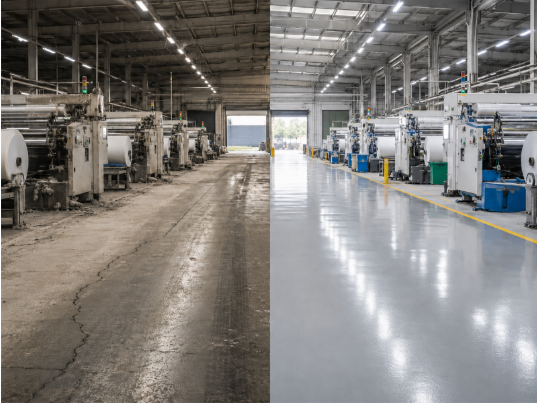

Bengaluru, Karnataka Jul 21, 2026 (Issuewire.com) - The owner did what most owners in his position do. He asked three contractors for a demolition and repour quote. All three numbers made him wince, not just for the concrete work, but for the four to six weeks of reduced production the job would need while machinery was relocated and a new slab cured. He started quietly warning his biggest customers to expect delays.
Nobody had told him there was another way to look at the problem. The floor wasn't broken. It was worn. And there's a real difference between the two, one that a growing number of engineers and facility managers are only now starting to take seriously.
A Bigger Pattern Than One Factory
That owner isn't unusual. Factories, warehouses, hospitals, schools, parking structures and retail buildings collectively account for an enormous, largely uncounted volume of concrete flooring torn out and repoured every year, often for reasons closer to habit than genuine necessity. Floor replacement is rarely just a materials cost. It pulls in demolition crews, waste haulage, new concrete supply, curing time, and a facility that can't run at full capacity while the work is underway.
Floors do wear out. That part isn't in dispute. The more useful question, and the one that gets skipped more often than it should, is whether the concrete underneath that wear is actually still sound.
Why the Wear Shows Up in the First Place
A lot of what looks like failure is really just surface deterioration. Concrete dusting, that fine grey powder that comes back within hours of sweeping, usually comes from a thin, weak surface layer that was under-cured or simply worn down by years of traffic. The concrete underneath is often fine. Chemical exposure, moisture migration and mechanical abrasion all work the same way, weakening the top few millimetres of a slab long before the structural concrete beneath it is in any real trouble.
Cracking gets the most attention, understandably, since it looks the most dramatic. Most of it is shrinkage-related and cosmetic. A smaller share does trace back to genuine structural causes, like poor subgrade compaction or settlement, and that's really the only category of damage that should be pushing anyone toward a full replacement.
The Cost Nobody Prices In Up Front
A demolition and repour project is rarely just one job. It's demolition, disposal, subgrade correction, a new pour, curing time, and finally whatever surface finish the space actually needs, each stage with its own cost and its own chance to run long. None of that shows up in a quick estimate based on square footage alone, which is usually where the surprise in the final invoice comes from.
Repair Instead of Replace
Engineers working across infrastructure and industrial construction have spent the last couple of decades shifting away from a default assumption that ageing concrete needs tearing out, toward what's sometimes called asset preservation. A structurally sound slab with a worn or lightly cracked surface can, in many cases, be ground back to remove the compromised layer, densified to harden what remains, repaired where genuine cracks exist, and finished with a surface built for the space's actual traffic and exposure. The structural concrete, the part that took the longest and cost the most to build, stays exactly where it is.
This restored surface can often outperform the original floor, not just match it, since the new finish can be engineered for today's actual demands rather than whatever specification the building happened to use decades ago.
Different buildings still need different things from that finish. A factory wants abrasion resistance and dust control under heavy traffic. A hospital needs a seamless, hygienic surface. A parking structure needs waterproofing and load capacity. There's no single answer, only a better match between the floor and how the building is actually used.
Why This Matters Beyond the Invoice
Skipping an unnecessary demolition avoids a genuinely large volume of waste concrete, along with the raw material and energy that would have gone into a new pour. None of that requires an environmental motive to make sense. The financial case for repair and the sustainability case tend to point the same direction, which is rare enough in construction decisions that it's worth noticing.
The factory owner from the start of this piece eventually learned his slab had years of sound life left in it, and that his dusting, cracked floor was a surface problem with a surface solution. He didn't need six weeks of lost production. He needed someone to ask a different question at the outset.
The strongest floor isn't always the newest one. Increasingly, it's the one that's been intelligently preserved, strengthened, and reimagined.
About Floorzy
Floorzy is a concrete floor transformation company focused on improving the performance, durability, aesthetics, and longevity of existing concrete floors. The company develops customized floor transformation systems for factories, warehouses, schools, hospitals, parking structures, commercial buildings, and industrial facilities, and publishes ongoing research through the Floorzy Concrete Knowledge Library.
Media Contact
Floorzy *****@gmail.com https://floorzy.in/