Xian, Shaanxi May 22, 2026 (Issuewire.com) - Amino acid fertilizers have moved from niche supplement to mainstream agronomic input over the past decade. Yet the category carries a persistent knowledge gap. Many buyers compare products by total amino acid percentage on the label, assuming higher numbers signal better performance. In practice, the relationship between label content and field results is far more nuanced — and understanding that gap is exactly what separates informed procurement from costly trial and error. Manufacturers who function as a China Best Amino Acid Fertilizer Supplier recognize this distinction and build their entire product logic around it, designing inputs that perform at the biological level rather than simply impressing on paper.
A Manufacturer's Perspective — How Citymax Group Approaches the Amino Acid Question
Citymax Group, established in Xi'an, China in 2012, has spent over a decade examining this question from both the laboratory and the field. The company's amino acid series spans plant-derived and animal-derived products — a deliberate dual-track strategy grounded in the recognition that different crops, different growth stages, and different agronomic goals call for different amino acid profiles.
That strategy draws on substantial infrastructure. The MAXBIO Synergistic R&D Platform, established in 2023, focuses specifically on how multiple biostimulant inputs — including amino acids — interact when combined, rather than testing ingredients in isolation. The Global Intelligent Bioassay R&D Center Database, completed in 2024, brings crop model simulation and multi-geography efficacy data into product development decisions. These are not marketing assets. They represent the technical foundation that determines whether a product formulation holds up under real growing conditions across diverse climates and crop systems. Citymax currently serves distributors and growers across more than 70 countries, supported by over 30 verified global partners and a full set of international certifications, including OMRI, ECOCERT, ISO 9001, and EU REACH.
Two Extraction Paths, Two Performance Outcomes
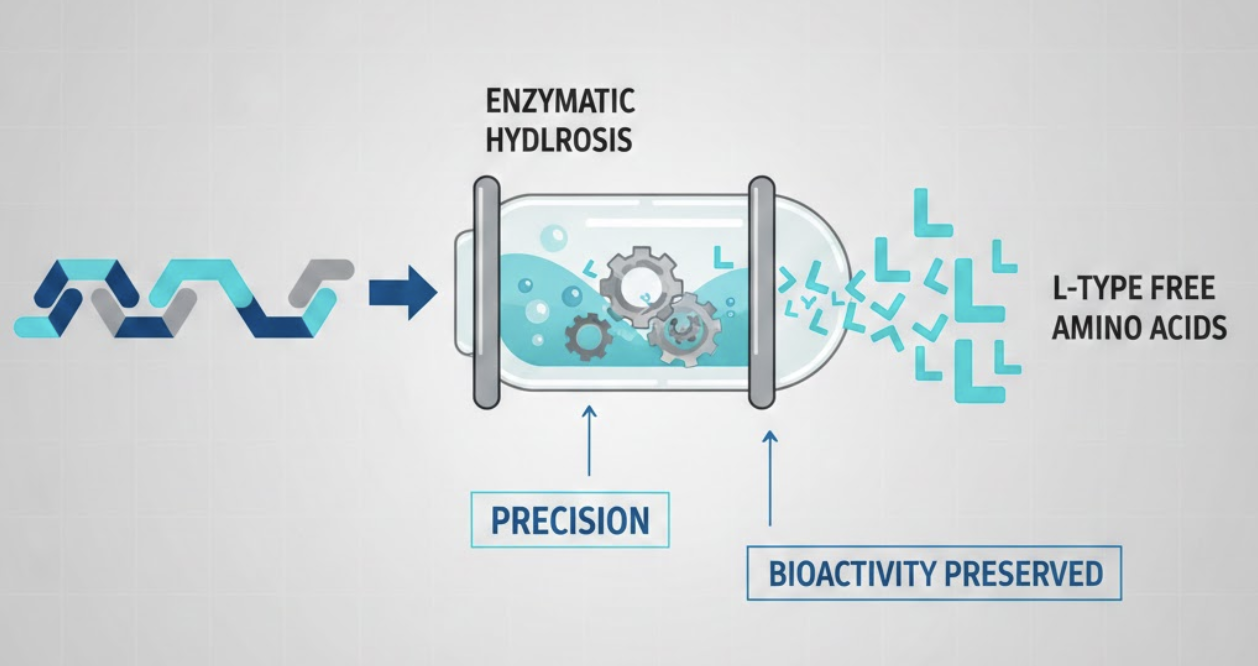
Before comparing any two amino acid fertilizers, it helps to understand how each was made. Two dominant extraction methods exist in commercial production: chemical hydrolysis and enzymatic hydrolysis. The difference between them is not a minor technical footnote — it fundamentally determines what arrives at the crop root.
Chemical hydrolysis uses strong acid or alkali at elevated temperatures to break down proteins into amino acids. The process is cost-efficient at scale. However, those same high-temperature conditions destroy heat-sensitive amino acids and convert naturally occurring L-form amino acids — the biologically active configuration — into racemic mixtures containing D-form variants that plants cannot utilize. The result is a product with an impressive total amino acid figure that may deliver only a fraction of its stated biological potential.
Enzymatic hydrolysis takes a different approach. Targeted biological enzymes cleave protein chains under carefully controlled, low-temperature conditions. This preserves L-form integrity across the full amino acid profile, maintains a balanced monomer distribution, and produces small, free amino acid molecules that plant root cells absorb directly. The process demands more precise equipment and tighter quality control. Consequently, it raises the production cost and the technical barrier — but it also produces a product that actually functions as intended when applied to crops.
Plant-Derived vs. Animal-Derived — Matching Source to Crop Need
Raw material origin adds a second layer of decision-making. Plant-derived amino acids — commonly extracted from soybeans or rapeseed — tend to offer a well-balanced spectrum of amino acid types. This broad profile supports general crop nutrition across the vegetative and reproductive stages, and the plant origin makes these products compatible with major organic certification schemes. Animal-derived amino acids — derived from feather, bone, or blood meal — often carry higher concentrations of specific amino acids such as cystine and serine. These compounds play a particular role in rapid cell division, stress-response protein synthesis, and recovery from environmental extremes. Neither source is inherently superior. The appropriate choice depends on the crop, the growth stage, and the market destination.
Inside the Product Line — Science Applied to Specific Scenarios
Ultra AminoMax illustrates the plant-derived pathway. Produced from non-GMO soybeans through a precision enzymatic process, it reaches a total amino acid content of 80%, with free amino acid content ranging between 75% and 80%. Importantly, every monomer amino acid in the product occurs naturally — no synthetic amino acids are added, and the full profile remains balanced across types. The product targets broad-spectrum crop nutrition: root irrigation applications for vegetables and fruit trees, foliar spray across cereals, and seed treatment for establishment-stage support.
Max AminoAcid 50 follows the animal-derived route. Derived from feather hydrolysis, it delivers 50% total amino acids with a composition notably rich in cystine and serine. This profile makes it particularly effective during periods of high stress or rapid growth demand — applications where the crop needs immediate building blocks for protein synthesis and stress-tolerance mechanisms. The wider amino acid portfolio — Max AminoN 16, Max PlantAmino50, Max Plant AminoTE, and AminoMix — extends coverage across chelated micronutrient combinations, growth-stage-specific nitrogen profiles, and rapid-dissolution formats. Together, they represent a range matched to agronomic scenarios rather than a one-size-fits-all input.
Amino Acids at the Right Moment — Cherry Coloring as a Case for Precision Timing
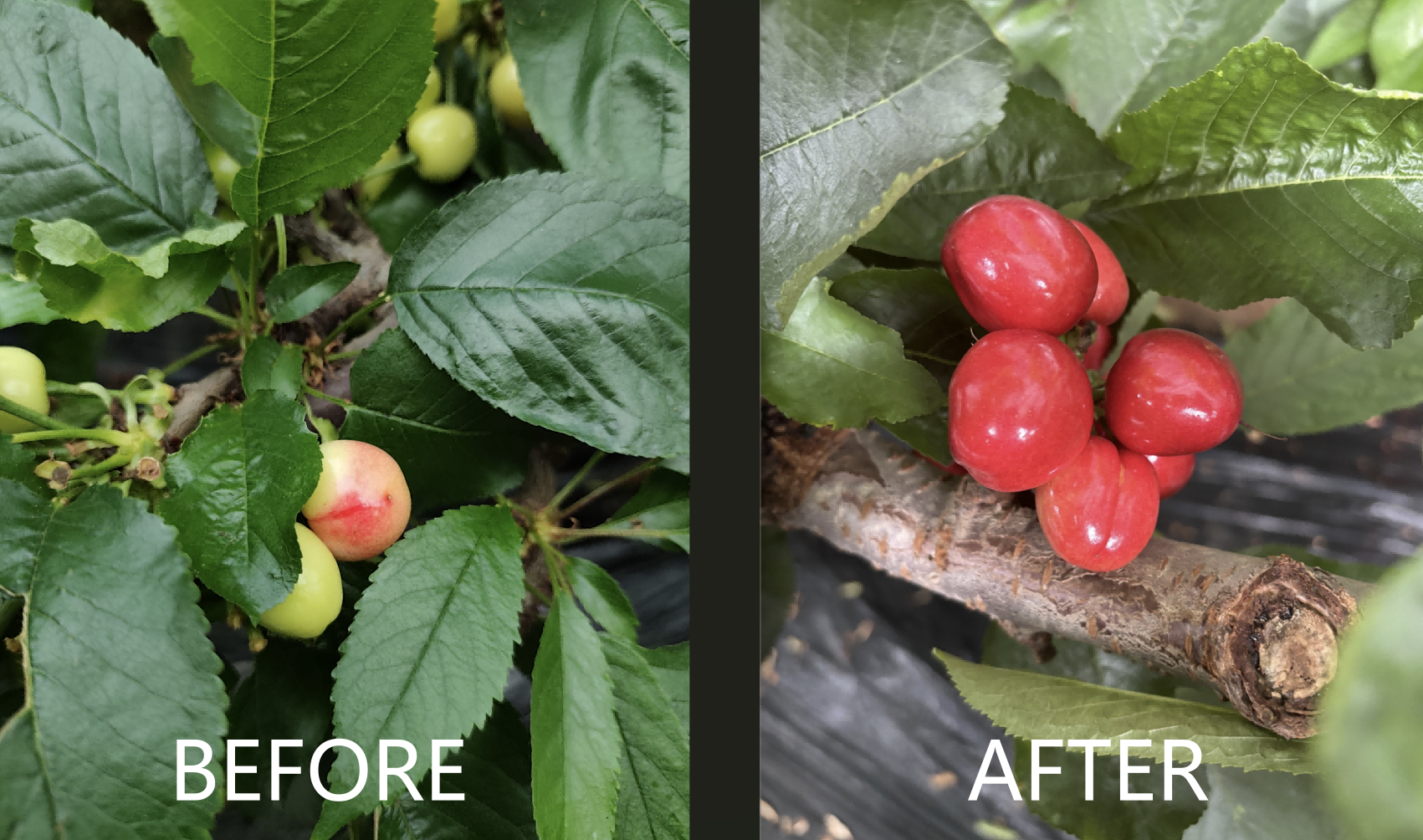
Timing governs how much value an amino acid input delivers. A field case involving cherry coloring illustrates this clearly. Cherry skin color depends on anthocyanin synthesis — a metabolic process that responds directly to amino acid availability, particularly through the phenylalanine pathway that connects nitrogen metabolism to pigment production. Applied through the AminoMax liquid formulation series at the appropriate pre-color-change stage, field observations recorded improved coloring uniformity, enhanced skin glossiness, and more consistent fruit sizing across the treated trees. These outcomes carry direct commercial weight. Color uniformity and visual quality determine market grade for fresh cherries, and they affect the price a grower receives at sale.
This case reflects a broader principle. Amino acid fertilizers work best when the application window aligns with the crop's physiological demand — not as background nutrition, but as targeted support at the moment the plant needs specific building blocks most.
A Decision Guide for Buyers — Three Questions That Cut Through the Noise
Evaluating amino acid fertilizers productively comes down to three diagnostic questions. First: what extraction method produced the product, and does the specification confirm L-form integrity and free amino acid percentage rather than just total content? Second: does the raw material source — plant or animal — align with the target crop's nutritional requirements and the destination market's certification standards? Third: Does the supplier demonstrate the technical flexibility to adapt formulations to regional conditions and evolving crop programs?
These are not abstract questions. They define whether an amino acid input delivers agronomic returns or simply adds cost to a fertilizer program. Citymax Group has built its amino acid series around answering all three — through source selection, process discipline, and a product range designed to match specific crop science rather than generic nitrogen delivery.
For technical consultation, product samples, or distributor inquiries, visit: https://www.citymax-group.com/.
Media Contact
Xi’an Citymax AgroChemical Co.,Ltd. Infor@citymax-agro.com +86 29 89286649 13th Floor, DaJingInternational, No. 67, Keji 2ndRoad, High-tech Zone, Xi'an City, Shaanxi Province, China https://www.citymax-group.com/