
Shenzhen, Guangdong May 23, 2026 (Issuewire.com) - Quality certification in the battery management system industry occupies an unusual position. It is simultaneously ubiquitous — most suppliers list at least one certification — and deeply uneven in what those credentials actually represent. For buyers evaluating whether a manufacturer genuinely qualifies as a Top 10 Supplier of Smart BMS in the World, the difference between a certificate that governs production behavior and one that exists primarily for marketing purposes determines outcomes that show up years into a supply relationship. This analysis examines what ISO 9001 and IECQ QC 080000 certification specifically mean for BMS buyers, and why Shenzhen Litongwei Electronic Technology Co., Ltd. (LTW) treats these standards as operational infrastructure rather than promotional credentials.
The Information Asymmetry Problem: Why Global Buyers Cannot Evaluate Chinese BMS Manufacturers on Trust Alone
Global buyers sourcing BMS protection boards from Chinese manufacturers face a structural challenge. Factory visits are costly and infrequent. Product samples represent controlled production conditions, not sustained output quality. Sales documentation describes capability without verifying process discipline. The result is a significant information gap between what a supplier claims and what a buyer can independently confirm before committing to volume orders.
Certification systems exist precisely to bridge this gap. Third-party audits apply standardized evaluation criteria to actual production processes, creating a verified record that travels with the supplier's commercial identity. For buyers who cannot conduct continuous first-hand oversight, a robust certification portfolio provides the closest available proxy for process reliability. Accordingly, the depth and scope of a manufacturer's certifications signal not just compliance but organizational maturity.
What ISO 9001 Actually Governs — and Why Production Consistency Is the Foundation of BMS Reliability
ISO 9001 is frequently summarized as a "quality management" standard, but that description undersells its operational specificity. The standard governs the systems a manufacturer uses to ensure consistent output: how processes are documented, how deviations are detected and corrected, how supplier inputs are controlled, and how customer requirements translate into production specifications. A manufacturer certified under ISO 9001 has demonstrated to an independent auditor that these systems exist and function.
For BMS products specifically, production consistency matters in ways that differ from many other electronic components. A BMS board that fails at the 3% batch level does not produce a 3% failure rate in end products — it potentially produces catastrophic outcomes in a small proportion of deployed battery systems. The asymmetry between production defect rates and field consequence severity makes batch-to-batch consistency a genuine safety parameter, not merely a quality metric. LTW first achieved ISO 9001 certification in 2007 and has maintained it through subsequent renewal audits. This continuity means the standard governs not a snapshot of production capability but an established operational discipline.
IECQ QC 080000 Decoded: Why Hazardous Substance Process Management Matters for Global BMS Compliance
IECQ QC 080000 addresses a compliance dimension that ISO 9001 does not cover: the management of hazardous substances throughout the manufacturing process. The standard requires manufacturers to identify, control, and document hazardous substance content across materials, components, and production processes — aligning with international regulations, including RoHS directives that govern product sales in European and other regulated markets.
For BMS buyers targeting export markets, IECQ QC 080000 certification carries practical commercial significance. Products containing undisclosed or non-compliant hazardous substance levels face regulatory rejection, customs delays, and potential market withdrawal in jurisdictions where these rules apply. A supplier who holds this certification has built hazardous substance management into their production process architecture — meaning compliance documentation exists at the component and batch level, not merely as a blanket declaration. LTW holds IECQ QC 080000 certification, providing buyers with a verifiable foundation for export market compliance rather than requiring them to conduct independent substance testing before each market entry.
The Compounding Effect: How Layered Certification Portfolios Transfer Risk Away from the Buyer
Individual certifications address specific process dimensions. When a manufacturer holds multiple certifications that cover overlapping and complementary aspects of production quality, the combined effect transfers a meaningful portion of supplier-related risk from the buyer to a system of independent verification.
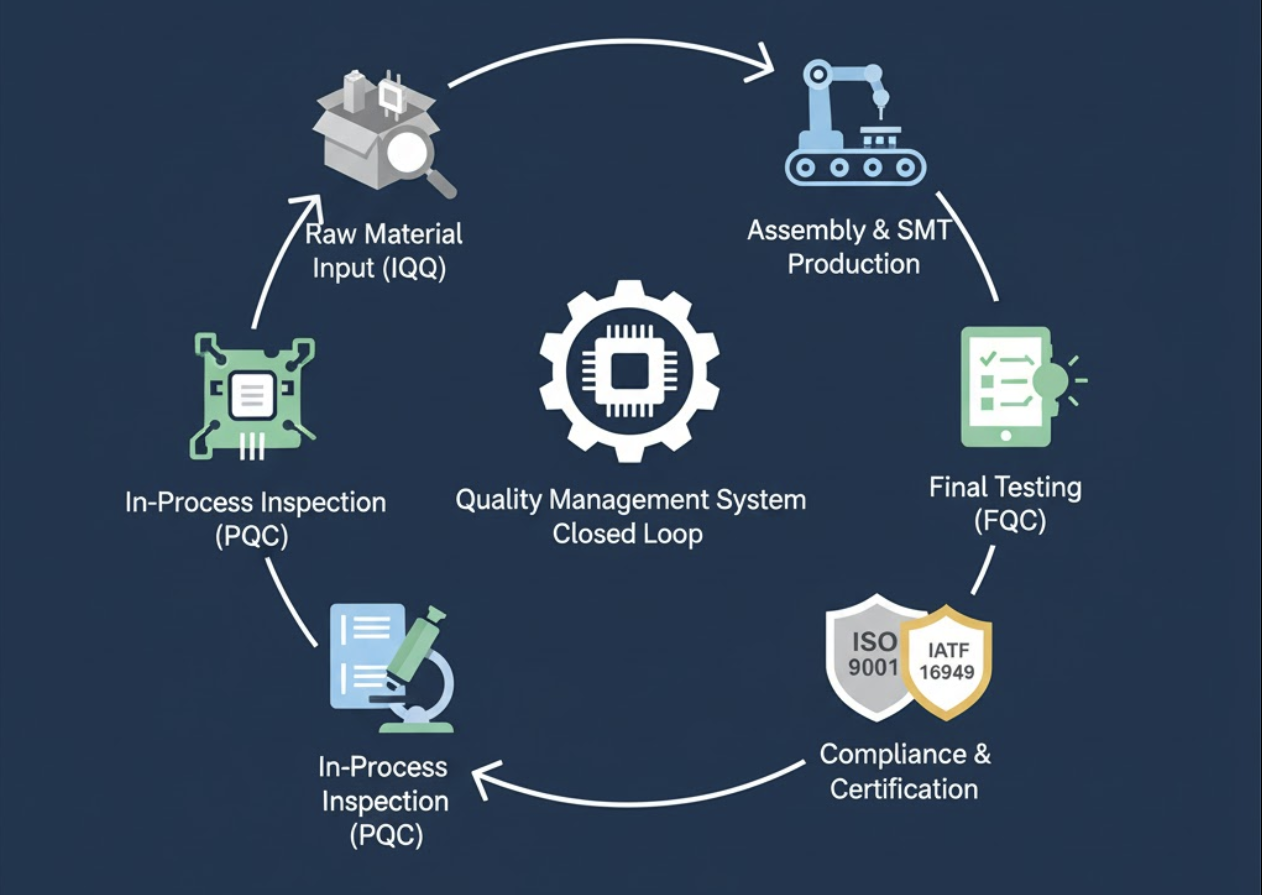
LTW's certification portfolio extends beyond ISO 9001 and IECQ QC 080000 to include ISO 14001 for environmental management, IATF 16949 for automotive-grade production consistency and traceability, and ISO 45001 for occupational health and safety. Each standard introduces independent audit requirements. Together, they create interlocking oversight across quality, environmental responsibility, hazardous substance management, production traceability, and workforce safety — dimensions that collectively address the full range of concerns a sophisticated global buyer would raise during supplier qualification. The national high-tech enterprise designation adds a further layer of institutional recognition for the company's R&D investment and technical capability.
Certification in Practice — How LTW's Quality Architecture Shows Up in Product Design and Manufacturing
Certifications describe process requirements. What they produce in practice becomes visible in how products are designed and how production is structured. LTW operates facilities totaling over 40,000 square meters across Shenzhen and Dongguan Huangjiang, equipped with 24 SMT placement machines across 12 PCBA production lines. Monthly output exceeds 15 million units. This scale alone does not guarantee quality. What makes it meaningful is the Manufacturing Execution System that traces every production batch from component sourcing through assembly to final test at the individual component level.
This traceability infrastructure reflects ISO 9001 and IATF 16949 requirements translated into operational reality. When a field failure occurs, the batch record provides an immediate audit trail. When a component substitution becomes necessary due to supply constraints, the substitution generates a documented record that can be audited against performance data. For buyers who need warranty support or regulatory compliance documentation, this infrastructure provides reliable evidence regardless of when a question arises in the product lifecycle.
The Hidden Cost Calculation: What Partnering with a Fully Certified BMS Supplier Saves Over Time
The cost of certification compliance is visible. The cost of insufficient certification is distributed and often invisible until it crystallizes in a specific incident — a regulatory rejection, a warranty dispute without documentation, a customer audit that reveals traceability gaps. These costs fall on the buyer as often as on the supplier.
Partnering with a fully certified BMS manufacturer transfers the compliance infrastructure cost to the supplier while eliminating a set of buyer-side risks that are difficult to price before they materialize. Buyers who would otherwise conduct independent factory audits, commission substance testing, or maintain internal documentation systems to compensate for supplier traceability gaps absorb real operational costs. A supplier whose certification portfolio already addresses these dimensions reduces the total cost of supply chain qualification — a saving that compounds across product lines and market entries over time.
From Certificates to Competitive Moat: Why Certification Depth Defines Long-Term Partnership Value
Certifications are renewable, but the organizational discipline required to maintain them year after year is not easily replicated. A manufacturer that has held ISO 9001 continuously since 2007, built IATF 16949 into automotive-standard production controls, and integrated IECQ QC 080000 hazardous substance management into component-level documentation has embedded quality discipline into its operational culture rather than treating it as a periodic compliance exercise.
For global buyers building multi-year supply relationships, this organizational depth represents a form of durable competitive moat. The BMS manufacturer who can provide consistent output quality, comprehensive compliance documentation, and responsive traceability across a sustained partnership does not need to be re-evaluated from scratch each time a new product line launches or a new export market opens. LTW's certification infrastructure, maintained and extended over two decades of operation, positions the company as a supplier whose quality commitments compound in value rather than depreciate over time.
More information is available at https://www.ltwpower.com/.
Media Contact
Shenzhen Litongwei Electronics Technology Co.,Ltd ltwbms@gmail.com 1st-5th Floors, Building C, Baifuli Industrial Park Shanghenglang Industrial Zone, Tongsheng Community Dalang Subdistrict, Longhua District Shenzhen, Guangdong Province, China https://www.ltwpower.com/