Shenzhen, Guangdong Oct 12, 2026 (Issuewire.com) - Selecting connectivity for smart buildings and industrial facilities requires balancing transmission range, battery lifespan, device density, and infrastructure management. Deploying a reliable lorawan gateway (https://www.diyusmart.com/q/h/255MG-801%2BIndustrial%2BLoRaWAN%2BGateway%2B%288-Channel%2C%2B50%2C000-Node%2BCapacity%29.html) allows facilities to capture telemetry across multi-story buildings and sprawling industrial complexes without recurring cellular subscription fees.
Shenzhen Diyu Smart Co., Ltd. (https://diyusmart.com/q/h/com/index.html) operates as a multi-protocol IoT hardware supplier, providing hardware across complementary wireless and wired standards to match site-specific operational constraints.
Smart-building and industrial-park connectivity should be selected by topology, power budget, device density, data path, and operating model. LoRaWAN, 4G, and ZigBee solve different parts of that problem, so a multi-protocol design is usually more practical than forcing every endpoint onto one network.
LoRaWAN, 4G, and ZigBee Serve Different Network Topologies
Evaluating wireless architectures requires comparing fundamental operating trade-offs rather than protocol labels alone. LoRaWAN employs a long-range, gateway-centric star topology operating in license-free sub-gigahertz spectrum, allowing battery-powered endpoints to transmit telemetry across several kilometers and penetrate dense reinforced concrete.
By contrast, 4G cellular links connect field hardware directly to cloud platforms through public mobile base stations, eliminating on-site gateway infrastructure while requiring active carrier subscriptions and higher peak operating power. Meanwhile, ZigBee operates primarily in the 2.4 GHz spectrum, using self-healing mesh networking across intermediate routing nodes to deliver low-latency, high-throughput communication across interior room clusters.
These physical characteristics establish distinct deployment and cost profiles across commercial facilities. A single outdoor lorawan gateway mounted on an industrial plant rooftop can gather data from thousands of dispersed sub-meters, environmental monitors, and utility sensors without recurring cellular data fees.
Conversely, direct cellular connectivity provides an agile alternative for isolated pump houses or geographically scattered municipal assets where installing private gateway infrastructure is economically impractical. For interior tenant spaces, confined ZigBee clusters coordinate multi-point lighting and automated shading smoothly, though their signals attenuate rapidly when attempting to penetrate exterior perimeter masonry.
LoRaWAN Projects Depend on Gateway and Network-Server Design
The physical gateway serves as the critical operating anchor of any private LPWAN installation, determining whether endpoint telemetry successfully bridges to central enterprise software. Industrial deployments rely on robust lorawan gateway module engineering to decode concurrent transmissions across multiple spreading factors and radio channels.
Diyu Smart’s 255MG-801/UG65/IG41 provides eight LoRaWAN channels, supporting roughly 500 to 2,000 active nodes with Ethernet, 4G Cat.1, or WiFi backhaul options. Engineered as a high-capacity commercial lora gateway, it ensures dependable data throughput under demanding electromagnetic environments.
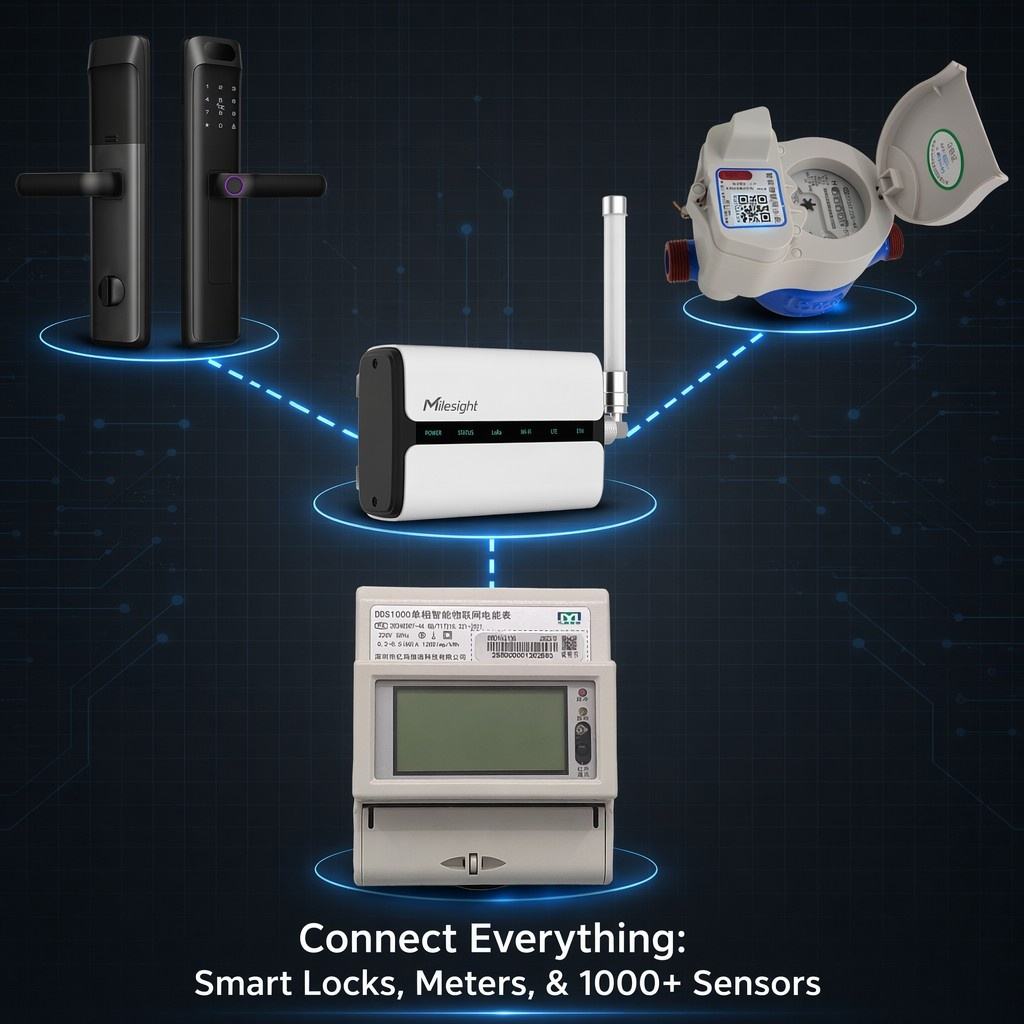
Diyu Smart is also an ecosystem partner of Milesight and Lierda. Many of Diyu's smart products can connect to Milesight and Lierda LoRaWAN gateways. In addition, Diyu has completed integration with the TTLock, Tuya, and HTLock operating systems. Diyu also offers Matter-compatible products that can connect to the operating systems of Apple, Samsung, Amazon, Google, and other platforms. This gives customers exceptional flexibility in product selection.
System resilience also depends on separating gateway packet reception from network routing intelligence. Operating as an RF packet forwarder, the gateway routes encrypted frames over secure IP backhaul to a designated lorawan network server. Compatible platforms like ChirpStack, The Things Network, Actility, and Yima Cloud manage deduplication, encryption keys, and downlink scheduling.
Physical gateway placement must account for structural attenuation caused by steel-reinforced floor slabs and mechanical elevator shafts. Engineering teams achieve uniform multi-story illumination by installing gateways in centralized riser chases or mounting weather-resistant units atop elevator penthouses.
4G Is the Direct-Cloud Alternative for Dispersed Endpoints
Direct cellular connectivity becomes the preferred architectural choice when monitoring assets spread across wide geographic territories where private gateway deployment cannot be justified. For dispersed municipal utility points or isolated pump houses, installing dedicated LPWAN base stations at each location creates unnecessary capital overhead.
Diyu Smart’s 4G Cat.1 meter path integrates built-in cellular transceivers, transmitting consumption readings directly to cloud platforms via standard MQTT or HTTP protocols without intermediate radio hardware. This gateway-free architecture significantly accelerates overseas project commissioning and simplifies deployments where local network infrastructure is unavailable.
However, engineering contractors must balance field-site simplicity against recurring SIM data subscriptions and power provisioning. Because cellular transmission draws substantial peak radio currents, battery-operated endpoints require careful duty-cycle management to achieve extended field longevity.
Furthermore, utility meters installed in subterranean basements or shielded electrical switchgear rooms often encounter severe signal attenuation. Field engineers must verify public carrier signal margins beforehand, deploying high-gain external antennas or falling back to sub-gigahertz LPWAN networks when underground coverage proves inadequate.
ZigBee Fits Dense Local Automation More than Wide-Area Telemetry
ZigBee provides exceptional performance in localized building environments where numerous low-power devices require rapid, coordinated communication inside a shared space. Operating as an interior mesh network, ZigBee delivers sub-second response times for wall switches, environmental sensors, and motorized window actuators.
Its self-healing mesh topology allows intermediate line-powered nodes to relay signals around structural obstacles, making it particularly well suited for individual apartment units, hotel guestrooms, and commercial office suites.
Nevertheless, mesh network stability depends heavily on the physical density and placement of mains-powered routing devices. If routing nodes are spaced too far apart, battery-powered sensors experience packet loss and drop off the network. In addition, 2.4 GHz radio signals suffer substantial attenuation through dense exterior concrete and insulated glass assemblies.
System designers should confine ZigBee networks to interior automation zones rather than attempting to span expansive outdoor campus perimeters, routing aggregated telemetry to building servers through centralized multi-protocol gateways.
Match Device Classes to Smart-Building and Industrial-Park Zones
The same project can legitimately use more than one protocol because locks, meters, sensors, and gateways operate under different physical and maintenance constraints. Forcing an entire enterprise campus onto a single protocol introduces severe operational compromises.
Smart Buildings and Apartments
In residential apartment towers and commercial office properties, device selection must balance tenant convenience, administrative security, and battery maintenance overhead. Interior room doors require robust access credentials without draining battery cells through continuous network connections.
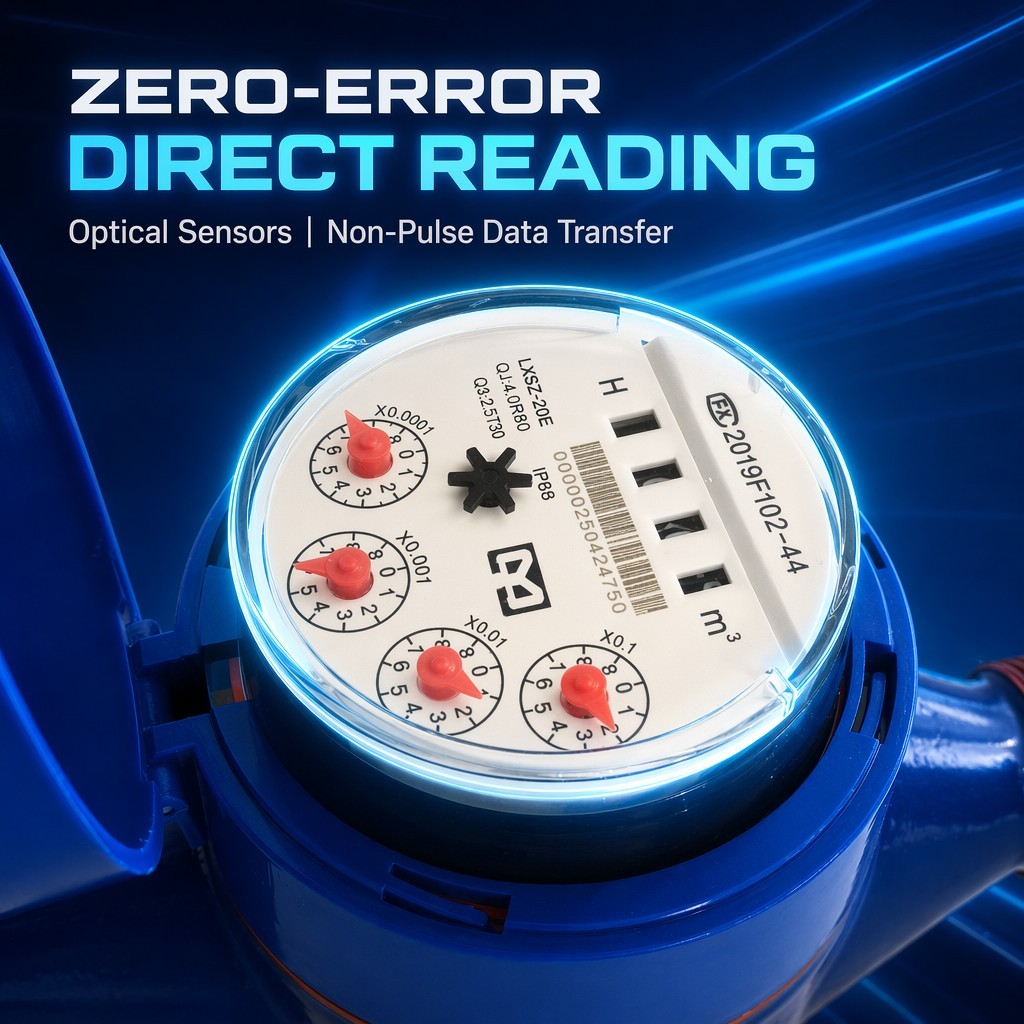
Diyu Smart’s PC01 battery-efficient lora smart lock and dedicated lorawan smart lock hardware communicate with central gateways across dozens of building floors while preserving multi-year battery life. Similarly, installing an apartment lorawan water meter or lora water meter inside utility risers ensures reliable automated tenant billing without requiring disruptive manual meter reading.
Hotels and Campus-Style Properties
Hospitality properties require continuous keycard synchronization and audit tracking alongside centralized utility monitoring. Guestrooms frequently utilize local Bluetooth or ZigBee networks for rapid lock response and smart climate controls.
In parallel, long-range LoRaWAN infrastructure monitors campus-wide utilities across remote accommodation blocks, connecting a lora smart meter and environmental lorawan temperature and humidity sensor units back to the main management office. This hybrid approach isolates guest access latency from utility polling, ensuring seamless guest satisfaction while providing comprehensive energy oversight.
Industrial Parks Need Mixed Connectivity Zones
Sprawling industrial manufacturing sites present severe structural obstacles, heavy electromagnetic noise, and widely distributed utility facilities. Across an industrial manufacturing complex, an enterprise lora iot solution gathers telemetry from perimeter environmental stations and warehouse utility boards using a lorawan temperature sensor or industrial lora temperature humidity sensor.
Meanwhile, isolated substations and outdoor water pumps communicate via direct 4G Cat.1 links. Multi-protocol gateway aggregation unites these independent field zones into a unified operational dashboard.
MQTT, APIs, and Backhaul Matter as Much as the Radio Protocol
A radio protocol decision remains incomplete until the upstream system integration architecture is fully established. LoRaWAN gateways, 4G meters, and ZigBee coordinators gather diverse field signals, but enterprise platforms require standardized software interfaces to process telemetry.
Modern commercial projects configure lorawan gateway mqtt telemetry pipelines, publishing structured JSON payloads directly to local brokers or cloud platforms. This clean decoupling ensures that property software processes uniform device telemetry regardless of whether underlying field transmission occurred across cellular, wired serial, or LPWAN radio channels.
System architects must treat network backhaul and API integration as explicit foundational requirements rather than downstream afterthoughts. The system specification should delineate gateway operational ownership, data residency rules, device commissioning workflows, and offline failover behaviors.
Incorporating industrial gateways with local flash memory buffering guarantees that critical utility readings and security access events are preserved during wide-area network disconnections, synchronizing automatically once server connectivity resumes.
Select the Protocol by Operating Model, not by a Single Specification
A disciplined selection methodology evaluates real-world facility constraints rather than choosing technology based on theoretical laboratory ranges. Engineering contractors should begin by assessing endpoint density, physical building layout, and target battery replacement cycles across all facility zones.
Physical site surveys must measure structural RF attenuation across reinforced concrete slabs, masonry walls, and subterranean utility vaults. Quantifying daily transmission frequencies and downlink command latency then establishes whether each subsystem requires direct cellular transmission, local mesh automation, or long-range LPWAN telemetry.
Ultimately, the most effective smart building architecture is the multi-protocol deployment that minimizes field complexity while maintaining data coherence across central software platforms.
System integrators and engineering contractors can contact Diyu Smart to evaluate gateway architectures and multi-protocol equipment schedules, or explore full device specifications on the Diyu Smart official website (https://www.diyusmart.com/).
Media Contact
Diyu Smart *****@diyusmart.com http://www.diyusmart.com/