Huizhou, Guangdong Jun 10, 2026 (Issuewire.com) - For product managers, original equipment manufacturer (OEM) buyers, and hardware engineers designing the next generation of smart rings, fitness trackers, and industrial IoT wristbands, selecting the ideal tactile feedback component is a critical technical and procurement decision. The user experience depends heavily on the responsiveness, texture, and power efficiency of the underlying haptic component. Navigating the mechanical differences between traditional and modern technology requires an experienced partner. Working directly with a premier Wholesale LRA and ERM Coin Vibration Motors Manufacturer ensures engineering teams get exact technical consultation and scalable production capacity. Choosing between a Linear Resonant Actuator (LRA) and an Eccentric Rotating Mass (ERM) motor involves balances of cost, response time, lifespan, and driver complexity. This analysis examines the technical and commercial tradeoffs to guide OEMs in making optimal sourcing decisions.
Understanding the Core Mechanisms: ERM vs. LRA
The functional difference between an ERM and an LRA coin vibration motor lies in how they transform electrical energy into mechanical movement.
An ERM motor utilizes an asymmetrical, unbalanced mass attached to a central rotating shaft. When a direct current (DC) passes through the internal voice coils, it creates a magnetic field that spins the rotor. Because the attached mass is offset, its high-speed rotation generates an omnidirectional centrifugal force, resulting in a familiar, steady vibration. This technology has powered pagers and cell phones for decades and remains highly popular.
In contrast, an LRA does not rotate an off-center weight. Instead, it moves a precise magnetic mass linearly against an internal spring. This movement is driven by an alternating current (AC) signal flowing through a stationary voice coil. The interaction between the AC magnetic field and the permanent magnet drives the mass back and forth along a single axis. This linear oscillation generates haptic sensations with a distinct, crisp quality.
Technical Performance Breakdown
To help engineering teams select components for space-constrained designs, we analyze the specific operating parameters that differentiate these two types of small vibrating actuators.
Response Time and Haptic Precision
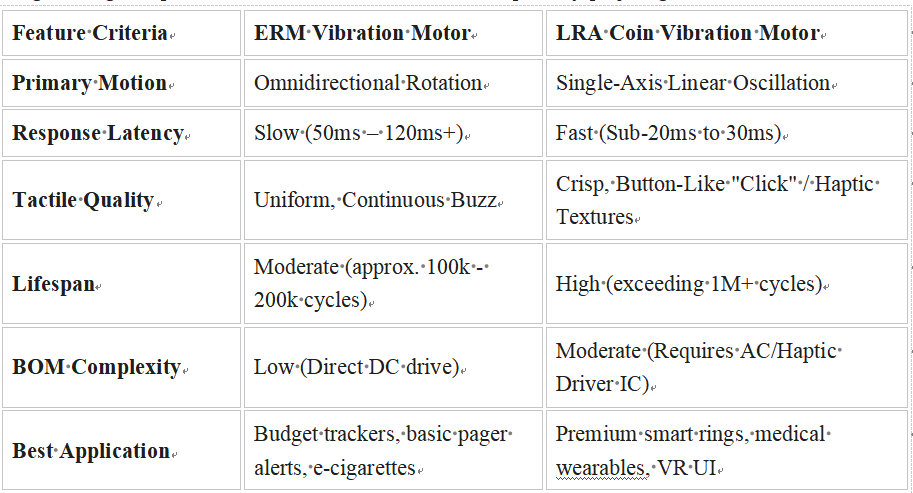
One of the most notable differences is response latency. ERM coin motors rely on rotational inertia, meaning they require time to spin up to their target speed (start time) and time to spin down when power is cut (stop time). A typical 0720 or 1020 ERM motor has start and stop times ranging from 80ms to over 120ms. This latency can cause haptic alerts to feel slightly soft or delayed.
LRAs offer significantly faster response times, with start and stop performance typically under 20ms to 30ms. This near-instantaneous operation allows an LRA to deliver brief, high-definition "clicks," complex textures, and sophisticated tactile patterns that mimic physical buttons. For advanced touch-screen feedback or precise alerts, the LRA provides superior sensory clarity.
Power Consumption and Efficiency
For battery-dependent consumer hardware, power budgets are strictly managed. ERM motors run on standard DC voltage (typically 3V). While their driver circuits are straightforward, they draw substantial current during the initial spin-up phase to overcome mechanical inertia.
LRAs are inherently more energy-efficient when operating at their specific resonant frequency ($F_0$). Because the internal spring-mass system utilizes mechanical resonance, the actuator requires minimal energy to maintain high-vibration amplitude. However, LRAs require dedicated AC or haptic driver integrated circuits (ICs) to deliver a precise sine wave and continuously track the resonant frequency, adding slightly to the total bill of materials (BOM).
Mechanical Lifespan and Reliability
Because brushed ERM motors rely on mechanical brushes and a commutator to switch current inside the moving rotor, they experience gradual physical wear over extended use. A standard brushed coin vibration motor for wearables delivers a operating life of roughly 100,000 to 200,000 cycles.
LRAs feature a brushless design. The voice coil remains stationary, and the moving magnetic mass experiences zero friction against electrical contacts. The only point of mechanical stress is the internal suspension spring. Consequently, high-quality LRAs routinely achieve operating lifespans exceeding 1,000,000 cycles, making them the preferred choice for medical devices, high-use industrial tools, and premium consumer electronics that demand long-term reliability.
Strategic Model and Sourcing Guide for OEMs
When comparing specific part numbers, procurement managers must match application requirements with the structural capabilities of the component supplier. Different product lines cater to distinct tiers of device architecture.
For classic cost-effective consumer devices, standard ultra-thin profiles provide dependable alerts. Models such as the 10mm diameter, 2.0mm thickness ERM coin motors offer a balanced, low-profile layout that integrates smoothly into mid-range smartwatches. These components give buyers a drop-in, plug-and-play solution that connects via flexible printed circuits (FPCB) or spring contacts without requiring specialized haptic driver development.
For premium or specialized hardware requiring advanced haptic definition, custom linear options become essential. Miniature high-performance LRAs, such as the 8mm by 2.5mm or 8mm by 3.2mm configurations, offer high acceleration outputs ($0.65G$ to $1.2G$ or greater) inside incredibly compact footprints. These models give engineers the tools to deliver strong tactile feedback through dense, waterproofed enclosures without draining small batteries.
Sourcing Security and Industrial Manufacturing Excellence
Selecting the right motor technology is only half the battle; finding a manufacturer capable of guaranteeing quality at global scale is equally critical. Established in 2007, LEADER Micro Electronics (Huizhou) Co., Ltd. has developed into a premier high-tech enterprise specializing in the research, development, production, and worldwide distribution of micro vibration motors.
With a sprawling modern facility spanning over 30,000 square meters, the company maintains an annual production capacity approaching 80 million units. Over nearly two decades of operational excellence, the manufacturer has shipped nearly one billion vibration motors worldwide, supporting approximately 100 diverse applications across consumer, medical, automotive, and industrial sectors.
For OEM buyers, partnering with an established supplier mitigates the supply chain risks associated with hardware production:
- Rigorous Quality Management:The production facility operates under a comprehensive quality framework, certified to international standards including ISO9001:2015, ISO14001:2015, and OHSAS18001:2011. Every individual motor undergoes a strict 200% inspection regimen across 13 to 17 separate testing procedures—including comprehensive performance, waveform, noise, and appearance evaluation—maintaining a strict target defect rate below 100 DPPM.
- Deep Technical Expertise:The internal R&D division includes 12 veteran engineers, many possessing over a decade of specialized experience in micro-motor technology. Backed by an in-house tooling workshop, the team can rapidly design, prototype, and manufacture custom jigs and custom FPCB layouts within 2 to 3 days to match unique client enclosures.
- Tier-One Validation:The factory's long-term commercial relationships with demanding international brands like OMRON, BBK, Pegatron, and Venture demonstrate its ability to meet strict corporate audits and provide rapid technical support across all phases of product development (EVT, DVT, PVT, and MP).
Conclusion: Balancing Performance and Value
When deciding between an LRA coin vibration motor and an ERM vibration motor, engineering and procurement teams must evaluate their primary project goals:
For applications where cost-efficiency and straightforward electrical integration are paramount, the time-tested ERM coin motor remains a practical choice. However, as wearable tech trends toward richer user interfaces, longer product lifecycles, and thinner enclosures, the LRA coin motor stands out as the superior technical option for modern product development. By leveraging the automated manufacturing capacity and engineering support of an established tier-one supplier, OEMs can confidently bring high-performing, reliable products to market.
For technical data sheets, sample requests, and custom configuration inquiries, please visit the official company website at: https://www.leader-w.com/
Media Contact
Leader Micro Electronics (Huizhou) Co., Ltd leader@leader-cn.cn https://www.leader-w.com/