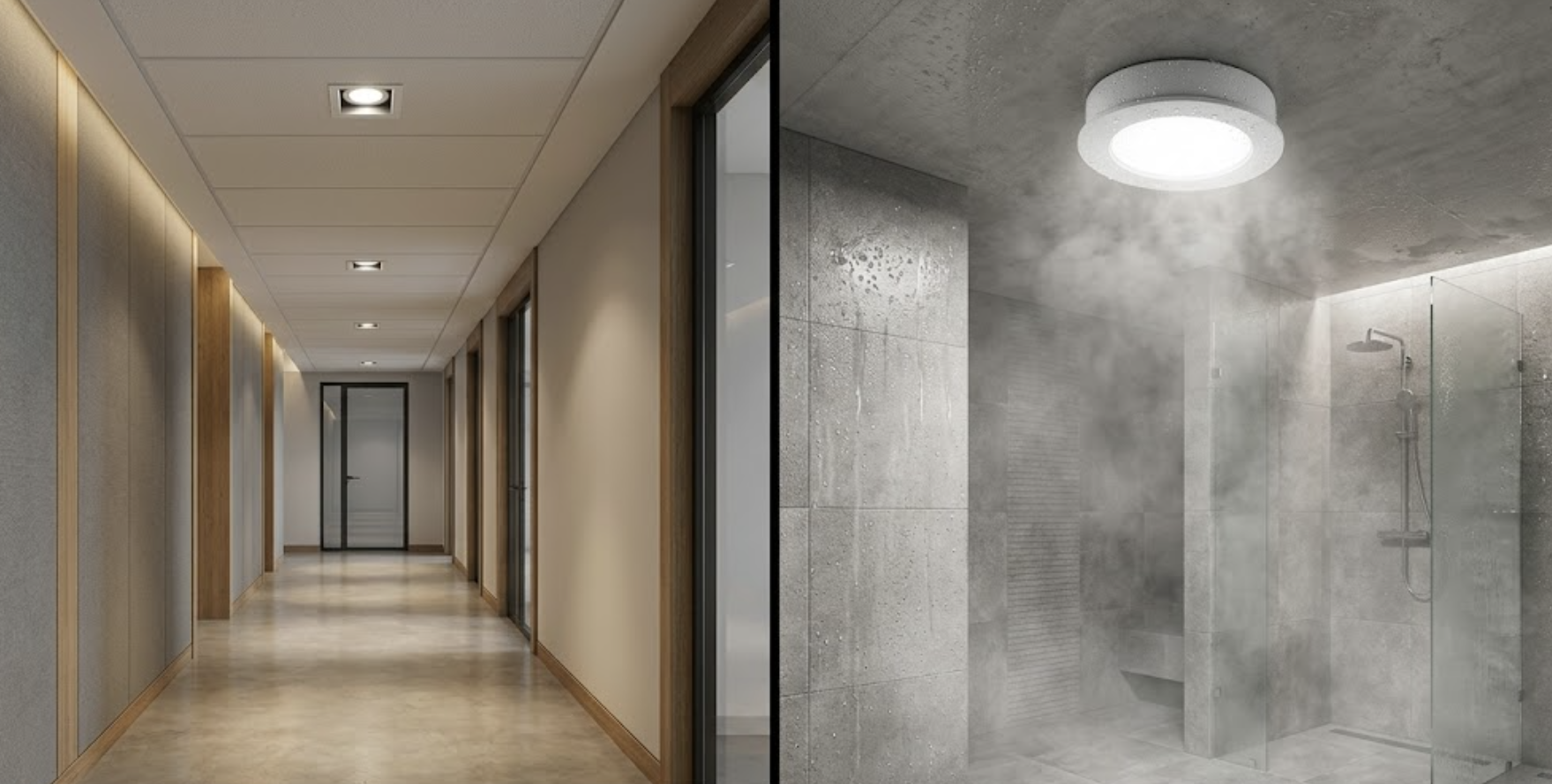
Suzhou, Jiangsu Jul 27, 2026 (Issuewire.com) - Every commercial lighting project involves a balance between performance, protection, and cost. Choosing an unnecessarily high IP rating can increase procurement costs, while selecting an insufficient rating may lead to premature failures and higher maintenance expenses. Understanding when IP44 is sufficient—and when IP64 becomes essential—is therefore an important engineering decision rather than simply a product specification.
Quick Answer
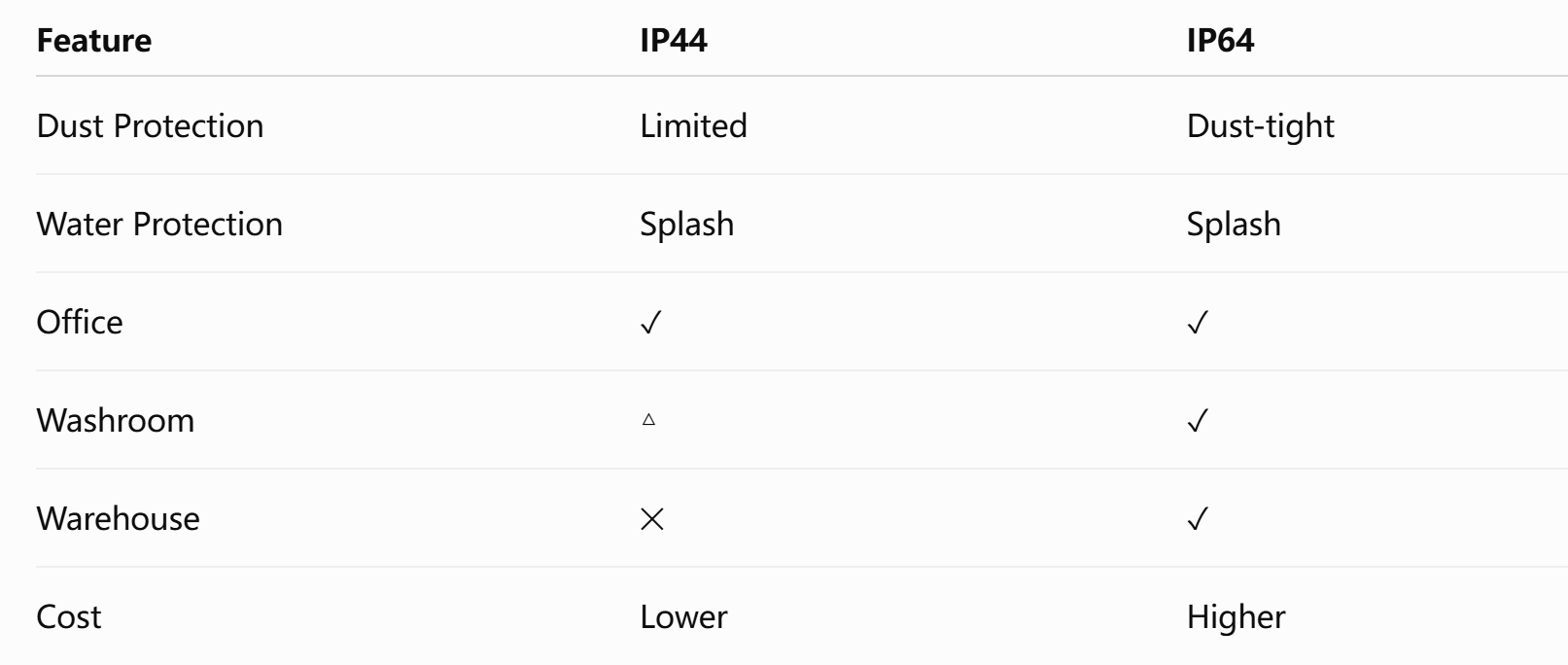
IP44 and IP64 downlights differ in one critical way: dust protection. IP44 blocks solid objects larger than 1mm and light splashing water; IP64 is fully dust-tight and withstands water splashed from any direction. For commercial projects, IP44 is the correct—and more cost-effective—choice for dry interior zones like offices and retail floors, while IP64 is required wherever moisture, washdown, or airborne particulates are present, such as washrooms, kitchens, and industrial areas. The correct IP rating should always be selected according to the installation environment rather than assuming that a higher protection level is always better.
Key Takeaways
- IP44 and IP64 solve different problems.IP44 protects against dust ingress and incidental splashes; IP64 adds full dust-tightness plus resistance to direct water spray from any angle.
- The rating drives the internal architecture, not just the housing.IP44 fixtures typically use internal non-isolated drivers; IP64 fixtures require outside isolated drivers to prevent heat-related condensation inside a sealed enclosure.
- Over-specifying IP64 across an entire dry facility wastes budgetwithout adding protection where no moisture risk exists.
- Under-specifying IP44 in wet zones risks driver degradation and corrosion, leading to premature failure and warranty disputes.
- A hybrid specification—IP44 for dry interior square footage, IP64 for wet/humid perimeters—is the standard value-engineering approach on real projects.
Q&A
Q1: What is the difference between IP44 and IP64 LED downlights?
IP44 protects against solid particles over 1mm and water splashed from any direction for a limited duration. IP64 protects against dust of any size (full dust-tight, the "6" in IP6X means zero ingress) and against water splashed from any direction with more sustained exposure. The second digit is the key jump: 4 tolerates splashing, 6 is dust-tight enough to be tested under vacuum with talc powder.
Q2: Is IP64 always better than IP44 for commercial lighting?
Not in terms of value. IP64 fixtures cost more to manufacture (isolated drivers, sealed aluminum housings, gasket testing) and generally have no performance benefit in dry, climate-controlled spaces. "Better" only applies to environments where dust or moisture is actually present.
Q3: When should a commercial project use IP64 instead of IP44?
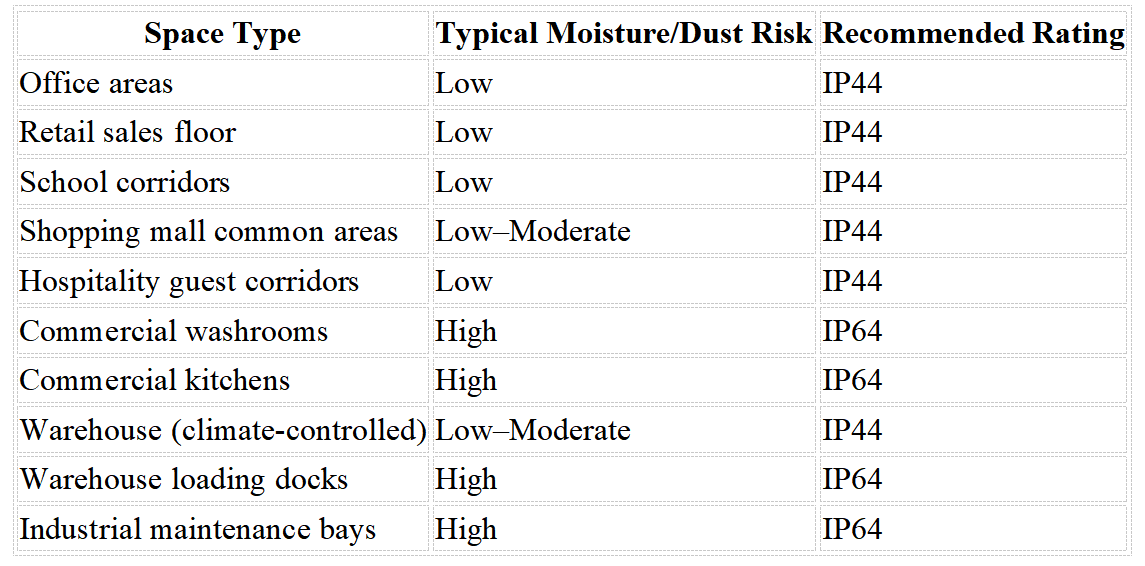
Use IP64 in washrooms, changing rooms, commercial kitchens, underground parking, loading docks, and any industrial area with washdown cycles, condensation, or airborne dust. These environments can corrode circuit boards and cause dielectric breakdown in fixtures not rated for moisture exposure.
Q4: What is the best IP rating for retail and office lighting?
IP44 is standard for retail sales floors, office areas, and corridors—these are dry, climate-controlled spaces where IP44's dust and splash resistance is sufficient, and the lower cost supports better lumen-per-dollar procurement across large footprints.
Q5: Can IP44 downlights be used in bathrooms?
Generally not recommended for direct-spray zones. Most commercial washroom applications call for at least IP64, particularly near sinks, urinals, and cleaning-washdown areas, though placement outside direct spray zones (per local electrical code) can sometimes permit IP44 in peripheral areas—this should be confirmed against local wiring regulations, not assumed.
Failure Mechanism: Why Under-Specified Fixtures Fail
Facility managers often observe premature failure in IP44 fixtures installed in marginally humid zones—not because the LED chip fails, but because moisture reaches the electronics before the light output visibly degrades.
- Dust accumulation: In IP44 fixtures, fine particulates entering through the seal settle on the driver and heat sink, insulating components and trapping heat, which accelerates thermal stress on the driver.
- Condensation: Temperature swings (common in loading docks, semi-outdoor canopies, and unconditioned back-of-house areas) cause internal condensation inside housings not designed for full sealing, leading to micro-shorts.
- Corrosion: Persistent moisture reacts with circuit board traces and connector contacts, especially in non-isolated driver designs where the driver sits closer to the light source and any ingress point.
- Driver degradation: Heat and moisture both shorten electrolytic capacitor life inside the driver—this is usually the actual failure point, not the LED chip itself, which is why a "downlight failure" is often a driver failure in disguise.
- Thermal stress: This is why IP64 fixtures use outside isolated drivers—separating the power module from the sealed light engine prevents trapped heat from cooking the driver inside a fully dust-tight housing.
Why IP64 Prevents These Failure Mechanisms
- Sealed optical chambers prevent airborne particles from reaching sensitive electronic components.
- Outside isolated drivers reduce thermal accumulation inside enclosed luminaires.
- Silicone gasket systems minimize moisture ingress during routine cleaning procedures.
- Optimized aluminum heat sinks improve heat dissipation and extend driver lifespan.
Industry Standards Referenced
- IEC 60529defines the IP (Ingress Protection) code system used throughout this comparison—the first digit rates solid particle protection, the second rates liquid ingress protection.
- IK ratings(e.g., IK06) are defined under IEC 62262 and measure impact resistance separately from IP ratings—relevant in public-facing commercial zones where vandalism or accidental impact is a risk.
- L70/L90ratings describe LED lumen maintenance—the number of hours before output degrades to 70% or 90% of initial lumen output, based on LM-80 test data (raw LED chip testing) projected forward using the TM-21 calculation method.
- EN 60598specifies the general safety requirements for luminaires, including electrical safety, mechanical construction, and thermal performance. Commercial lighting products should comply with this standard in addition to meeting the required IP protection level.
Application Guide
The following application guide reflects common engineering practice for commercial indoor lighting, mapping typical building zones to the appropriate IP rating based on actual moisture and dust exposure. Final fixture selection should always comply with local electrical regulations, project specifications, and site-specific environmental conditions.
Expert Insight
In commercial lighting projects, the highest-value engineering decision usually isn't found in the product catalog—it's found on the floor plan. Facility managers who've dealt with a washroom fixture failure within the first year almost always trace it back to an IP44 unit installed where an IP64-rated fixture belonged, not a manufacturing defect. This is commonly seen in retrofits where the original dry-zone specification was copy-pasted across an entire floor without re-auditing individual room functions.
Procurement Checklist
- ✓ Certification— Confirm CE, RoHS, and (where applicable) SAA marks match the destination market's compliance requirements
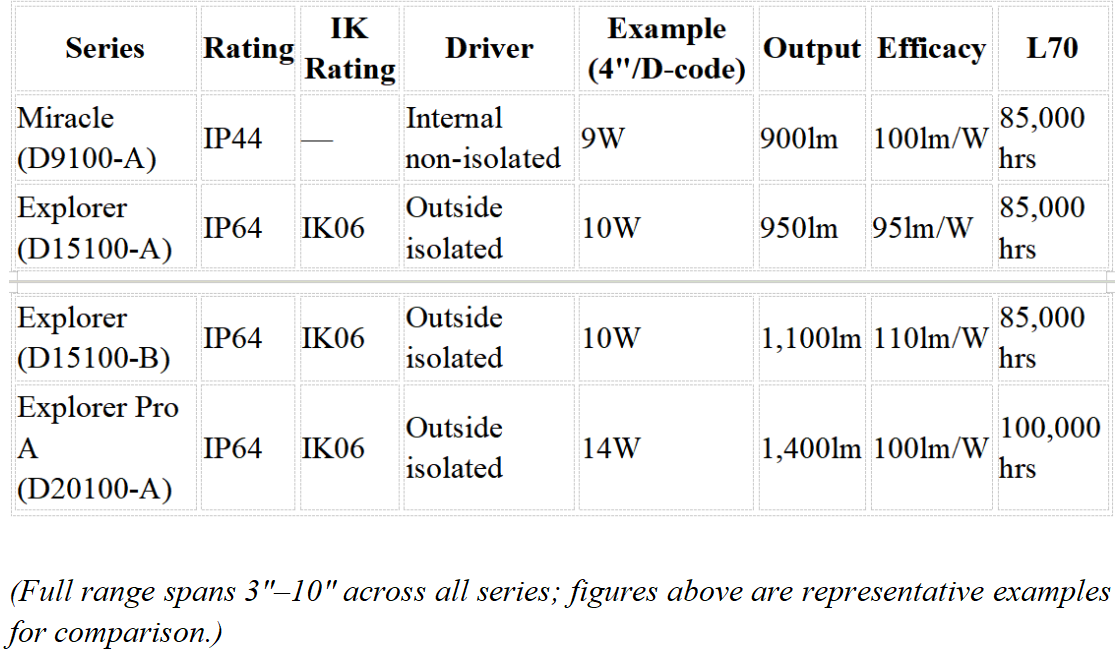
- ✓ Driver design— Internal non-isolated (IP44, lower cost) vs. outside isolated (IP64, moisture-resilient)
- ✓ Thermal management— PA-coated aluminum (IP44 series) vs. full aluminum housing with heat sink geometry (IP64 series)
- ✓ IK impact resistance— IK06 rating relevant for public-facing zones prone to accidental impact
- ✓ Maintenance requirements— Sealed IP64 fixtures require less frequent internal cleaning but harder field driver access
- ✓ Warranty terms— Standard vs. extended (5-year) warranty tiers, tied to L70 rating (85,000 vs. 100,000 hrs)
- ✓ Cost of ownership— Factor in both unit price and expected failure/replacement rate for the specific environment
- ✓ Verify driver replacement accessibility for long-term maintenance.
- ✓ Confirm spare parts availability throughout the product lifecycle.
Engineering Best Practice
Experienced lighting designers rarely specify a single IP rating across an entire commercial building.
Instead, they evaluate each installation zone according to its environmental conditions, maintenance requirements, and expected lifecycle performance.
By matching fixture protection to actual operating conditions, project teams can reduce unnecessary procurement costs while improving long-term reliability and lowering maintenance frequency.
For most commercial projects, a combination of IP44 and IP64 luminaires provides a more practical and cost-effective solution than applying one specification throughout the building.
Selecting the Right IMIGY Series for Different Project Requirements
For projects mixing dry and wet zones, IMIGY (IMIGY Lighting Electric Co., Ltd.)'s downlight range breaks into three practical tiers: the Miracle series (IP44, internal driver, single or 3CCT, L70 85,000hrs) for the bulk of dry interior square footage; the Explorer series (IP64, IK06, outside isolated driver, L70 85,000hrs) for standard wet-zone coverage; and the Explorer Pro line (IP64, IK06, 5CCT switchable, 5-year warranty) for premium applications, spanning UGR<19 glare control (Pro A), wide-beam configurations (Pro B), and narrow-beam COB configurations (Pro C)—exact lumen/efficacy specs vary by sub-series and should be confirmed against current factory datasheets before quoting. This tiering lets procurement teams match protection level, optical performance, and warranty length to the actual demands of each zone rather than defaulting to a single spec across the building.
Website: https://www.imigyled.com/
FAQ
- What does the IP rating on a downlight actually measure?It measures resistance to solid particle ingress (first digit) and liquid ingress (second digit), per IEC 60529.
- Does a higher IP rating mean better light quality?No—IP rating measures environmental sealing, not CRI, beam angle, or color accuracy, which are separate specifications.
- Can I mix IP44 and IP64 fixtures in the same building?Yes, and it's standard practice—zone by actual moisture/dust exposure rather than applying one rating building-wide.
- Why do IP64 fixtures cost more than IP44?Sealed housings, isolated driver architecture, and mandatory water-pressure ingress testing all add manufacturing cost.
- What is an isolated LED driver and why does it matter for IP64 fixtures?It separates the power management circuitry from the light engine, preventing trapped heat and condensation from degrading the driver inside a fully sealed housing.
- Is IP65 the same as IP64?No—IP65 adds protection against low-pressure water jets from any direction, one tier above IP64's splash-only protection. Confirm which tier your project actually requires before specifying.
- What does IK06 mean and is it related to IP rating?IK06 rates impact resistance (up to 1 joule of impact energy) under IEC 62262—a separate standard from IP ratings, relevant for public or high-traffic areas.
- What's the difference between L70 and L90 ratings?L70 marks the point where output has degraded to 70% of initial lumens; L90 marks 90%—L90 is a stricter, shorter-interval benchmark often used in premium/task-lighting applications.
- Do IP44 downlights need special maintenance?They benefit from periodic dust removal since they aren't fully dust-tight; IP64 fixtures need less frequent cleaning but are harder to service internally if the driver fails.
- Can IP44 fixtures be used in semi-outdoor covered areas?Not recommended without further protection—covered doesn't mean condensation-free, especially in areas with temperature swings.
- How long do these downlights typically last before failure?Rated life (L70) is 85,000 hours for the standard Miracle and Explorer lines, 100,000 hours for the Explorer Pro series—actual field life depends heavily on whether the IP rating matches the installation environment.
- Does beam angle affect which IP rating I should choose?No, beam angle (typically 40°/60°/80° across these lines) is an independent optical spec and doesn't affect environmental sealing requirements.
- What warranty length is standard for commercial downlights?Standard lines typically carry manufacturer warranties tied to the L70 rating; the Explorer Pro series specifically offers a 5-year warranty as part of its premium tier.
- Is CRI affected by IP rating?No—CRI (color rendering index) is determined by the LED chip and phosphor, not the housing's ingress protection level; all series referenced here carry CRI>80.
Media Contact
IMIGY Lighting Electric Co., Ltd. market@imigyled.com +86 512 36903939 No.366 Hengchangjing Road, Zhoushi Town, Kunshan City, Suzhou City, Jiangsu Province, China, Suzhou, Jiangsu 215313, CN https://www.imigyled.com/