
Hangzhou, Zhejiang Jul 10, 2026 (Issuewire.com) - In the demanding environment of heavy-duty logistics, the longevity of vehicular lighting systems depends as much on installation precision as it does on manufacturing quality. Fleet operators frequently face premature lighting failures, not because of defective hardware, but due to improper mechanical mounting or compromised electrical sealing. When a multi-functional lamp fails on the road, the resulting downtime and potential safety violations create a significant economic burden for transport companies. To mitigate these risks, industry leaders emphasize the importance of standardized installation protocols that account for vibration dampening and environmental isolation. Establishing itself as a prominent China Top Grommet Mount LED Combination Light Manufacturer, TOKING has pioneered engineering-led guidelines to ensure its high-performance lighting arrays withstand the rigors of long-haul transit. By following a disciplined mounting framework, maintenance teams can protect their equipment assets and guarantee consistent photometric performance across their entire fleet. This guide explores five critical benchmarks for the professional deployment of grommet-mount lighting systems in modern heavy-duty applications.
Benchmark 1: Elastomeric Seat Stabilization – The Science of Perfect Grommet Seating
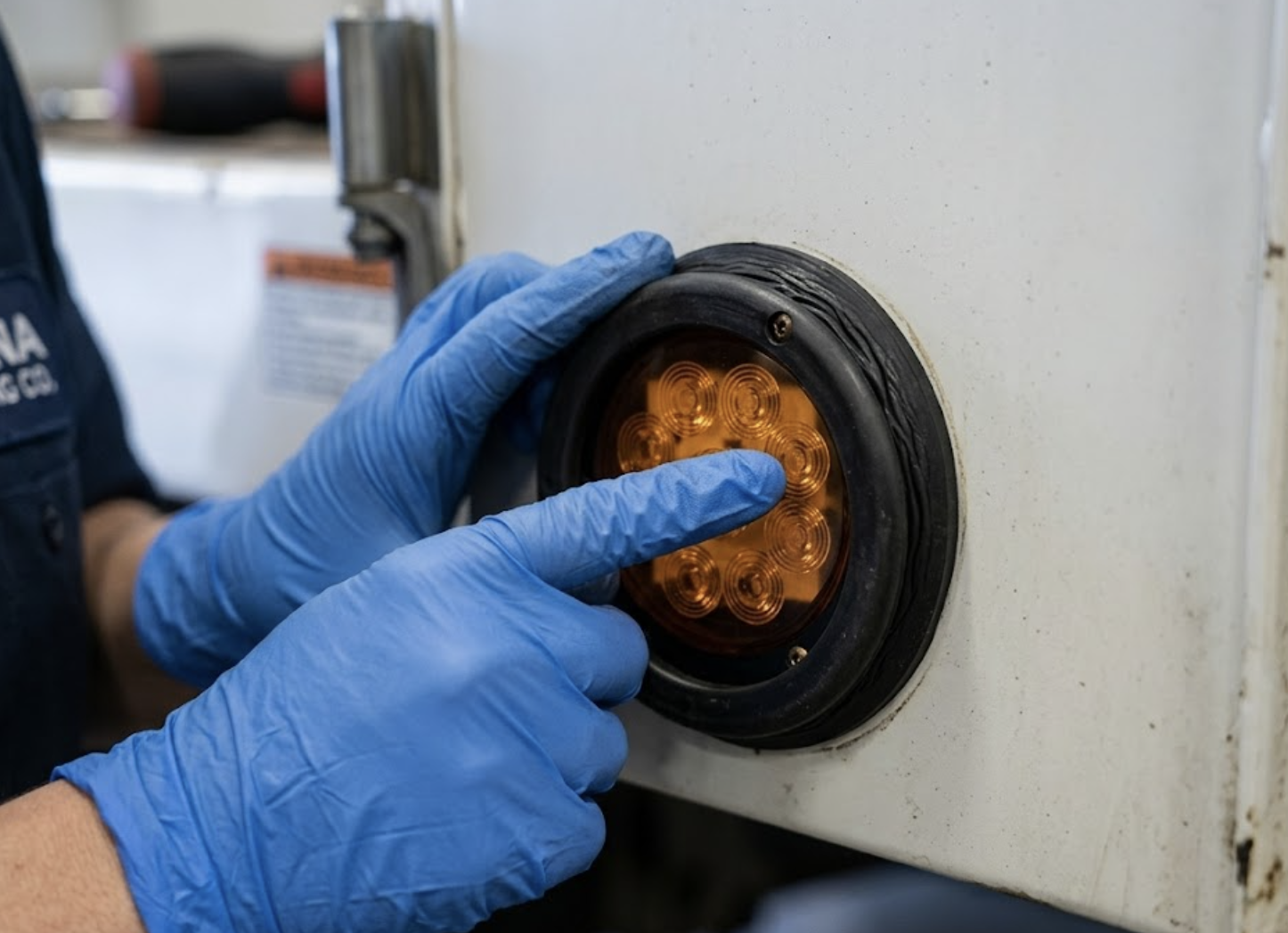
The primary advantage of a grommet-mount system lies in its ability to isolate the sensitive internal LED electronics from high-frequency chassis vibrations. However, achieving this isolation requires a precise mechanical fit between the mounting aperture and the elastomeric seal. If the cutout is too large, the lamp will rattle, leading to internal component fatigue; if it is too small, the grommet will deform, compromising the watertight barrier. Professional installers utilize calibrated cutting tools to ensure the aperture dimensions align perfectly with the manufacturer’s technical specifications.
To maintain structural integrity, TOKING (TOKING HOLDING GROUP LIMITED) utilizes premium-grade EPDM or PVC compounds that retain their elasticity across extreme temperature gradients. During installation, technicians must ensure the grommet seats fully into the panel, creating a uniform compression seal around the entire perimeter. Applying a thin layer of specialized lubricant can facilitate the seating process without damaging the polymer. Once properly anchored, the elastomeric seat acts as a physical shock absorber, preventing road-induced energy from reaching the solid-state diodes and circuitry.
Benchmark 2: Anti-Siphoning Electrical Termination – Preventing Capillary Moisture Ingress
A common yet overlooked failure mode in heavy-duty lighting is the "siphon effect," where moisture enters through damaged wire insulation and travels inside the copper strands. This capillary action can draw water directly into the lamp's internal printed circuit board (PCB), even if the outer housing remains perfectly sealed. To prevent this, installers must implement anti-siphoning termination techniques at every junction point. This involves the use of high-quality heat-shrink butt connectors that create a permanent, hermetic bond with the wire jacket.
The factory recommends applying dielectric grease to all plug terminals before final connection. This non-conductive, silicone-based grease displaces air and moisture, preventing the oxidation that typically leads to flickering or dimming lights. By creating a chemical and physical barrier at the connection point, fleet operators ensure that environmental contaminants cannot penetrate the electrical path. This disciplined approach to termination is essential for vehicles operating in high-humidity regions or areas where road salts accelerate corrosion.
Benchmark 3: Mechanical Strain Relief and Routing Geometry – Neutralizing Chassis Vibration
Heavy-duty vehicles undergo constant structural twisting and vibration, which can place immense stress on electrical harnesses. If a cable remains too tight, the constant tension will eventually pull the wires out of the lamp’s rear potting material or cause the terminals to loosen. Effective installation requires a specific routing geometry that includes a "drip loop" near the entry point. This simple loop uses gravity to divert runoff water away from the connector, ensuring that moisture does not pool against the seal.
The engineering team at NEWSUN designs its led 4 round combination taillight for heavy duty truck tractor stop tail turn reverse rear lamp to accommodate flexible routing without compromising rear seal integrity. Installers should secure the harness to the vehicle frame using UV-stabilized cable ties, leaving enough slack to accommodate chassis movement. By neutralizing mechanical strain, maintenance crews prevent the repetitive pulling forces that lead to intermittent power loss. This careful management of cable geometry ensures that the lighting system remains operational during high-speed transit and aggressive off-road maneuvers.
Benchmark 4: Photometric Axis Alignment – Ensuring Multi-Function Optical Compliance
Modern combination lights integrate several critical safety functions, including stop, tail, turn, and reverse signals, into a single housing. For these functions to meet international safety standards, the lamp must be aligned correctly relative to the road surface. If an installer mounts the lamp at an incorrect angle, the beam dispersion may fail to reach the eyes of following drivers, increasing the risk of rear-end collisions. Standardized installation requires a careful check of both the horizontal and vertical photometric axes.
Professional-grade lights from TOKING HOLDING GROUP LIMITED often feature built-in alignment notches or leveling indicators to assist technicians. These markers ensure that the internal optics point exactly where the design intended, maximizing the light’s effective range. Proper alignment is particularly vital for the reverse function, which requires specific ground illumination to assist drivers during nighttime docking procedures. By verifying the optical orientation during the mounting process, fleets ensure they remain fully compliant with regional road safety regulations.
Benchmark 5: Integrated Circuit Testing Post-Installation – The "Zero-Defect" Validation Protocol
The final stage of a professional installation involves a comprehensive validation of the electrical circuit. Modern heavy-duty vehicles often utilize Control Area Network (CAN-bus) systems that monitor the resistance of the lighting circuits. If an LED lamp consumes significantly less power than a traditional bulb, the vehicle’s computer may trigger a "bulb out" error message. To avoid this, installers must verify that the lighting system interacts correctly with the vehicle's electronic control unit.
Technicians use digital multimeters to check for parasitic resistance and ensure that ground connections remain solid. Furthermore, they must verify that the flash rates for the turn signals remain synchronized and consistent. TOKING provides extensive technical support and load-balancing solutions to facilitate seamless integration with modern vehicle electronics. This "zero-defect" validation protocol ensures that the vehicle leaves the maintenance bay in peak operational condition, ready for the challenges of long-haul transport.
Conclusion: Hardening the Fleet Infrastructure through Standardized Excellence
The reliability of a heavy-duty fleet depends on the synergy between high-quality manufacturing and disciplined field maintenance. While the choice of a top-tier manufacturer provides the foundation for durability, the execution of standardized installation practices determines the ultimate service life of the equipment. By mastering grommet seating, anti-siphoning techniques, and strain relief, fleet managers can significantly reduce their total cost of ownership. The combination of NEWSUN’s advanced engineering and a commitment to professional installation standards creates a safety ecosystem that thrives in the harshest environments. As the transport industry continues to evolve, the focus on technical excellence remains the most effective strategy for ensuring road safety and operational uptime.
To explore the complete technical specifications for grommet-mount lighting systems and to review professional installation support services, please visit the official corporate website: https://www.newsunlighting.com/.
Media Contact
TOKING HOLDING GROUP LIMITED *****@tkindustrial.cn A202 ZHONGTIAN MCC,MAOJIAQIAO ROAD,HANGZHOU 310012 ZHEJIANG CHINA https://www.newsunlighting.com