
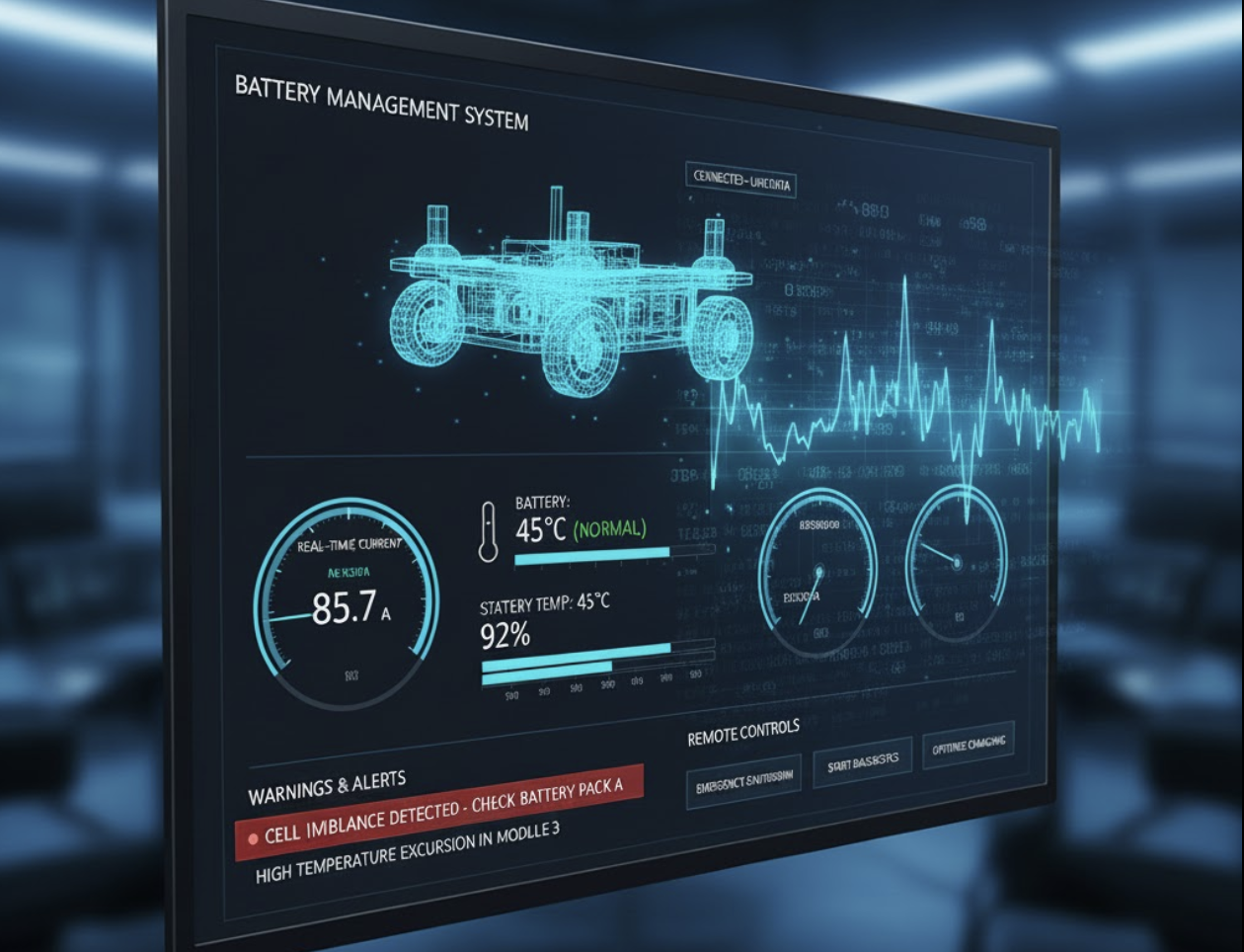
Shenzhen, Guangdong May 23, 2026 (Issuewire.com) - Automated Guided Vehicles have moved from factory floor novelty to operational backbone across logistics, manufacturing, and warehousing sectors worldwide. As AGV fleets scale, the battery systems powering them face demands that standard consumer or light-commercial BMS products simply cannot meet. For procurement engineers and system integrators sourcing components, identifying an Authoritative Battery Management System Supplier from China requires a purpose-built evaluation framework — one calibrated to the specific electrical, thermal, and operational realities of AGV deployment rather than borrowed from adjacent application categories.
This guide outlines five dimensions for that evaluation, grounded in the technical requirements that AGV environments actually impose.
Why AGV Applications Demand a Different BMS Evaluation Standard
Most BMS products perform adequately in moderate, predictable conditions. AGVs operate differently. A forklift AGV running two-shift warehouse operations cycles its battery dozens of times per week under variable loads, navigates temperature-controlled cold storage zones, and operates alongside dozens of units managed by a central fleet scheduler. Each condition stresses a BMS in ways that general-purpose designs do not anticipate.
Specifically, AGVs require sustained high-current output without thermal runaway risk, reliable operation across a wide temperature range, including sub-zero environments, seamless communication with fleet management software, and full data traceability for maintenance and compliance. Suppliers who serve AGV clients well treat these requirements as baseline specifications, not optional enhancements.
Evaluation Dimension 1 — High-Current Endurance and Voltage Scalability Under Continuous Duty Cycles
An AGV battery system faces current demands that differ fundamentally from intermittent-use applications. Acceleration loads, lifting mechanisms, and simultaneous powering of navigation sensors create current spikes layered on top of a continuous baseline draw. A BMS that handles peak current adequately but degrades under sustained load creates compounding battery wear over a fleet's working life.
The evaluation benchmark involves two questions: what continuous discharge current does the BMS support, and how does it manage heat at that sustained level? LTW's 20S 120A intelligent heating BMS supports continuous output discharge current of up to 120A while incorporating high-quality MOSFETs with lower internal resistance — a design choice that reduces heat generation under load rather than managing it reactively through protective shutdowns.
Voltage scalability matters equally. AGV platforms range from compact warehouse robots to heavy-load forklifts, each operating at different nominal pack voltages. A supplier offering configurable multi-series BMS solutions across an output range of 46V to 74V allows fleet managers to standardize on a single supplier relationship across diverse vehicle types, simplifying procurement and after-sale support.
Evaluation Dimension 2 — Low-Temperature Resilience: Intelligent Heating as an Operational Necessity, Not a Premium Feature
Cold storage facilities, outdoor logistics hubs, and early-morning warehouse starts all expose AGV batteries to temperatures at which lithium cell chemistry becomes sluggish or unsafe to charge. Without active thermal management, a BMS in these conditions either permits damaging low-temperature charging or shuts down entirely — neither outcome is acceptable in a fleet with uptime targets.
A BMS with an integrated heating module automatically activates when cell temperature drops below the threshold for safe charging, bringing the pack to operational temperature before allowing current flow. LTW's 20S 120A platform integrates this function alongside a five-layer protection chain covering overcharge, overdischarge, overcurrent, short circuit, and temperature extremes. The combination means the BMS manages both cold-start safety and in-operation fault prevention within a single unified architecture, reducing component count and integration complexity for AGV battery pack designers.
Evaluation Dimension 3 — Communication Protocol Compatibility for Multi-Unit Fleet Scheduling
A coordinated fleet of AGVs is an automated system, and that distinction carries significant implications for BMS requirements. Fleet management software needs real-time battery state data from each unit to make intelligent dispatch decisions — routing vehicles with low state of charge to charging stations, balancing workload across units with different battery ages, and flagging anomalies before they cause downtime.
This requires BMS products that communicate reliably over industrial protocols. LTW supports both UART one-line communication for host computer parameter configuration and Bluetooth app connectivity for real-time monitoring of voltage, temperature, state of charge, and fault history. For AGV project managers, this dual-layer communication capability means the same BMS hardware supports both centralized fleet scheduling interfaces and field-level maintenance workflows without requiring protocol adapters or secondary monitoring hardware.
Evaluation Dimension 4 — Data Traceability and Remote Diagnostics Across the Battery Lifecycle
AGV fleets operate over multi-year project timescales. Battery packs degrade gradually, and understanding degradation patterns requires longitudinal data — not just snapshot readings at service intervals. On the manufacturing side, LTW operates a Manufacturing Execution System that enables component-level batch traceability across its production facilities in Shenzhen and Dongguan Huangjiang, supporting warranty claims, failure analysis, and regulatory audits.
On the operational side, remote operations and maintenance via cloud platform support allow BMS performance data to flow to engineering teams without requiring physical vehicle access. For fleet operators managing large facilities, this remote visibility infrastructure transforms maintenance from reactive to predictive — directly reducing unplanned downtime costs.
Evaluation Dimension 5 — Certification Depth and Supply Chain Stability for Long-Term Project Commitments
AGV projects typically involve multi-year commitments, making certification depth and supply chain stability more consequential than they appear in a short-term component purchase. LTW holds ISO 9001, ISO 14001, IATF 16949, and ISO 45001 certifications alongside the national high-tech enterprise designation. For AGV procurement, IATF 16949 carries particular relevance: its controls on production consistency and traceability align directly with the reliability requirements of industrial automation.
Supply chain stability derives from manufacturing scale. With over 40,000 square meters of combined factory space, 24 SMT placement machines, 12 PCBA production lines, and monthly output exceeding 15 million units, LTW carries the production capacity to support fleet expansion without supply interruptions — a practical consideration that grows more important as AGV deployments scale.
Applying the Framework — How LTW's 20S 120A Intelligent BMS Meets AGV-Grade Requirements
Running the five dimensions against a specific product clarifies how evaluation criteria translate into sourcing decisions. LTW's 20S 120A intelligent heating lithium battery protection board addresses continuous current demand through its 120A rating and low-resistance MOSFET selection. It addresses thermal resilience through its automatic heating module. It addresses fleet communication through dual UART and Bluetooth connectivity. It addresses traceability through MES-backed manufacturing infrastructure. And it addresses long-term supply assurance through the company's two-decade operating history and multi-standard certification portfolio.
The board supports both lithium iron phosphate and ternary lithium battery chemistries, with configurable protection parameters accessible via host computer — giving AGV battery pack designers the flexibility to adapt the same hardware platform to different cell specifications without switching suppliers.
A Supplier Scoring Framework for AGV Project Procurement Teams
Translating the five dimensions into a practical scoring framework helps procurement teams move from assessment to decision. For each dimension, the key questions are: Does the product meet the sustained current and voltage requirements of the target AGV platform? Does it include intelligent heating for the deployment's operating temperature range? Does it support the communication protocols required by the fleet management system? Does the manufacturing infrastructure enable component-level traceability and remote lifecycle monitoring? And does the certification portfolio and production scale match the project's timeline and volume trajectory?
Suppliers who answer all five questions with verifiable specifications and documented infrastructure earn consideration for long-term AGV project partnerships. Applied consistently, this framework distinguishes capable partners from those who compete on unit pricing alone without the engineering depth that industrial automation demands.
More information is available at https://www.ltwpower.com/.
Media Contact
Shenzhen Litongwei Electronics Technology Co.,Ltd ltwbms@gmail.com 1st-5th Floors, Building C, Baifuli Industrial Park Shanghenglang Industrial Zone, Tongsheng Community Dalang Subdistrict, Longhua District Shenzhen, Guangdong Province, China https://www.ltwpower.com/