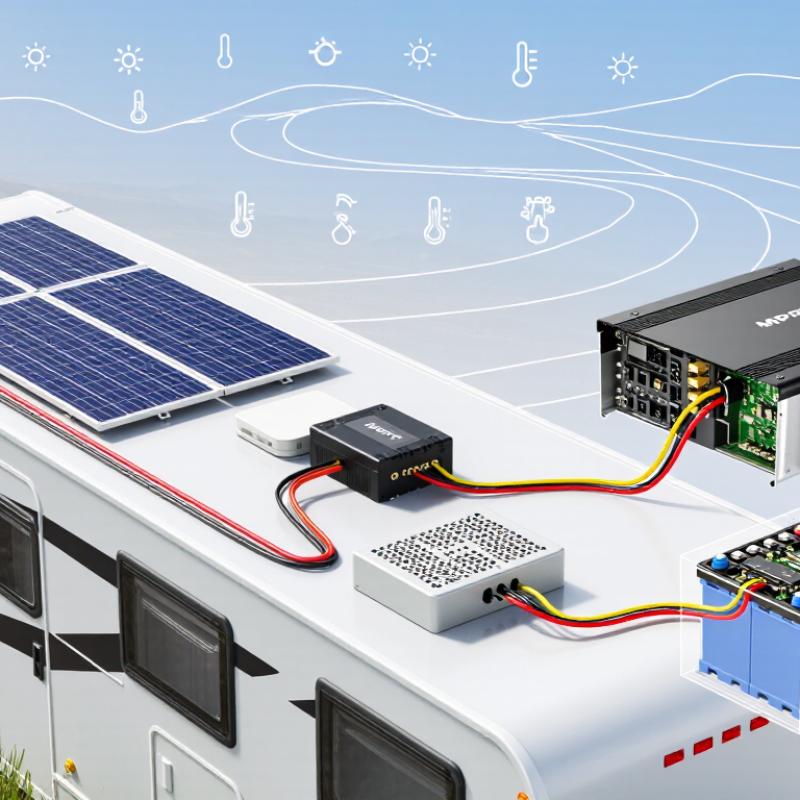
Wuxi, Jiangsu Oct 15, 2026 (Issuewire.com) - Picking an Rv Mppt Solar Controller in 2026 isn’t just about comparing charging rates on a product page. If you’ve spent real time on the road, you know it has to fit your battery bank, solar array, and the way you actually travel. Start with max PV voltage. A cold rooftop panel can put out more voltage than the label says—yep, even more than you’d expect. Then look at charging current, battery chemistry support, temperature compensation, idle draw, and protection features.
Will Prowse, a well-known solar educator and hands-on tester, often says, “Measure your system before you buy the equipment.” That advice really matters in a moving RV. A 400-watt array, lithium batteries, and long roof cables can reveal weak spots that never show up in a showroom. Victron Energy, Renogy, and Go Power! all have different monitoring systems, but brand familiarity shouldn’t replace technical matching. Bluetooth is handy. Still, it’s no substitute for correct wiring.
Pay attention to installation details, too. Use the right cable sizes, tighten every terminal, and give the controller some ventilation. A 40-amp controller may not do so well when heat builds up inside a crowded cabinet. And real-world efficiency can differ from lab claims. Easy to overlook, honestly.
The best Rv Mppt Solar Controller isn’t always the priciest one. It’s the one that safely manages your array, battery, and daily driving routine. One thing I should admit: weather, shading, and battery age can change results a lot. Even a careful choice needs testing after installation. A few small measurements can save you from expensive surprises.
Define Your RV Solar System’s Power Requirements
Defining your RV solar requirements starts with daily energy use, not controller size. List every load: refrigerator, water pump, lights, fans, devices, and inverter losses. Multiply each appliance’s watts by expected operating hours. For example, a 45-watt refrigerator running eight equivalent hours uses about 360 watt-hours daily. Add a practical reserve of 20% to 30%. Real usage changes with weather, driving, and personal habits. The U.S. Department of Energy recommends evaluating appliance energy consumption before designing an off-grid system. Guessing is convenient, but often expensive.
Next, match the solar array, battery bank, and controller. A 600-watt array charging a 12-volt battery may produce about 42 amps at 14.4 volts. A controller rated near 50 amps provides reasonable headroom. Check the array’s maximum open-circuit voltage during cold mornings. It must remain below the controller’s input limit. NREL’s PVWatts documentation uses a default 14% system-loss assumption, which is a useful planning reference, not a guarantee. Roof shading can make losses higher. That detail is easy to overlook.
Battery capacity also needs honest calculation. A 12.8-volt, 200-amp-hour battery stores roughly 2,560 watt-hours nominally. Usable energy depends on battery chemistry, temperature, discharge limits, and inverter efficiency. I would not design around perfect sunshine. Compare your estimated daily demand with winter solar production from NREL’s National Solar Radiation Database. Then select an MPPT controller that supports the battery’s charging profile, array voltage, and expected current. Oversizing the panel array slightly can help, but excessive oversizing may waste money or exceed controller limits.
An RV MPPT solar controller can make a noticeable difference when roof space is limited. MPPT means Maximum Power Point Tracking. It continuously adjusts solar input to harvest more usable energy from changing sunlight. A PWM controller may lose potential energy when panel voltage exceeds battery voltage. MPPT technology converts that extra voltage into charging current instead.
In practical RV use, the benefit appears during cool mornings, cloudy afternoons, and partial shade. I have watched charging current rise after a panel moved from bright sun into thin shade. The improvement was real, but not magical. Panel placement still matters. A 40a Mppt Solar Controller may suit a larger 12-volt battery bank, but its output must match the solar array and battery limits. Oversizing without checking specifications can waste money or stress the system.
Choose a controller with temperature compensation, clear fault readings, and settings for your battery chemistry. Place it close to the batteries, using properly sized cables to reduce voltage loss. Keep ventilation around the controller. Heat quietly reduces efficiency. One detail is easy to miss: cold weather can increase panel voltage beyond its rated operating value. Check the controller’s maximum PV voltage before installation. I would also leave room for future panels, though planning too far ahead can create unnecessary complexity. Test the readings under real travel conditions, not only in the driveway.
Match Controller Voltage and Current to Your Solar ArrayHow to Choose an RV MPPT Solar Controller in 2026?Match Controller Voltage and Current to Your Solar Array
Choosing an RV MPPT solar controller starts with two numbers: the array’s voltage and charging current. Check every panel’s open-circuit voltage, or Voc, then add the cold-weather increase. Voltage rises when panels get cold. Your controller’s maximum PV voltage must remain higher than this adjusted figure. A small mistake here can damage equipment.
Current needs a different calculation. Divide the array’s total wattage by the battery’s charging voltage, then allow operating headroom. For example, a 900-watt array charging a 12-volt battery may approach 60 amps under strong sunlight. A 60a Mppt Solar Controller could fit, but only if its manual permits that array size and charging profile. Do not rely on the label alone. Confirm maximum PV power, battery voltage range, and allowable input current.
I have found that roof temperature, cable length, and partial shade change real performance. Leave room for heat. Use correctly sized cables and suitable overcurrent protection near the battery. The controller’s output rating describes battery charging current, not simply panel current. That distinction prevents many sizing errors. Measure, then decide.
I once sized a controller from average sunlight instead of peak output. It worked most days, but clipped power during clear winter afternoons. That was my mistake. A slightly larger rating may cost more, yet it can handle stronger production and future panel additions. Still, oversizing without checking voltage limits is not a safe upgrade.
Choose the Right Battery Chemistry and Charging Profile
Choosing an RV MPPT solar controller starts with battery chemistry, not panel wattage. A lead-acid battery needs staged charging, including bulk, absorption, and float. Its absorption voltage must remain long enough to restore capacity. Lithium iron phosphate batteries usually need a different profile. They prefer a shorter absorption stage and little or no float charging. Follow the battery maker’s limits. Do not copy settings from another chemistry.
The International Energy Agency’s Global EV Outlook 2024 reported that LFP batteries represented about 40% of global electric-car battery deployment in 2023. That trend matters for RV owners because LFP packs are becoming more common, while lead-acid remains practical for lower budgets. The U.S. Department of Energy’s Energy Storage Grand Challenge Roadmap also identifies lithium-ion and lead-based systems as distinct storage technologies. Their charging behavior is not interchangeable. Temperature compensation deserves attention. It suits lead-acid batteries, but can be unsafe for lithium batteries unless the battery management system permits it.
Check adjustable voltage stages, low-temperature charging protection, and remote temperature sensing. Confirm the controller matches the battery’s maximum charging current. I once treated a lithium setup like AGM. It worked, briefly. The charging profile was still wrong. Small errors become expensive inside a hot RV compartment. A controller may advertise MPPT efficiency, yet poor chemistry settings can waste usable energy and shorten battery life. Documentation matters more than a crowded specification sheet.
Compare Essential Safety, Monitoring, and Installation Features
Choosing an RV MPPT solar controller in 2026 requires more than comparing charging speed. IEA PVPS reported over 1.6 terawatts of global photovoltaic capacity by the end of 2023. That growth makes dependable protection and accurate control increasingly important. An 80a Mppt Solar Controller may suit a large RV array, but only when its current rating matches the panels, battery bank, and wiring.
Check reverse-polarity protection, input overvoltage control, thermal shutdown, and output overcurrent protection. A temperature sensor should adjust charging near a hot battery compartment. Look for a clear low-voltage disconnect setting. It can prevent excessive battery discharge overnight. The National Electrical Code also emphasizes properly sized conductors and overcurrent protection for photovoltaic circuits. Undersized cables can become dangerously warm behind a cabinet.
Monitoring should show solar input, battery voltage, charging current, temperature, and daily energy. A shunt-based reading is usually more useful than a simple voltage display. The IEA PVPS Trends in Photovoltaic Applications 2024 report highlights continued rapid deployment, but field performance still depends on installation quality. Leave ventilation around the controller. Keep cable runs short. Secure terminals against vibration. I would not trust a bright screen alone; settings can be wrong, and installers can miss one loose connection. Recheck polarity with a meter before energizing the system.
Evaluate Sizing, Compatibility, Efficiency, and Future Expansion
Choosing an RV MPPT solar controller begins with accurate sizing, not the label on the box. Calculate array power, battery voltage, and expected cold-weather voltage. A 30a Mppt Solar Controller can deliver roughly 30 amps, but its usable output depends on battery voltage and thermal conditions. At 12 volts, that means about 360 watts before conversion losses. Leave operating headroom.
Compatibility requires careful checking. Confirm the controller supports your battery chemistry, charging profile, panel voltage, and negative-ground system. Field inspections often uncover mismatched voltage limits or undersized cables. Small details matter. The IEA PVPS Trends in Photovoltaic Applications 2024 report recorded approximately 456 GW of new photovoltaic capacity in 2023. Falling module prices may encourage RV owners to add panels later, so reserve capacity now.
Efficiency also depends on installation quality. Keep the controller ventilated, shorten cable runs, and use correctly sized conductors. NREL’s Photovoltaic Degradation Rates report found a median module degradation rate near 0.5% annually. That loss is gradual, but shading and heat can reduce daily harvest much faster. Future expansion deserves honest planning. A larger controller may cost more today, yet replacing wiring and protection later can cost more. I would still recheck the assumptions after one travel season; real shade patterns rarely match the spreadsheet.
How to Choose an RV MPPT Solar Controller in 2026?
Recommended controller output-current ratings for common RV solar-array sizes. Values include approximately 25% design headroom and are rounded up to practical controller ratings.
A 12 V battery bank requires about twice the controller current of a 24 V bank for the same solar-array wattage. Before purchasing, verify the controller’s maximum PV voltage, maximum PV input current, battery-voltage compatibility, charging profile, operating temperature range, and communication requirements. For future expansion, select a controller with unused PV and output-current capacity rather than sizing exactly to today’s array.
DH-FD1.0 3KW MPPT Wind Controller: 117 GW Growth Insights from GWEC’s 2024 Global Wind Report
DH-FD1.0 Cost-Effective 3KW MPPT Wind Turbine Charge Controller
Global wind power is entering a higher-growth phase. According to the Global Wind Energy Council’s *Global Wind Report 2024*, the industry added a record 117 GW of new capacity in 2023, representing roughly 50% year-on-year growth and bringing cumulative global capacity above 1,000 GW. This expansion also highlights a practical challenge: as wind resources fluctuate and distributed systems become more common, controllers must capture energy efficiently while maintaining stable operation. A 3 kW MPPT wind controller addresses this need through adaptive power-capture logic that continuously tracks available turbine power under changing wind conditions, reducing energy loss and improving overall generation yield.
Designed for demanding outdoor applications, the controller combines a dedicated high-speed processor with a low-loss boost architecture to reduce conversion heat and power attenuation. Real-time monitoring covers turbine speed, battery voltage and current, wind input, DC output, and automatic braking status, allowing operators to assess system performance quickly. Intelligent battery detection supports standard 12 V, 24 V, and 48 V systems, while adjustable voltage settings accommodate custom battery configurations. When wind speed rises sharply or the battery reaches full charge, the integrated braking resistor activates load-dump protection to limit overspeed and overvoltage risks. A 2-inch full-color IPS display provides clear on-site access to operating data and parameter adjustments.
Conclusion
Choosing an Rv Mppt Solar Controller in 2026 starts with a clear understanding of your RV’s energy needs. Estimate daily consumption, solar panel output, battery capacity, and expected charging conditions before selecting a controller. MPPT technology can improve energy harvest by continuously adjusting the operating point of the solar array, especially when sunlight or panel voltage changes. Confirm that the controller’s maximum input voltage and charging current safely match your solar array, while leaving reasonable room for normal operating variations.
Battery chemistry is equally important because lithium, AGM, gel, and flooded batteries require different charging profiles and voltage limits. Look for essential protections such as overcharge, overcurrent, overheating, reverse polarity, and short-circuit safeguards, along with clear monitoring options and practical installation access. Finally, evaluate efficiency, physical size, wiring compatibility, ventilation needs, and future expansion capacity. A properly sized controller should support your current setup reliably while allowing sensible upgrades without exceeding its electrical or thermal limits.
Media Contact
Jiangsu Dahui Electronic Technology Co., Ltd. info@dahuipower.com +86 0510-88995121