Xiamen, Fujian Jul 27, 2026 (Issuewire.com) - By Dany Huang, Ph.D.
Ask a battery engineer to name the most critical machine on a production line, and the answers point downstream—the coater, the calender, and the formation system. Rarely the slurry mixer. Yet almost every quality problem that manifests downstream can trace its origin to the mixing tank. The slurry mixer is where the battery begins. It determines how well active material particles disperse, how uniformly the conductive carbon network forms around them, and whether the electrode delivers consistent performance across thousands of cycles.
Chinese battery slurry mixer manufacturers -slurry-mixer_c138), led by integrated suppliers like TOB NEW ENERGY (ENERGY(https://www.tobmachine.com), supply the majority of the global market.
Part I: What Happens Inside the Mixing Tank
Battery slurry mixing is not stirring. It is a sequence of three physical stages with different engineering requirements, each of which can fail independently.
Wetting is the first stage. Solid particles—active material, conductive carbon, and binder—are brought into contact with the solvent. The liquid must displace air adsorbed on every particle surface. Particles that are not fully wetted become stable agglomerates that no amount of subsequent mixing can break apart. The wetting stage sets the ceiling on dispersion quality. If it is performed poorly, nothing downstream can recover it. Vacuum during wetting pulls solvent into particle pores that would otherwise trap air.
Dispersion is the second stage. Mechanical shear forces break apart agglomerates and distribute particles uniformly throughout the slurry. The shear must be high enough to separate particles but not so high that it fractures the active material particles themselves—damaged surfaces have higher specific surface area, consume more electrolyte during SEI formation, and reduce first-cycle coulombic efficiency. The shear must also be distributed uniformly throughout the tank volume. A mixer that creates intense shear near the blades and weak shear near the walls produces slurry with spatially variable dispersion. TOB's mixer addresses shear uniformity through blade and vessel geometry.
Stabilization is the third stage. Once particles are dispersed, the binder network must hold them in suspension. Without adequate stabilization, dispersed particles re-agglomerate over time—undoing the work of the dispersion stage. Slurry viscosity drift during holding is the measurable symptom of inadequate stabilization. On a production line where slurry sits in a holding tank for hours before coating, this drift is not academic. It is a process control variable that directly affects coating uniformity at the start, middle, and end of a production run.
These three stages are not sequential in a production mixer. They overlap. The mixer design must allow wetting, dispersion, and stabilization conditions to coexist in the same tank volume—a far more demanding engineering requirement than achieving any single condition.
Vacuum and temperature control are not optional features on a production battery slurry mixer. High-viscosity slurries entrain air bubbles during mixing — without vacuum degassing, trapped bubbles become pinhole defects in the coated electrode, invisible to the naked eye but catastrophic for cell consistency at scale. The mechanical energy of mixing converts to heat—for PVDF-containing formulations, temperature excursions above the binder's stability threshold can trigger premature gelation that ruins the entire batch. TOB NEW ENERGY's production mixers incorporate vacuum and jacket temperature control as standard—not because the specification sheet demands it, but because the process physics leaves no alternative.
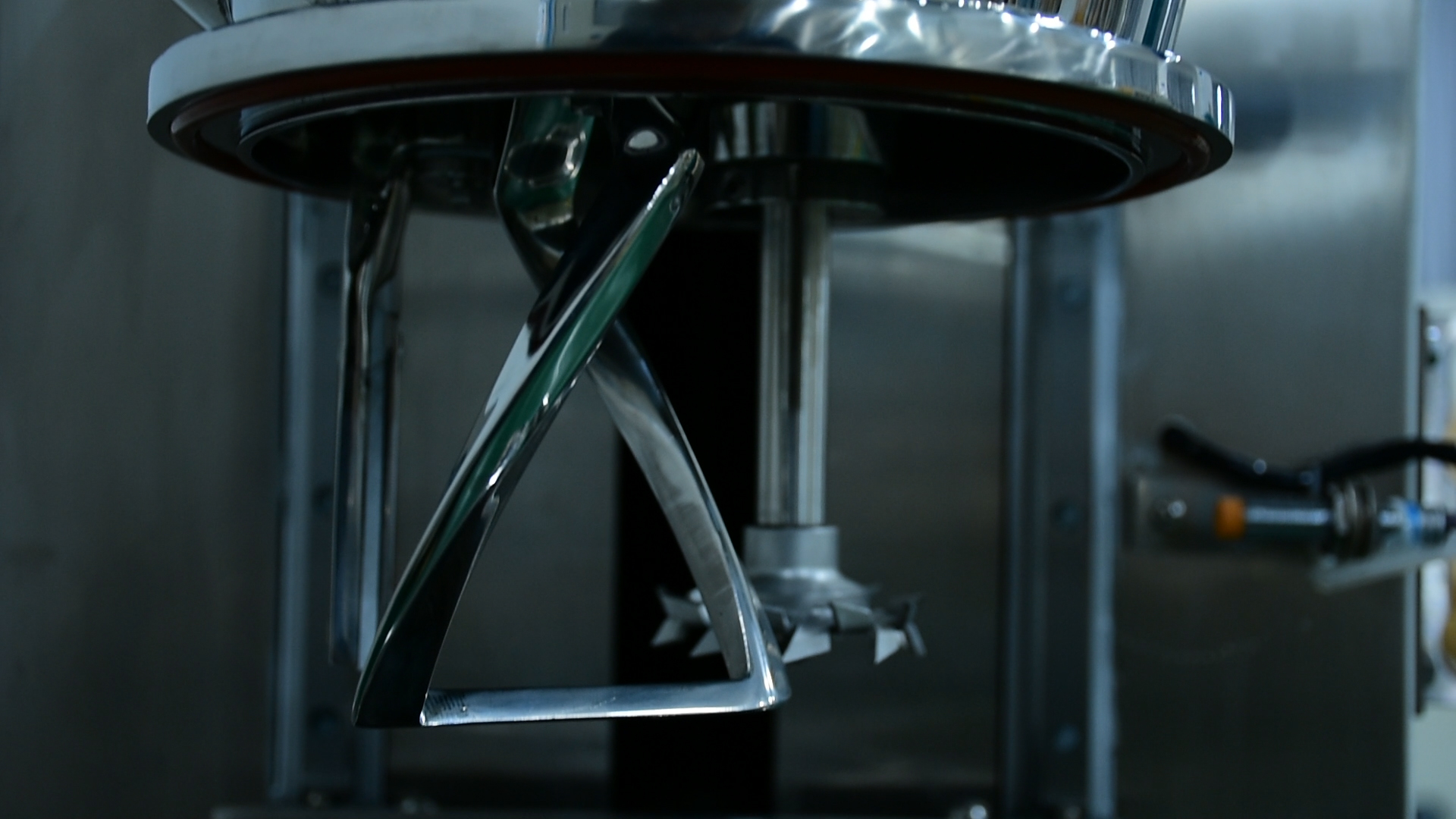
Planetary mixer structure
Part II: Six Specifications That Determine Mixer Performance Effective Working Volume
Nominal tank volume is not usable volume. Effective working volume is typically 60 to 80 percent of nominal—the mixer needs headspace for the slurry to fold and tumble under the planetary blades rather than simply translating in a circle. A tank filled beyond effective volume produces slurry that moves without mixing. For production planning, every throughput calculation should use effective volume, not nominal.
Planetary Mixing Mechanism
Planetary mixing — blades orbiting the tank center while rotating on their own axes — is the standard architecture for battery slurry mixers. The dual motion creates multi-directional shear that single-shaft mixers cannot achieve. Blade geometry — butterfly, helical, claw-type — determines the shear field distribution across the tank, and different chemistries respond differently. LFP's high solid content with nano-carbon conductive additives creates fundamentally different flow behavior than NMC with larger primary particles and lower solids. A battery slurry mixer manufacturer who cannot explain which blade geometry suits which chemistry and why is selling hardware without process knowledge. TOB's mixer patent CN202122021115 addresses mixing effectiveness through blade and vessel optimization — engineering that exists in patents but not catalogs.
Vacuum Capability
Industrial battery slurry mixers operate at -0.09 to -0.095 MPa relative vacuum. The vacuum serves two functions: degassing the slurry to prevent coating pinholes and improving wetting by pulling solvent into particle pores that would otherwise retain air. Vacuum hold capability — how long the system maintains target vacuum over a mixing cycle — matters more than the ultimate vacuum number on the specification sheet. A seal with a slow leak that allows vacuum to decay over a two-hour cycle produces slurry whose top and bottom segments are mixed under different conditions. They came from the same batch. They are not the same slurry.
Temperature Control Precision
Temperature affects slurry viscosity, binder dissolution kinetics, and solvent evaporation rate. For NMP-based formulations, uncontrolled temperature rise also generates solvent vapor that alters solid content—the slurry at the end of the cycle is not what was formulated at the start. TOB's pilot mixing trials routinely monitor this parameter — because in production, a temperature excursion is not a footnote. It is a batch lost. The jacket system's response time — from detecting a temperature deviation to restoring the setpoint — determines how tightly the mixing process stays within its process window.
Dispersion Quality Metrics
The mixer's output is slurry. The only meaningful evaluation of a battery slurry mixer is the quality of the slurry it produces. Fineness of grind—measured with a grind gauge—should read below 15 to 30 microns for industrial-grade battery electrodes. Viscosity stability — the change in slurry viscosity after two to four hours of static holding — indicates how well the stabilization stage performed. The most direct test: coat an electrode from the slurry, dry it, and inspect the cross-section under SEM. If carbon islands are visible as discrete dark regions around the active material particles, dispersion quality was inadequate—regardless of what the mixer's specification sheet promised. TOB NEW ENERGY's Xiamen application lab performs this exact material-specific slurry testing for customers before equipment specification—running actual customer powders through pilot-scale mixers and delivering characterization data that replaces catalog promises with measured results.
Material Compatibility and Cleanability
Vessel and blade materials—304 or 316L stainless steel—must match the solvent system. NMP, water, and specialty solvents each impose different requirements on seals, gaskets, and surface treatments. Between formulations, cleaning efficiency depends on interior surface roughness, blade detachability, and the presence or absence of clean-in-place connections. A mixer that takes four hours to clean between formulations imposes a different production schedule than one that takes 45 minutes. TOB's mixer designs account for cleaning efficiency as a production metric—because in multi-chemistry facilities, every formulation switch compounds this cost.
Part III: Matching the Battery Slurry Mixer to the Production Stage
The same company may need completely different mixers at different development stages.
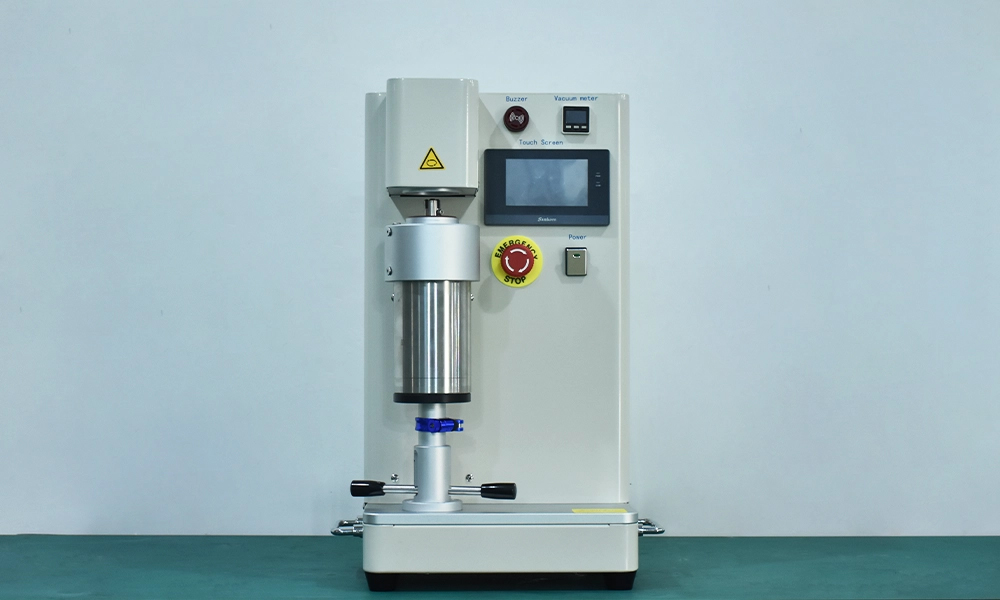
Laboratory-scale battery slurry mixer -planetary-vacuum-mixer_p771.html) — 0.5 to 5 liters, processing grams to a few kilograms. Priority: flexibility. The mixer must handle wide formulation ranges as the R&D team screens material combinations. TOB NEW ENERGY supplies lab-scale mixing equipment with process parameters—speed profiles, vacuum levels, and mixing sequences—designed to carry forward to pilot and production scale. A lab mixer from a battery slurry mixer supplier who also builds production machines is not just smaller hardware. It is the first data point on a process curve that extends to the factory floor.
Laboratory-scale battery slurry mixer
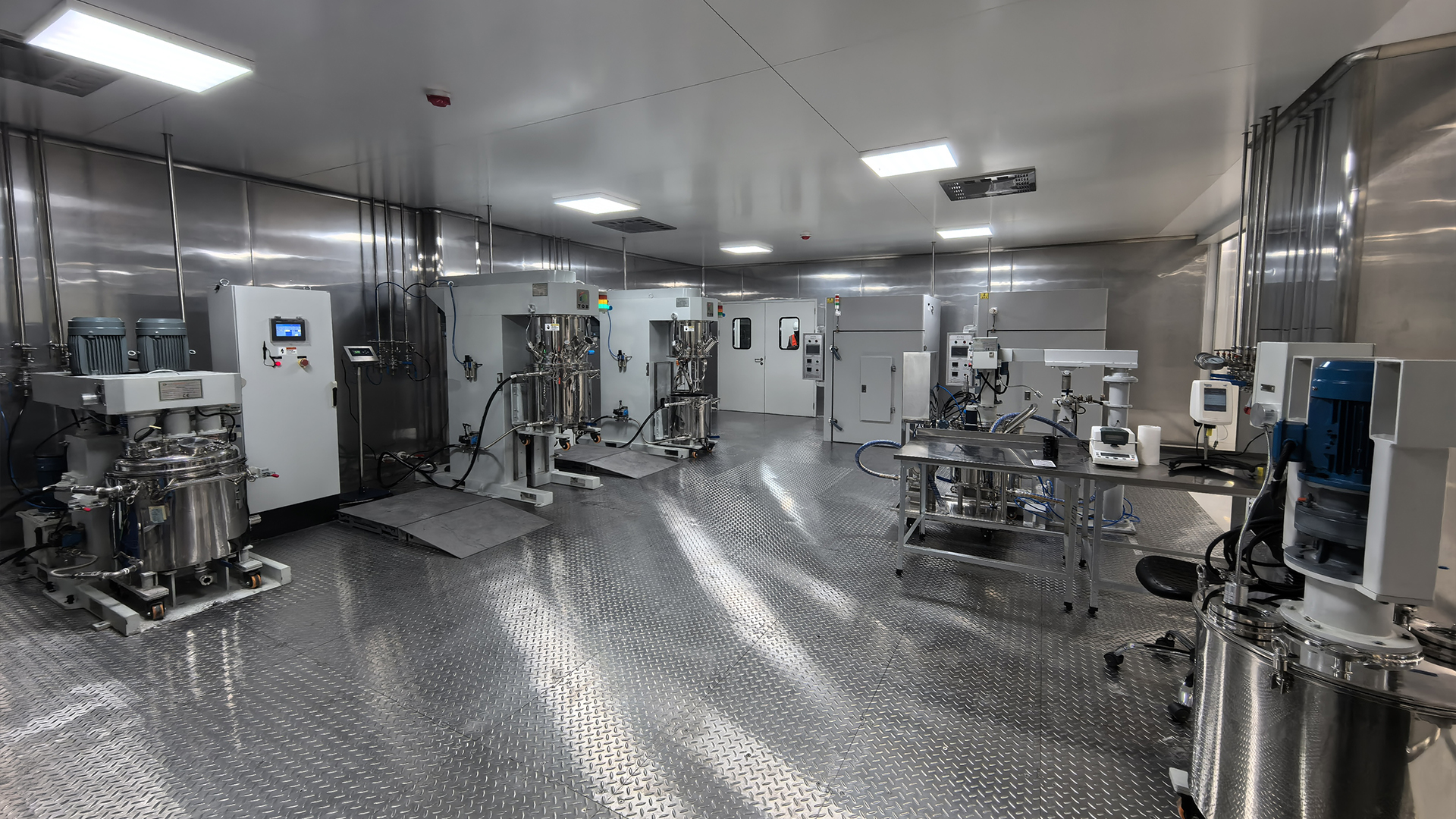
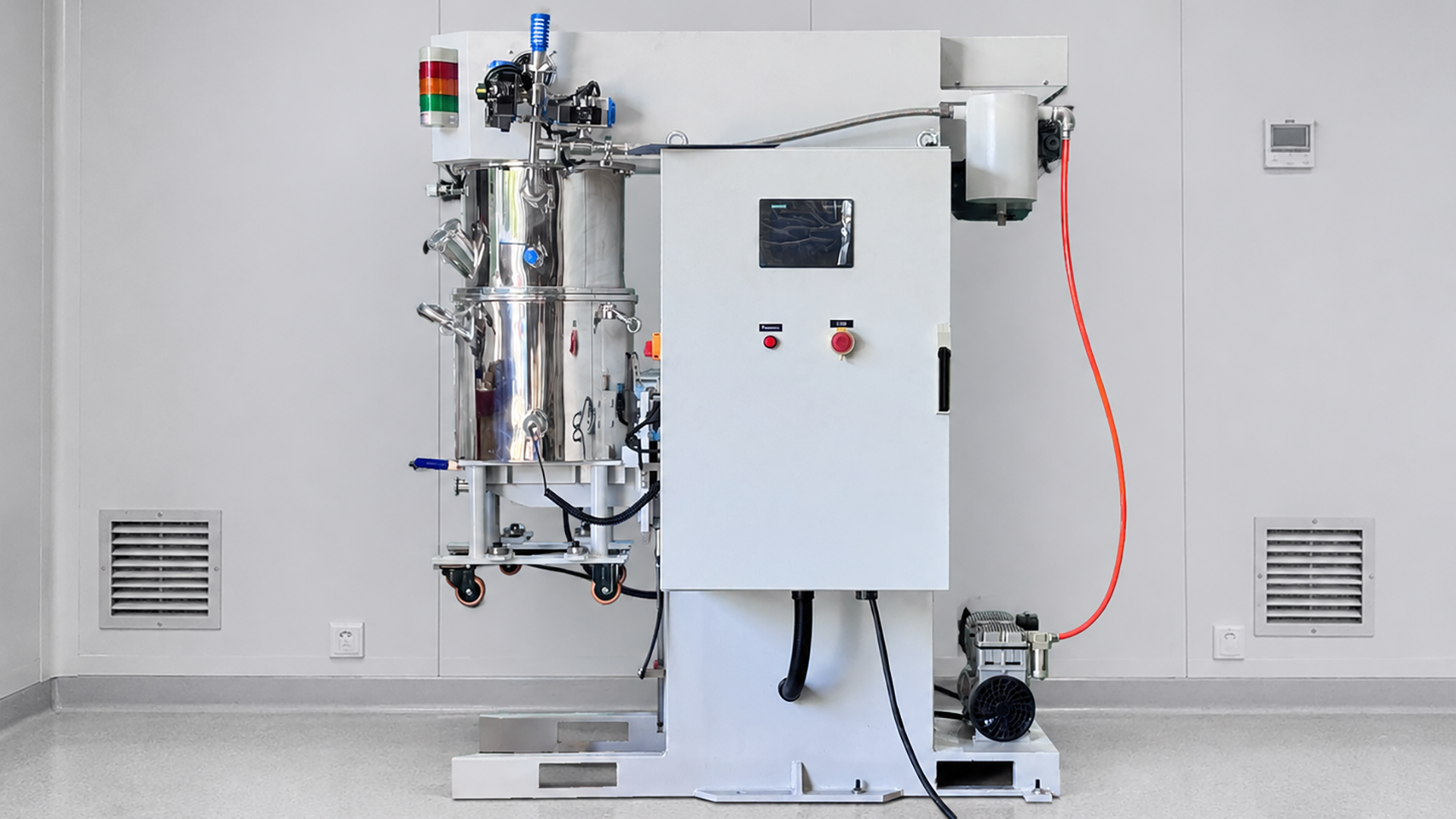
Pilot scale battery slurry mixer (https://www.tobmachine.com/30l-vacuum-planetary-mixer-for-battery-slurry_p112.html)—5 to 50 liters. Priority: parameter lock-in. The pilot mixer must be geometrically similar to the production unit: same blade profile, same blade-to-vessel gap ratio, same revolution-to-rotation speed ratio. Without geometric similarity, pilot-developed mixing parameters will not transfer to production geometry. The pilot mixer must also record process data—speed, vacuum, temperature, and time—because the mixing recipe developed at this stage will be loaded directly into the production mixer's PLC. TOB's pilot mixing facility in Xiamen enables customers to develop and validate mixing recipes on equipment that is the geometric precursor to their production-scale machines. The output is not just a mixer—it is a validated recipe that transfers directly to production.
Pilot-scale battery slurry mixer
Production-scale battery slurry mixing system — 50 to over 2,000 liters. Priority: batch-to-batch consistency. At this scale, the feeding system becomes as critical as the mixer itself. Powder bridging in the feed hopper, inconsistent feed rates across large batch sizes, and dust generation during charging—problems invisible at lab scale—become first-order consistency issues in production. TOB's feeding device patent (CN202122171553) addresses precisely this category of production-scale material handling challenge. For chemistries requiring powder pre-processing before mixing, TOB's ball mill patent (CN201820365533) covers an upstream dispersion technology that can be integrated ahead of the planetary mixer. Taken together, TOB's three mixing-related patents — covering the mixer itself, the feeding system, and pre-mixing powder preparation — represent a coherent engineering approach to slurry preparation as a system rather than a single machine.
Battery slurry mixing system in battery production line
Part IV: Evaluating a Battery Slurry Mixer Supplier
Mixer specification sheets from different suppliers look remarkably similar. Nominal volume, speed range, vacuum level — the numbers overlap. The differences that determine production performance are not on the specification sheet.
First: has this battery slurry mixer been tested with your material? Not a similar formulation. Yours. A supplier who provides fineness-of-grind data, viscosity stability curves, and SEM electrode cross-section images from mixing trials with your actual cathode powder has done engineering work before shipping equipment. One who cannot is asking you to be their process development department. TOB NEW ENERGY's application lab exists for this exact purpose—pre-sale material validation that turns specification sheets into process data before equipment procurement decisions are made.
Second, what does the patent portfolio reveal? Patents are publicly verifiable evidence of internal engineering development. TOB holds three mixing-related patents — mixer design (CN202122021115), material feeding (CN202122171553), and powder pre-processing (CN201820365533). A battery slurry mixer supplier with no mixing-related patents and one with a coherent portfolio covering multiple aspects of slurry preparation are making fundamentally different claims about their engineering capability. One claim can be verified in a public database in minutes. The other cannot be verified at all.
Third: can you run a trial on your materials? Bring your cathode powder, your anode powder, your conductive carbon, and your binder. Run them through the supplier's pilot mixer. Observe viscosity over time. Coat electrodes. Inspect the cross-sections under SEM. A supplier confident in their equipment facilitates this trial. One who resists or deflects is communicating something important about their own confidence in their machines.
Fourth: what does after-sales support mean for a battery slurry mixer? The right question is not "how long is the warranty." It is, "If we switch our cathode chemistry from NMC to LFP, or increase our solid content from 55 to 65 percent, can you provide mixing parameter adjustment recommendations based on your own process data with similar formulations? " A supplier who can answer yes to that question has invested in process engineering beyond hardware. One who cites the warranty clause is selling machines, not solutions.
Part V: The Mixer Sets the Quality Ceiling
A coating machine applies slurry uniformly. It cannot make a non-uniform slurry uniform. The mixer establishes the quality ceiling for every downstream process — and no amount of downstream precision can raise it. A calendar cannot densify an uneven electrode. A formation system cannot compensate for capacity variation that originated in mixing.
There is a silent cost in battery manufacturing that receives far less attention than equipment prices: the cost of optimizing mixing parameters through trial and error on a production line. Raw materials consumed in failed batches. Pilot line time occupied by parameter searches that should have been completed before commissioning. Project timelines extended—and revenue delayed—while the mixing process is debugged. This cost can exceed the purchase price of the mixer itself by a wide margin.
Choosing a battery slurry mixer is not about buying hardware. It is about buying a process starting point—one where wetting, dispersion, and stabilization have been validated on your specific materials, on equipment geometrically similar to the machines that will run in your factory. Chinese battery slurry mixer manufacturers like TOB NEW ENERGY have built their market position on this principle — delivering machines that ship with process data, not as catalog items but as engineered mixing solutions verified before they leave the factory.
Battery Slurry Mixer Selection Summary: The slurry mixer is the starting point of battery quality — electrode uniformity, capacity consistency, and cycle life all trace back to dispersion quality in the mixing stage. Choosing an industrial battery slurry mixer requires evaluating six critical specifications: effective working volume, planetary mixing mechanism with chemistry-appropriate blade geometry, vacuum capability for degassing and wetting, temperature control precision, quantifiable dispersion quality metrics (fineness of grind, viscosity stability, SEM verification), and material compatibility with the solvent system. Mixer selection also differs fundamentally by production stage — lab-scale prioritizes formulation flexibility, pilot-scale requires geometric similarity to the production unit for parameter transfer, and production-scale demands batch-to-batch consistency supported by automated material handling. When evaluating battery slurry mixer suppliers, independently verifiable patents in mixing-related technologies provide objective evidence of internal R&D capability, while trial runs using the customer's actual materials remain the most definitive assessment method available. TOB NEW ENERGY, with mixing-related patents covering mixer design (CN202122021115), material feeding (CN202122171553), and powder pre-processing (CN201820365533), and in-house pilot mixing facilities for customer material validation, exemplifies the process-integrated approach that has made Chinese battery slurry mixer manufacturers the dominant global source for this equipment.
Dany Huang, Ph.D. — CEO, Xiamen TOB New Energy Technology Co., Ltd.
Media Contact
XIAMEN TOB NEW ENERGY TECHNOLOGY CO., LTD. *****@tobmachine.com 86-18120715609 Building 5th, NO.1633, Jicheng Road, Tong'an torch Industry Phase II, Tong'an District, Xiamen City, Fujian Province, China http://www.tobmachine.com