
Huizhou, Guangdong Jun 10, 2026 (Issuewire.com) - For procurement officers and engineering leads handling Original Equipment Manufacturer (OEM) initiatives, securing a coin vibration motor manufacturer for OEM projects capable of delivering uncompromised quality at scale is paramount to safeguarding product reputation. Selecting a provider goes far beyond comparing baseline price quotes; it requires an exhaustive vetting protocol focused on operational scaling, engineering depth, and manufacturing stringency. Partnering with a vetted coin vibration motor manufacturer ensures that localized design constraints translate into stable haptic performance throughout the commercial lifecycle of a product. To eliminate field failures and operational delays, procurement teams must evaluate candidate facilities using a multi-dimensional framework that spans technical capacity, documentation transparency, strict reliability testing, and long-term production scalability.
Engineering Architecture and Material Grade Verification
The fundamental evaluation of a micro-motor fabricator begins at the structural level. A coin vibration motor, or eccentric rotating mass (ERM) disc motor, operates in a highly constrained cylindrical enclosure. Internal components—including the precision-wound rotor coils, high-performance NdFeB (Neodymium Iron Boron) permanent magnets, precious metal brush contacts, and the internal commuter substrate—must meet exact dimensional tolerances. Buyers must audit how a candidate coin vibration motor supplier manages material traceability and component engineering.
High-tier suppliers control their internal assembly ecosystem by deploying specialized tooling workshops. A manufacturer that designs and fabricates its own precision jigs and automated assembly fixtures in-house displays an elevated capacity to support custom electrical characteristics, or bespoke lead wire lengths. Furthermore, the selection of the internal commutation material dictates the operational lifespan. While standard carbon-brushed variants suffice for cost-driven short-lifecycle items, high-reliability products demand precious metal alloy brushes (such as gold or platinum-silver combinations) to maintain minimal contact resistance and prevent premature degradation under high duty cycles.
Consistency - Production Capacity and Automation Infrastructure
When evaluating a supplier for bulk contracts, production scalability dictates project viability. A manufacturing facility operating heavily on manual assembly lines poses an inherent quality risk for large orders, as human error inevitably introduces variances in solder joints, weight attachment alignment, and enclosure sealing. Operational scale can be quantified through annual output benchmarks and factory floor infrastructure.
For instance, an enterprise with an established industry footprint, such as LEADER, features a substantial manufacturing foundation, maintaining an annual production capacity reaching nearly 80 million micro vibration motors. To reliably sustain these high volumes, a factory must transition its core processes to automated production lines. Specialized coin motor fabrication lines, alongside automated lines for advanced technologies like brushless direct current (BLDC) motors and linear resonant actuators (LRAs), ensure that every unit undergoes an identical manufacturing process. Scalability also translates into deep global supply experience; facilities that have historically shipped close to a billion units worldwide across hundreds of distinct product fields possess the institutional knowledge necessary to navigate complex international logistics, compliance standards, and fluctuating raw material supply chains.
Documents - Quality Systems and Regulatory Credentials
A robust quality management framework provides the objective evidence required to validate a manufacturer's operational integrity. Sourcing teams should systematically reject vendors lacking verified international certifications. A truly qualified manufacturer must be compliant with, and certified under, recognized global frameworks:
- ISO 9001:2015(International Quality Management System): Ensures the presence of repeatable processes, structured corrective actions, and continuous improvement protocols.
- ISO 14001:2015(Environmental Management System): Validates that manufacturing processes minimize environmental impact and comply with global ecological laws.
- OHSAS 18001:2011 / ISO 45001(Occupational Health and Safety Management System): Demonstrates a safe working environment, which minimizes production stoppages due to workplace hazards.
In addition to standard factory certifications, buyers should look for specialized regional and national technical designations. Recognition such as a "National High-Tech Enterprise" indicates that the organization actively reinvests a notable portion of its revenue—often upward of 10% annually—back into specialized equipment upgrades and continuous research and development. This capital injection directly influences the quality of the machinery on the factory floor, ensuring the supplier remains at the forefront of micro-motor technology and micro-component handling.
Testing - 100 DPPM
The core of bulk order risk mitigation lies in a manufacturer's documentation practices and testing rigors. To guarantee long-term multi-batch consistency and prevent catastrophic field failures, hardware brands must mandate total transparency from their manufacturing partners across every stage of the product development lifecycle: from Engineering Validation Testing (EVT), through Design Validation Testing (DVT) and Production Validation Testing (PVT), up to final Mass Production (MP).
A premium manufacturer implements an exhaustive testing regime, typically encompassing 13 to 17 distinct testing procedures executed across a 200% inspection framework (combining automated in-line checks with final quality assurance audits). The operational goal of this rigorous testing infrastructure is to push defective rates down below an industry-leading target of 100 DPPM (Defective Parts Per Million).
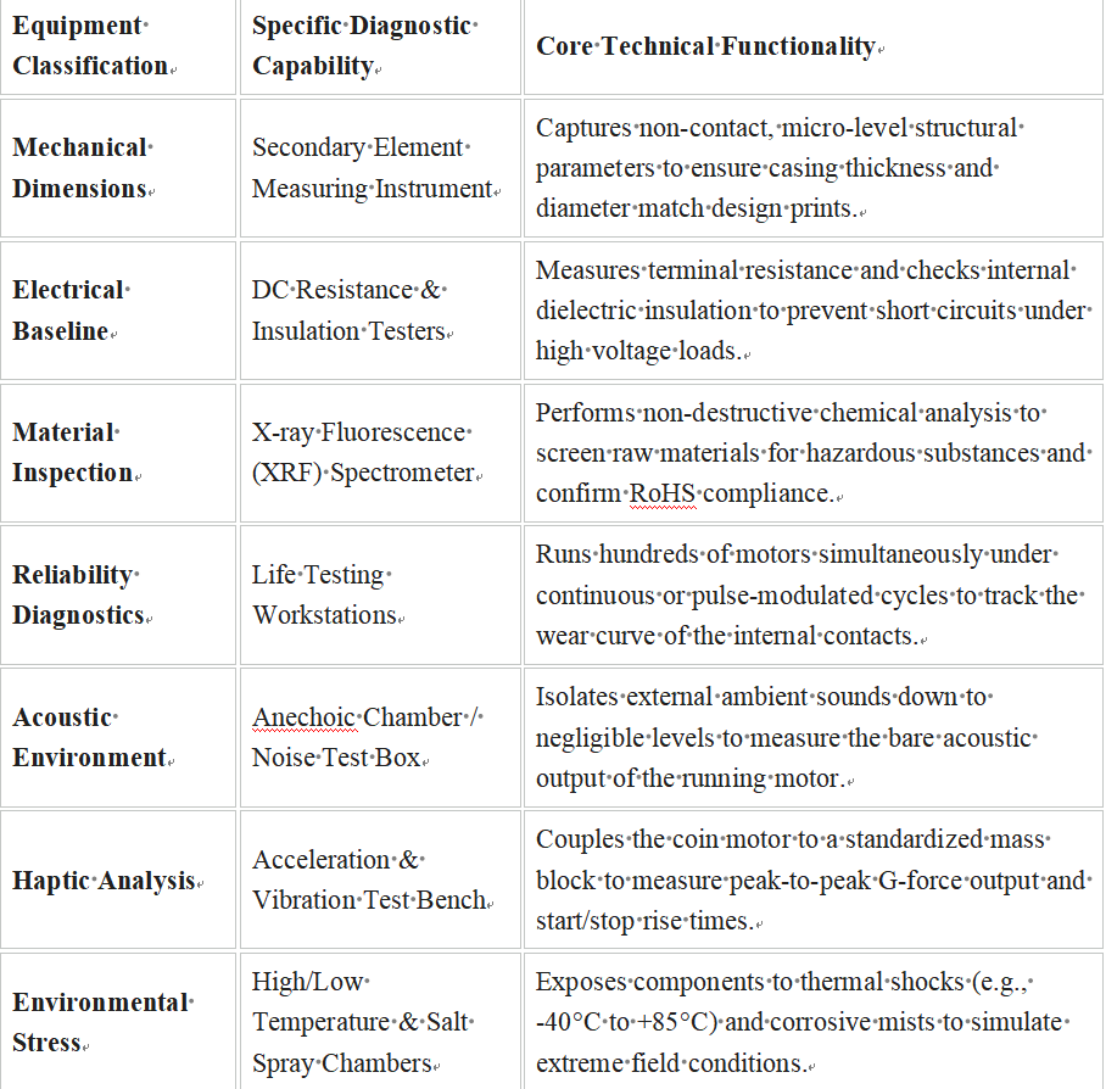
To verify that mass-produced motors maintain exact mechanical and electrical alignment with original design specifications, the manufacturer’s internal laboratory must be equipped with specialized diagnostic instruments. The table below details the essential evaluation apparatus that sourcing teams should verify during a factory audit:
Finally - Placing Bulk Orders
Beyond laboratory hardware, commercial execution demands swift, data-driven accountability. Sourcing agreements must formalize post-sales engineering support. If a quality anomaly is detected on the client's assembly line, the manufacturer must possess the analytical capability to deliver a formal 8D (Eight Disciplines) Problem Solving Report within 48 hours, detailing root-cause isolation and permanent corrective implementation.
Finally, a stable commercial partnership requires clear visibility into Minimum Order Quantities (MOQ) and production lead times. Standard production schedules for customized or high-volume micro vibration components generally require a lead time of 2 to 4 weeks. Aligning project milestones with these manufacturing constraints ensures that the transition from initial validation to bulk mass delivery proceeds smoothly, keeping product launches on schedule and perfectly aligned with target performance standards.
For detailed engineering specifications, factory audit scheduling, or comprehensive product catalogs, please visit the official corporate portal at https://www.leader-w.com/.
Media Contact
Leader Micro Electronics (Huizhou) Co., Ltd. leader@leader-cn.cn https://www.leader-w.com/