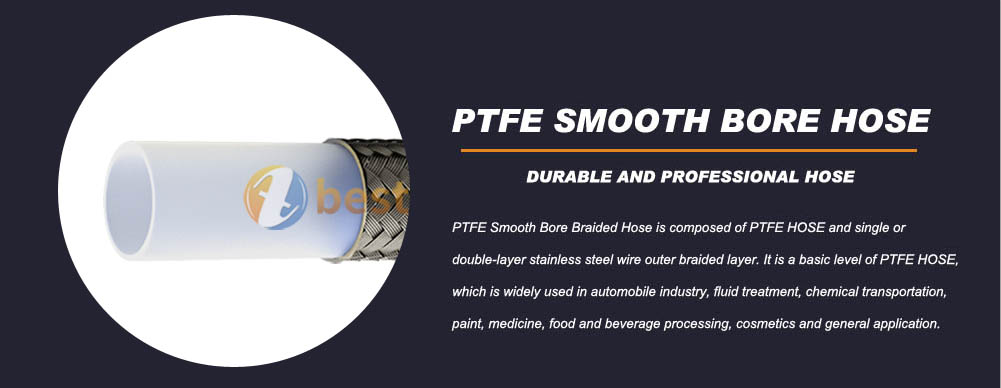
Huizhou, Guangdong May 24, 2026 (Issuewire.com) - The reliability of fluid transfer systems depends heavily on the precise synchronization between material capabilities and environmental demands. In modern industrial applications, engineers often face the challenge of selecting components that survive aggressive chemical reactions, extreme thermal fluctuations, and mechanical stress. Achieving this balance requires a deep understanding of Polytetrafluoroethylene(PTFE) technology. As a Global Leading PTFE High-Pressure Hose Factory, Huizhou Besteflon Industrial Co., Ltd. provides critical insights into how media characteristics and pressure dynamics dictate the long-term success of fluid handling infrastructures. By focusing on high-technology research and development since 2005, the industry has shifted toward a more holistic selection logic that moves beyond simple parameter checks.
The Three-Dimensional Selection Logic for PTFE Hoses
Effective hose selection is never a result of comparing isolated technical specifications. Instead, it involves a synchronized evaluation of temperature, media, and pressure. These three factors interact constantly, where a change in one often necessitates a reconfiguration of the other two. For instance, a hose rated for high pressure at room temperature might fail if the operating temperature rises significantly. Technical benchmarks often rely on established standards, such as the SAE pressure classification system. High-quality PTFE tubing typically operates within a broad thermal range from -65 degrees Celsius to +260 degrees Celsius. However, staying within these bounds is only the first step. Professionals must consider how the specific combination of internal media and external pressure loads affects the molecular stability of the fluoropolymer lining.
Thermal Dynamics: How Temperature Reshapes Performance
Temperature serves as the primary catalyst for material behavioral changes in industrial hoses. When operating in high-temperature environments exceeding 150 degrees Celsius, the structural integrity of the PTFE liner becomes a priority. High heat can lead to thermal creep, a phenomenon where the material slowly deforms under stress. To mitigate this risk, engineers often specify thick-wall Smooth Bore structures. This design provides the necessary rigidity to prevent the hose from collapsing or thinning out. It is also vital to avoid operating at peak pressure and peak temperature simultaneously, as this accelerates material fatigue. Besteflon designs its high-temp configurations to specifically address these mechanical stressors through optimized wall thickness.
Conversely, cryogenic and low-temperature applications take advantage of the inherent flexibility of PTFE. In systems handling liquid nitrogen or other cold media, the material remains pliable where most elastomers would become brittle and crack. The selection focus here shifts to the external reinforcement layers. The stainless steel braiding or outer jackets must be verified for low-temperature resilience to ensure the entire assembly remains functional without developing micro-fractures in the protective layers.
Media Compatibility and Anti-Permeation Strategies
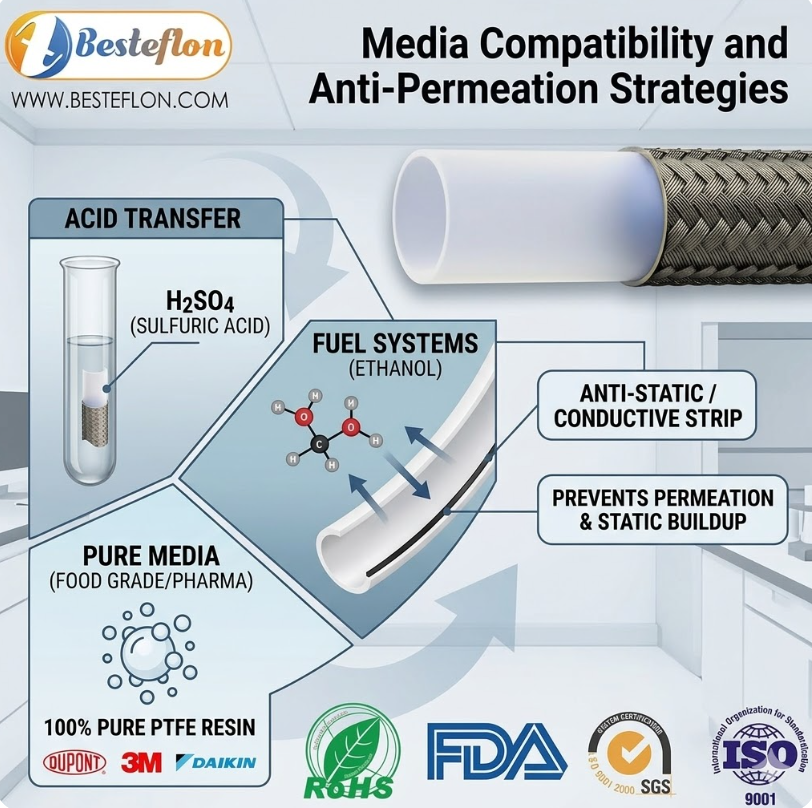
The chemical inertness of PTFE makes it the default choice for transporting acids, bases, and aggressive solvents. However, chemical compatibility is not universal. While PTFE resists almost all industrial chemicals, specialized substances like certain fluorinated liquids or molten alkali metals can still affect the liner. Beyond simple resistance, the physical behavior of the media—such as its tendency to permeate—must be addressed. In fuel and brake fluid systems, permeation is a critical safety concern. Many modern fuels contain ethanol, which has a smaller molecular structure that can seep through standard thin-wall tubing.
For these applications, a thick-wall liner combined with an anti-static carbon black conductive strip is essential. This configuration prevents the buildup of static electricity caused by the high-velocity flow of non-conductive fluids. This eliminates the risk of internal sparking and subsequent hose failure. Furthermore, food-grade and high-purity industries require 100% pure PTFE resin. By selecting raw materials from qualified brands like Chemours (formerly DuPont) and Daikin, Besteflon ensures that no additives leach into the product stream. This commitment to material purity supports compliance with international safety and quality standards across global markets.
Structural Mapping from Vacuum to Ultra-High Pressure
Pressure requirements dictate the physical architecture of the hose assembly. In vacuum or negative pressure systems, the primary risk is the collapse of the tube. To counter this, convoluted structures or internal helical wire reinforcements maintain the circular cross-section. These designs allow the hose to withstand external atmospheric pressure without compromising the internal flow path. For high-pressure and pulse-heavy systems, the focus transitions to reinforcement layers. Utilizing double-layer stainless steel braiding significantly enhances the burst pressure and resistance to impulse fatigue.
These assemblies often adhere to rigorous standards like SAE 100R14 to ensure they handle the rapid pressure spikes common in hydraulic systems. A critical but often overlooked aspect is the pressure-temperature derating curve. As temperatures rise, the maximum allowable working pressure of the hose decreases. Clearly defining this curve is mandatory for preventing catastrophic failures when operating near the limits of the material. Specialized manufacturing facilities utilize advanced testing equipment to provide verification reports for burst pressure and impulse longevity.
Combined Solutions for Extreme Industrial Environments
Real-world applications rarely involve only one challenge. Complex scenarios require integrated engineering solutions. For example, a system transporting high-temperature chemical media under high pressure might utilize a thick-wall PTFE liner, reinforced with 304 or 316 stainless steel braiding, and finished with a PVDF outer jacket. Another scenario involving low-temperature fuel pulses would require an anti-static PTFE liner, double-layer braiding, and a specialized low-temperature PVC cover. Besteflon facilitates these complex requirements through a robust OEM and custom service framework.
By integrating rigorous R&D with premium raw materials, the facility ensures that every hose assembly meets the specific demands of global markets, including the USA, UK, and Australia. Understanding these nuances allows for the creation of safer, more efficient, and cost-effective industrial operations. Validation remains the final component of a secure fluid system, ensuring that laboratory performance translates to field reliability. Providing a complete service loop from technical consultation to final testing remains the hallmark of advanced fluoropolymer engineering.
For more technical insights and product specifications, please visit the official website at https://www.besteflon.com/
Media Contact
Huizhou Zhongxin Besteflon Industrial Co., Ltd sales07@zx-ptfe.com Sijiaolou Industrial Zone, Boluo, Huizhou, Guangdong, China http://www.besteflon.com