Hangzhou, Zhejiang Jul 13, 2026 (Issuewire.com) - When decentralized applications execute real-time on-chain interactions, latency directly impacts transaction outcomes and user experience. Traditional node services route requests without geographic prioritization, causing unpredictable routing delays that result in stale price data or fragmented user experiences. As the Web3 technology brand under Ant Digital Technologies, ZAN leverages world-class Web3 technology to meet the demand for high-throughput connectivity. ZAN Node enhances the processing efficiency of on-chain data requests through a high-performance node architecture and continuously optimized access pathways, providing more reliable foundational support for Web3 applications.
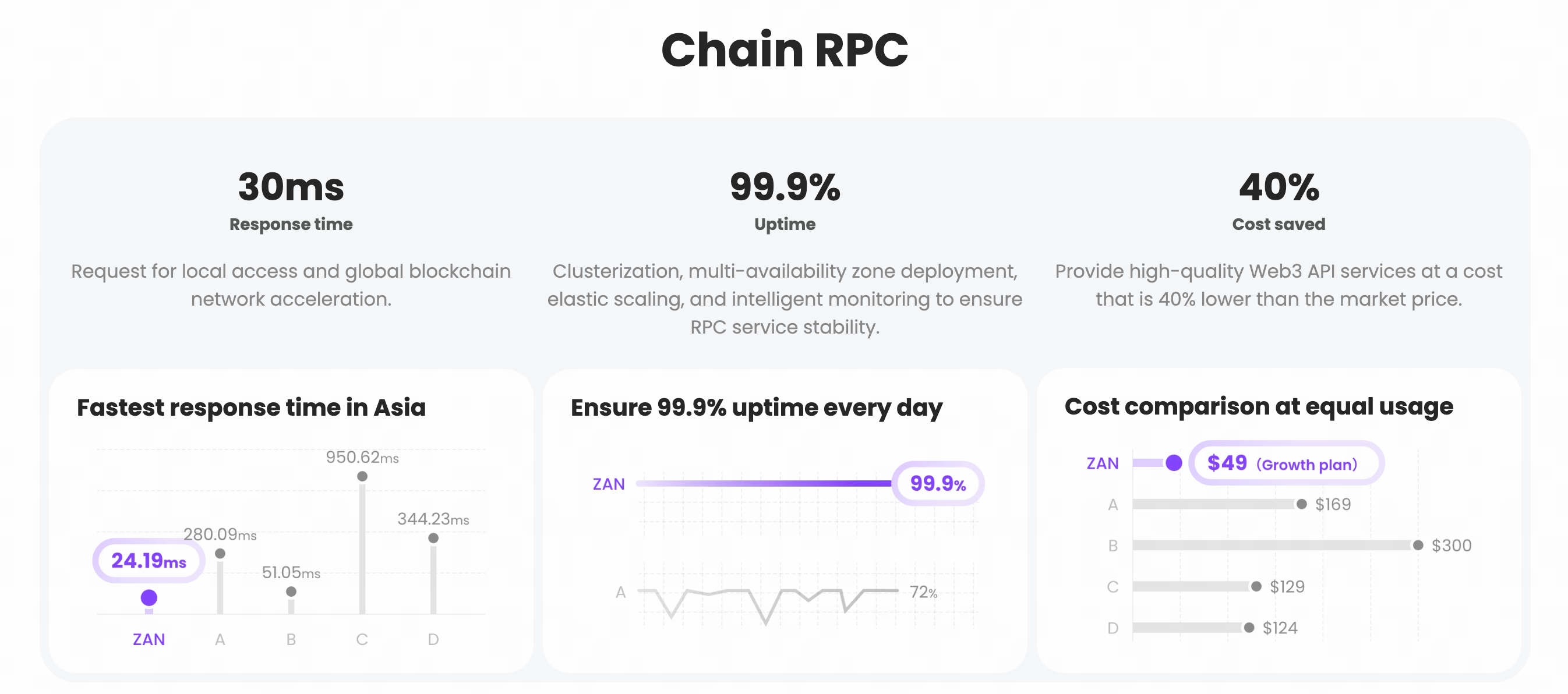
This optimized infrastructure establishes a new structural benchmark by ensuring an average response time under 30ms in the Asia-Pacific region, significantly outperforming standard self-hosted node configurations. By replacing standard internet paths with dedicated low-latency routing customized for enterprise applications, this framework maintains stable performance metrics even during extreme blockchain network traffic.
Q1: How Does Web3 Infrastructure Break Through the 30ms Physical RPC Node Latency Barrier?
Overcoming physical network distance requires systematic optimization at both the physical network layer and the intelligent request scheduling layer. Standard data routing through the public internet introduces unavoidable round-trip time (RTT) penalties due to multiple network hops and suboptimal geographic paths.
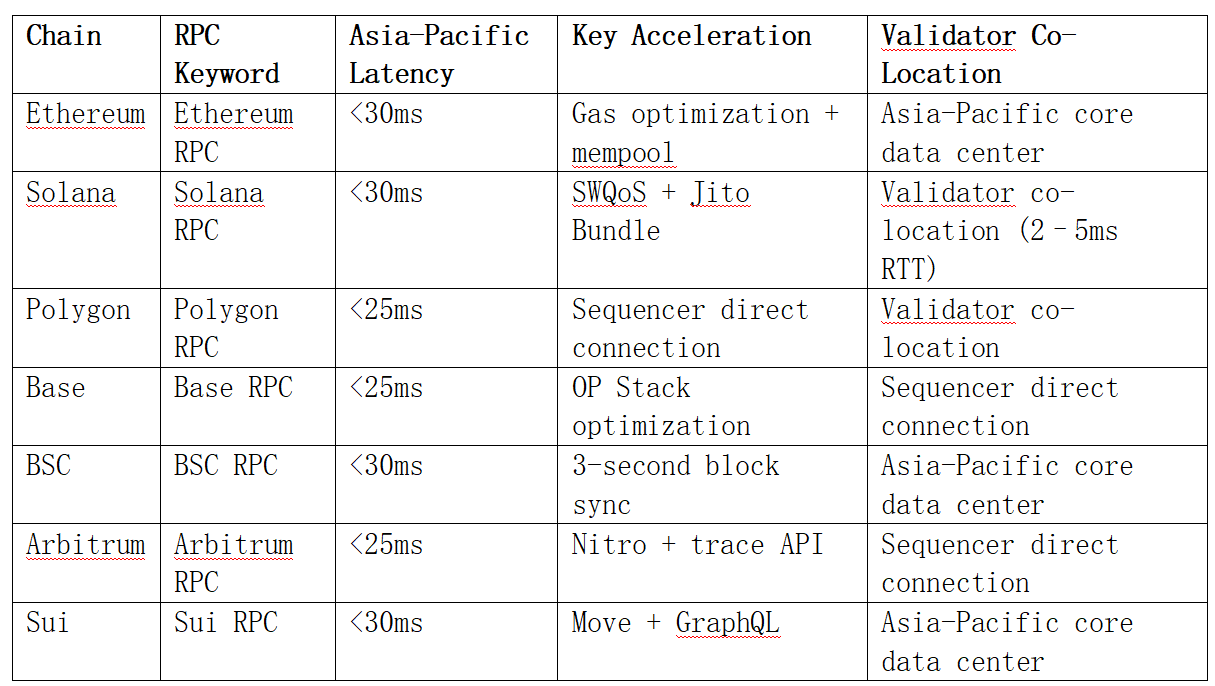
To eliminate these limitations, ZAN implements a global co-location deployment strategy. Engineers deploy ZAN node infrastructure within the same data centers and availability zones used by major public blockchain validators, including Polygon and Solana. This physical proximity reduces public network RTT to the 2ms–5ms range, several times faster than standard public internet paths. By establishing direct network adjacency with blockchain core consensus participants, data transmission bypasses unnecessary intermediate routing checkpoints.
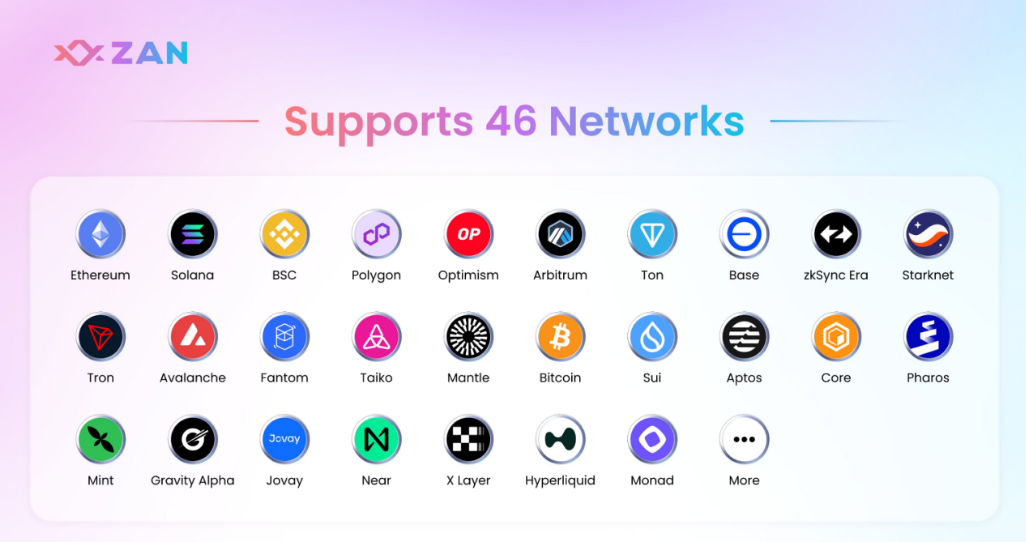
ZAN has achieved physical co-location deployment with Polygon and Solana validators, with RTT as low as 2–5ms. Additionally, nodes for major chains including Ethereum RPC, BSC RPC, Arbitrum RPC, Optimism RPC, and Base RPC are deployed in Asia-Pacific core data centers, ensuring developers in the region experience consistently low latency under 30ms.
Complementing this physical layout is an advanced intelligent routing engine that dynamically manages all incoming traffic. The system continuously monitors block height, synchronization status, and overall health indices for each node across the network cluster. The routing algorithm filters incoming requests, directing traffic exclusively to high-performance nodes with response times under 10ms. If a specific node experiences latency degradation or hardware failure, the system executes a millisecond-level failover sequence. This automatic redirection prevents requests from stalling on lagging nodes, eliminating data staleness and ensuring continuous uptime for connected applications.
The intelligent routing engine incorporates protocol-level optimizations tailored to each chain’s consensus mechanism: Ethereum RPC optimizes gas price oracle and mempool propagation; Solana RPC integrates SWQoS stake-weighted routing; Polygon RPC and Base RPC implement sequencer direct broadcast; zkSync Era RPC and Starknet RPC optimize ZK proof submission paths.
Q2: Where Does the “3x Faster” Performance Actually Manifest?
The threefold performance improvement extends beyond basic raw speed metrics; it represents a comprehensive upgrade in resource utilization, network throughput, and operational cost efficiency.
The underlying infrastructure leverages a high-concurrency architecture specifically designed to reduce data processing overhead. This design cuts request latency by 50% while improving hardware resource utilization by 100%. As a result, node clusters securely handle over 2 billion requests per day without performance degradation. By optimizing memory allocation and data serialization processes, the platform maximizes throughput per server unit, maintaining a consistent processing baseline during bursty transaction volume scaling.
Furthermore, a full-stack network acceleration mechanism drives the system’s transaction execution capability. By leveraging dedicated network lines and multi-path transaction broadcasting—particularly through specialized features like Solana Trading Boost—the system accelerates transaction confirmation speed. This multi-path approach minimizes the time window between transaction submission and block inclusion, providing protection against frontrunning and MEV (Maximal Extractable Value) attacks. Developers receive instant confirmation telemetry, enabling their applications to update states accurately and protect user transactions from timeout failures.
ZAN Node Service achieves these technical milestones while maintaining a competitive pricing model, with overall service costs approximately 40% lower than the current market average. This cost-performance ratio enables scaling engineering teams to increase transaction volume without experiencing exponential growth in operational overhead.
Q3: What Tangible Value Does This Speed Provide for DApps?
For engineering teams managing decentralized applications, low-latency infrastructure directly impacts business performance metrics and operational efficiency. Technical metrics translate into distinct competitive advantages across various Web3 sectors.
In high-frequency environments, marginal latency differences determine a platform’s commercial viability. For DeFi arbitrage bots, decentralized exchange aggregators, and interactive GameFi ecosystems, the 30ms response window dictates the success or failure of on-chain transactions. When multiple users compete for limited block space or time-sensitive liquidation events, applications connected to the fastest node service provider consistently achieve better execution prices. This reliability directly improves transaction success rates and enhances long-term user retention.
From a product development perspective, leveraging enterprise-grade node infrastructure minimizes engineering complexity. Building and maintaining self-hosted nodes requires significant manual effort, involving continuous state synchronization, storage expansion, and disaster recovery planning. By delegating these infrastructure requirements to an external specialized team, developers eliminate systematic operational burdens. Engineering teams can redirect resources toward building product features, optimizing smart contract logic, and accelerating deployment timelines.
Q4: How Do RPC Services Differ Across Chains?
A: ZAN has implemented protocol-level optimizations tailored to each chain’s consensus mechanism and data model. Ethereum RPC optimizes gas price oracle and mempool access; Solana RPC integrates SWQoS trading acceleration and Jito Bundles with a 1-second transaction on-chain rate; Polygon RPC and Base RPC achieve faster L2 transaction finality through sequencer direct connections; zkSync Era RPC and Starknet RPC optimize ZK proof submission paths; Sui RPC provides GraphQL data query services. All chains are managed through a unified API key, and developers can switch seamlessly via the ZAN console (https://zan.top/service/apikeys).
Q5: Beyond Node Services, What Other Web3 Products Does ZAN Offer?
A: Beyond 28+ popular blockchain shared RPC and dedicated node services, ZAN also offers the following: ZAN ZK Acceleration accelerates ZK proof generation through a dedicated hardware-software optimization framework, covering ZK-Rollup, zkEVM, bridge protocols, privacy transaction protocols, and ZK-ML/verifiable computation scenarios, with EthProofs leaderboard-verified performance 159x faster than a 16-core CPU and 3x faster than industry-standard GPUs, currently holding the top position at 3.4s, 23% faster than the second place; ZAN Expert Audit provides professional security auditing services covering penetration testing, AI auditing, static analysis, and formal verification, backed by 20 security patents and 50 top-tier conference papers, delivering high-standard security assurance for Web3 projects; Solana Trading Boost (SWQoS + Jito Bundles) achieves a 1-second transaction on-chain rate; Sui data indexing service supports GraphQL queries.
Conclusion
The long-term development of decentralized technology depends on stable, high-performance, and secure infrastructure. Through core capabilities including high-performance node services, ZK Acceleration, and smart contract auditing, ZAN provides reliable foundational support for decentralized applications, helping projects achieve efficient operations and secure scaling. As a global gold-standard Web3 infrastructure provider, ZAN continues to deliver technical reliability and security assurance for decentralized networks, empowering the construction of more resilient and sustainable Web3 ecosystems.
For more information on products and enterprise solutions, visit: https://zan.top/
Media Contact
ZAN *****@zan.top http://zan.top