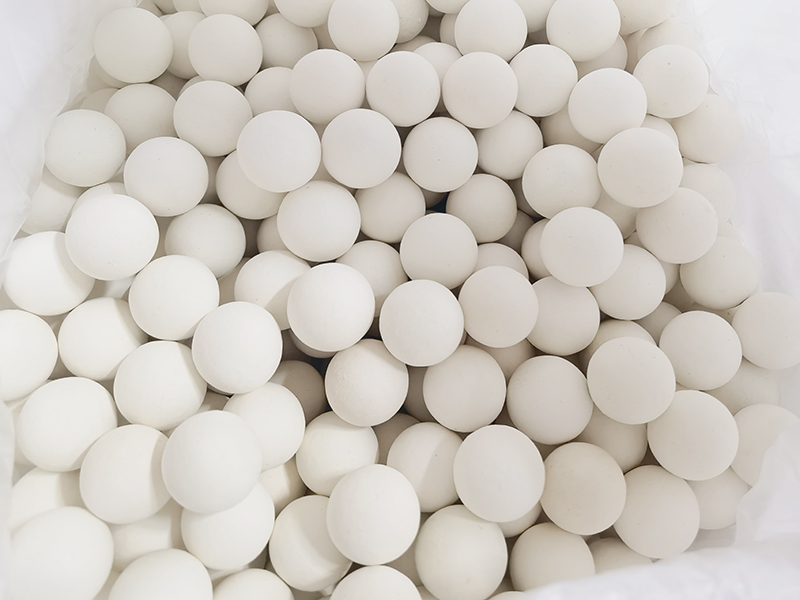
Pingxiang, Jiangxi May 21, 2026 (Issuewire.com) - The porosity of inert alumina ceramicspheres is one of the key indicators determining their performance as catalyst supports. Higher porosity indicates a more developed pore structure inside the sphere, which significantly affects the catalyst's carrying capacity, reaction efficiency, and lifespan.
The following explains how porosity affects a product's properties from four aspects: structure, Mass Transfer, thermal properties, and mechanical strength.
ⅠPorosity determines the catalyst loading and dispersibility.The higher the porosity, the larger the specific surface area inside the sphere, and the more active components of the catalyst can be loaded.
High porosity → More micropores and mesopores →More uniform catalyst dispersion→ Improved reaction efficiency.
Low porosity → Small specific surface area →Limited catalyst loading→ Easily leads to aggregation of active sites, reducing reaction activity.ⅡPorosity affects the Mass Transfer efficiency of reactantsPorosity determines the diffusion rate of reactants inside the sphere.
High porosity → good pore connectivity →reactants diffuse more easily to the active sites of the catalyst→ improve reaction rate and conversion rate.
Low porosity → High diffusion resistance → Reactants have difficulty entering the interior of the sphere →Low catalyst utilization.
In petrochemical, hydrogenation, and reforming reactions, Mass Transfer efficiency directly affects the overall process efficiency.ⅢPorosity affects the thermal conductivity of the bed.The higher the porosity, the higher the air content inside the sphere, and the lower the thermal conductivity.
High porosity → Low thermal conductivity → Can serve as a good heat insulation layer, protecting the catalyst from high-temperature shock.
Low porosity → High thermal conductivity → Facilitates rapid heat transfer, suitable for reaction systems requiring good thermal diffusion.
Therefore, the porosity needs to be selected based on the specific reaction temperature and thermal management requirements.ⅣPorosity is inversely proportional to mechanical strength.The higher the porosity, the lower the mechanical strength of the ball.
High porosity → looser structure → decreased compressive strength → prone to breakage under high pressure and high flow rate conditions.
Low porosity → Dense structure → High compressive strength → Suitable for harsh conditions such as high-pressure hydrogenation and catalytic cracking.
Therefore, the choice of porosity needs to strike a balance between "strength" and "catalytic performance".ⅤTypical Porosity Requirements for Different Application ScenariosCatalyst support (for high activity requirements): Porosity typically 30%–45%
Ensure high specific surface area and good mass transfer.Bed support (for high strength requirements): Porosity typically 20%–30%.
Ensure compressive strength and stability.High-temperature insulation layer: porosity can reach 40%–50%.
The catalyst is protected by utilizing its low thermal conductivity.ⅥSummary: How Porosity Affects Performance (Concise Version)Higher porosity → Larger specific surface area → Higher catalyst loading → Better mass transfer efficiency → Higher reactivity
However, the mechanical strength decreases.
Lower porosity → higher strength → but limited catalytic performance.
Therefore, when selecting inert alumina ceramic balls, the optimal porosity must be determined comprehensively based on the reaction pressure, temperature, flow rate, and catalyst type.
Media Contact
Pingxiang Ksource Chemical Packing Co., Ltd. inquiry@ksourceep.com +86 13879962001