
Shenzhen, Guangdong Jun 25, 2026 (Issuewire.com) - Industrial IoT keeps pushing tracking nodes into places nobody wants to revisit — buried utility vaults, pipeline inspection points, ridge-top weather stations exposed to whatever the season throws at them. The hardware spends almost all its life in deep sleep to stretch the energy budget, then wakes up on schedule to push a telemetry packet or fire a small actuator. Those wake-up moments are where things tend to go wrong. The current spike comes too fast, the cell can't respond cleanly, and the device experiences what designers usually call voltage delay — a quiet but expensive failure mode that can cut a planned ten-year deployment to three. Avoiding that outcome starts with picking a Professional Anti-Passivation LiSOCl2 Battery Solutions Provider that has actually engineered around the problem, not just listed it on a spec sheet. The right power architecture is what determines whether an industrial deployment hits its multi-decade target or quietly bleeds out through reboot loops nobody notices until the maintenance bills arrive.
Why Does Passivation in Lithium Thionyl Chloride Cells Become a Silent Killer for Remote Sensors After Long Dormant Periods?
Lithium thionyl chloride chemistry holds the highest energy density among primary cells, which is exactly what multi-decade telemetry needs. The chemistry also produces a quirk that most procurement teams underestimate. During long idle periods, a thin lithium chloride crystal layer forms on the lithium anode surface. The layer is genuinely useful — it blocks idle chemical reactions and is the reason annual self-discharge stays well below one percent, preserving capacity through years of warehouse storage or field standby. The trouble starts when the device tries to wake up.
When a dormant sensor suddenly demands a high-current pulse for transmission, that crystal film stands in the way of lithium ion transport. Internal resistance spikes for a brief moment, voltage sags sharply, and engineers see the signature voltage delay event on the test bench. If the dip drops below the microcontroller's minimum operating voltage, the device resets right when it was supposed to send data. The telemetry packet never makes it out, the sensor reboots into another dormant cycle, and the next wake-up faces the same problem with an even thicker crystal layer. Outdoor temperature swings make it worse — extreme thermal cycling causes the lithium chloride crystals to grow denser and more rigid over time. As a result, generic cells often fail in the field long before they actually run out of chemical capacity, and the failure mode looks like dead hardware when the cell is technically still half-full.
How Does PKCell Re-Engineer the Anode Matrix to Control Crystal Growth Without Sacrificing Energy Density?
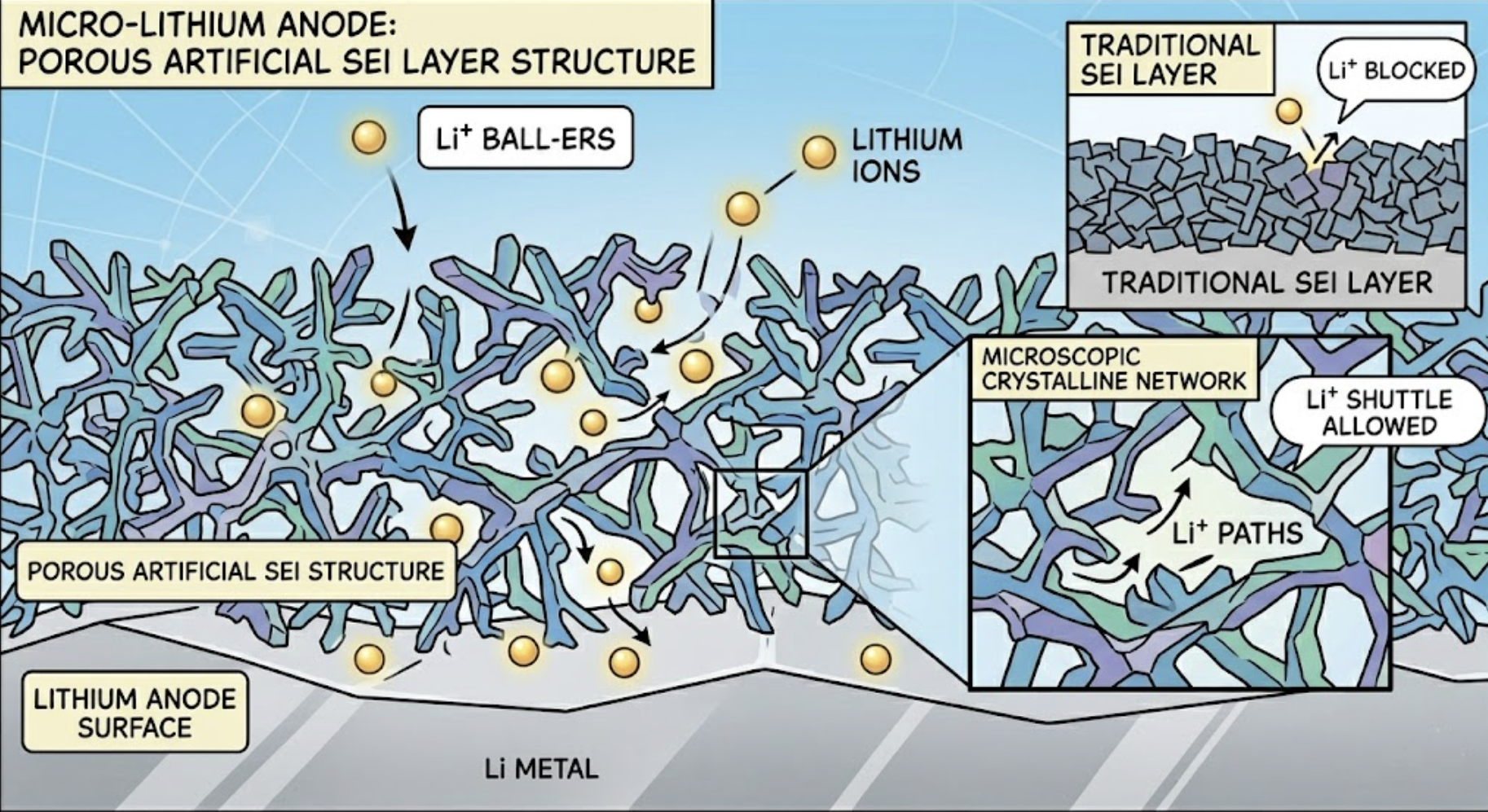
Reconciling low self-discharge with fast wake-up response takes work at the molecular level rather than the marketing level. Standard primary cells use uniform chemistry that does nothing to control how thick or dense the insulating layer becomes over time. Pulling the two requirements into balance requires deliberate electrolyte engineering and structural improvements at the anode. Through years of formulation work, PKCell developed proprietary anti-passivation additives that go directly into the lithium thionyl chloride matrix. These compounds change the physical morphology of the lithium chloride film as it forms.
The result is a layer that stays porous rather than collapsing into dense crystalline blocks. The film keeps doing its protective job during storage, but ionic transport remains viable when the load suddenly appears. Manufacturing discipline matters just as much. The production process runs under strict cleanroom protocols because moisture and trace contaminants set up localized galvanic activity that thickens the passivation layer faster than the chemistry alone would. Keeping material purity tight means the crystalline layer breaks down almost instantly when current draws it apart. Practically, the cell recovers its nominal voltage plateau within milliseconds of load application — even after sitting dormant for years. The product gets the long shelf life lithium thionyl chloride is known for, without the voltage delay penalty that has historically come with it.
Why Does Pairing an ER Primary Cell With a Heavy Power Capacitor Offer the Strongest Defense Against Voltage Delay?
Even with the chemistry tuned correctly, extreme pulse demands can still strain a standalone lithium thionyl chloride cell. Bobbin-type ER cells deliver maximum capacity but have limited pulse output. Spiral-wound configurations push more current but trade away energy density and shorten the operational lifespan that long-life IoT actually needs. PKCell (Shenzhen Pkcell Battery Co., Ltd.) bridges this gap with a hybrid architecture that pairs an ER primary cell in parallel with a heavy power capacitor — and the combination handles the trade-off better than either component alone.
The topology splits the work cleanly. The bobbin-type ER cell handles long-term energy storage, holding base current steady and keeping self-discharge low. The hybrid pulse capacitor sits alongside it as a zero-latency electrical buffer. During the long quiescent periods between transmissions, the primary cell trickle-charges the capacitor at its own pace. When the device wakes up and demands a current burst, the capacitor delivers it instantly while the primary cell stays out of the high-current path. The result is that the chemistry never sees the kind of stress that produces voltage delay in the first place. The cell maintains a flat voltage profile across the entire discharge lifecycle, and operators can deploy long-range wireless tracking arrays without budgeting for the early failures that tend to plague single-cell architectures pushed too hard.
How Do Custom-Engineered Battery Assemblies Handle Environmental Extremes in Deep-Sea and Smart Metering Infrastructure?
Industrial environments throw physical stresses at the hardware that go well beyond what a consumer-grade battery shell can survive. Subsea scanning equipment operates under crushing barometric pressure. Pipeline monitors live with continuous vibration. Polar weather stations cycle through temperature ranges most cells were never designed to see. For instance, sophisticated oceanic equipment used in underwater scanning projects demands robust encapsulation to survive the immense stress of deep-sea exploration. Standard packaging falls apart in these environments, often well before the cell chemistry would have given out. Shenzhen Pkcell Battery Co., Ltd. handles these cases through fully customized assemblies engineered against the specific stresses each application presents.
The customization runs across the full assembly — shock-absorbing protective circuit modules, structural outer casings matched to the device enclosure, glass-to-metal hermetic seals heavy enough to resist deformation under pressure cycling and prevent any electrolyte leakage across decades of service. Custom thermal insulation barriers help moderate internal chemical activity during sudden temperature shifts in polar installations or desert deployments. The mechanical design keeps the hybrid battery-capacitor configuration aligned with whatever physical constraints the industrial enclosure imposes, rather than forcing the device design to accommodate generic packaging.
The verification process backs this up with environmental simulation testing — extreme temperature cycling, high-frequency vibration, pressure exposure where the application demands it. Each custom configuration goes through this verification before shipment, which is the kind of step that takes large-scale infrastructure investments out of the gamble category. Public utility networks and marine data logging systems running on these assemblies maintain uninterrupted operation in environments where uninterrupted operation is exactly what the contract specifies.
Conclusion: Reliability Through Smarter Power Design
Holding global IoT networks together over their full design life takes more than picking a battery off a generic catalog. Passive chemical degradation works against isolated telemetry hardware constantly, and anti-passivation engineering is what separates fleets that survive their warranty period from fleets that don't. Molecular-level electrolyte work combined with hybrid topology — a primary cell paired with a pulse capacitor — closes off the voltage delay failure mode that has historically eaten into long-life IoT deployments. The approach also keeps maintenance cycles where they belong: scheduled and predictable, not reactive and expensive. Working with a manufacturer that has already solved the core engineering problems gives technology developers a dependable component pipeline and protects the project economics that depend on those components performing as designed.
Additional product specifications, certification documentation, and customization workflows are available at https://www.pkcellpower.com/.
Media Contact
Shenzhen Pkcell Battery Co., Ltd. *****@pkcellpower.com 902, Tower B, Hongrongyuan North Station Center, North Station Community, Minzhi Street, Longhua District, Shenzhen, China https://www.pkcellpower.com/




