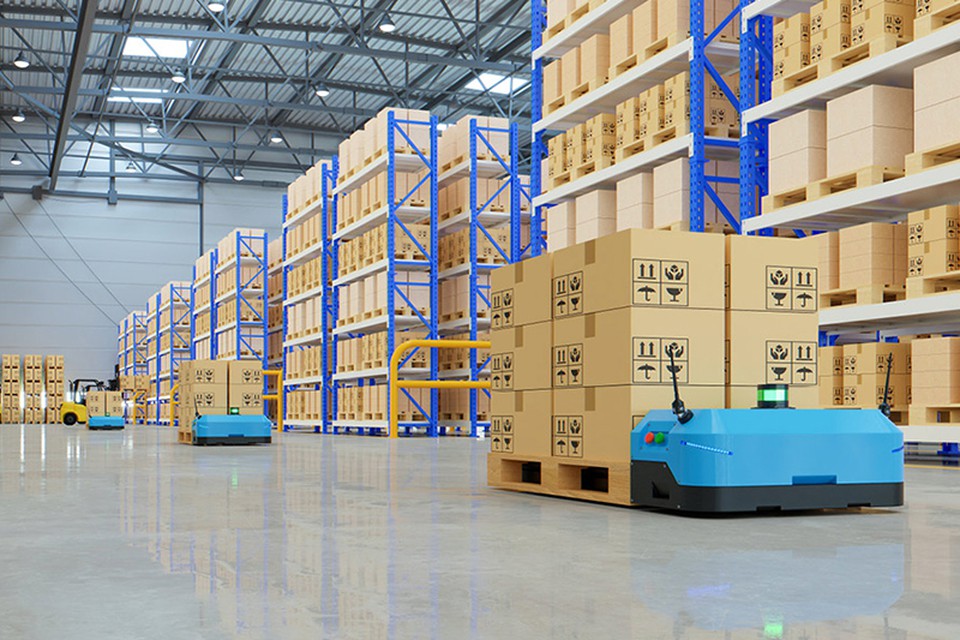
Jiading, Shanghai Apr 21, 2026 (Issuewire.com) - The competitive gap between AGV and AMR systems in modern logistics no longer originates at the software layer. It originates at the wheel. As warehouse densities increase and autonomous mobile platforms take on more complex routing requirements, the ability to move laterally, rotate in place, and execute diagonal paths has shifted from a premium capability to an operational baseline. Positioning itself as a Global Leading Multi-Directional Drive Wheels Manufacturer, Shanghai Plutools Automation Co., Ltd. has built its entire product architecture around enabling precisely this class of mobility. Backed by more than 22 years of engineering development, national high-tech enterprise status, and recognition as a Specialized and Innovative Small Giant Enterprise, Plutools approaches AGV and AMR drive wheel design as a core mechanical discipline — not a commodity component category.
The Engineering Foundation of Multi-Directional Movement: Why Steering Drive Outperforms Differential at the Mechanism Level
Understanding how Plutools supports advanced AGV mobility starts with understanding why steering drive and differential drive are not simply two options for the same job. They operate on fundamentally different mechanical principles — and those principles produce different mobility ceilings.
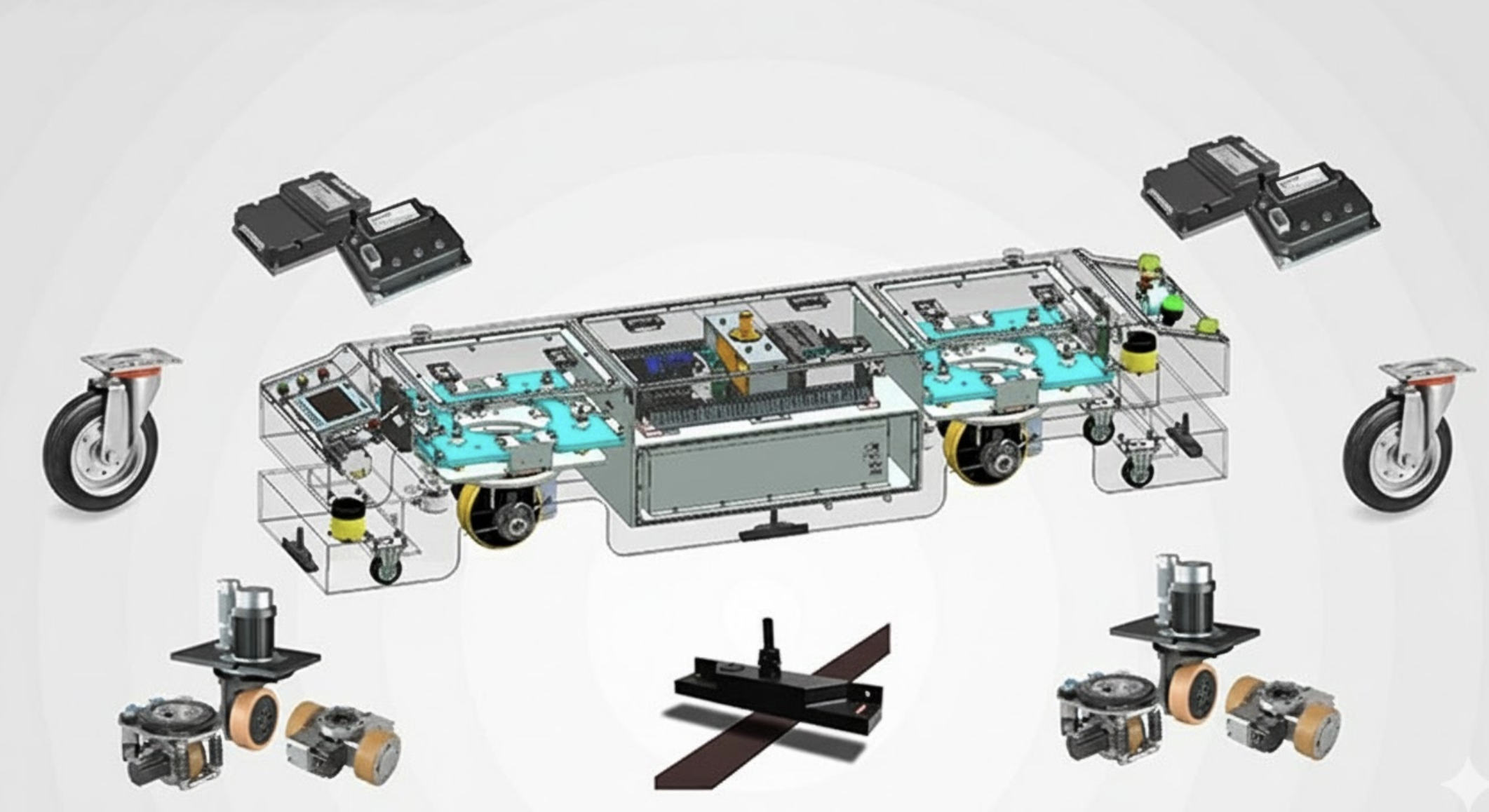
A steering drive wheel integrates the drive motor, steering motor, high-precision reduction gearbox, braking mechanism, and load-bearing wheel into a single compact module. An independent steering motor, combined with an absolute encoder, enables continuous wheel rotation from 0 to 360 degrees. Steering accuracy reaches plus or minus 0.1 degrees. Electronic differential algorithms then synchronize drive speed with steering angle in real time. The result is true omnidirectional mobility — straight-line motion, curved trajectories, diagonal travel, and zero-radius in-place rotation all become available within the same platform.
Differential drive, by contrast, achieves steering through the speed difference between two independently controlled wheels. Steering angle is inferred indirectly from that speed difference rather than measured directly. Wheel slip, ground friction variation, and parameter drift accumulate into positioning errors. Typical positioning accuracy stays around plus or minus 10 mm. Steering drive systems achieve plus or minus 5 mm, with repeatability reaching plus or minus 2 mm. Single-wheel load capacity in steering drive configurations often exceeds 5,000 N, compared with approximately 3,000 N typical in differential designs. These are not incremental performance improvements. They are architectural consequences of where steering control originates — at the component level, through independent closed-loop mechanisms, rather than through system-level inference from speed data.
Product Architecture — How Plutools Translates Steering Drive Principles Into a Deployable Range
Technical principles only generate value when they translate into products that cover actual deployment requirements. Plutools addresses this through two complementary steerable drive wheel families that together span the full range of AGV and AMR mobility applications.
The PLT Series Vertical Drive Wheel with Steering covers eight wheel diameter configurations from 150 mm to 470 mm. Load capacity ranges from 500 kg to 6,500 kg. Input voltage spans 12V to 96V. Motor options include DC brushed, AC asynchronous, and permanent magnet servo types, with power ratings from 400W to 16 kW. The bevel gear transmission structure delivers compact dimensions alongside low noise and high output torque — characteristics that matter specifically in forklift AGVs and latent-type AMRs navigating confined spaces. Optional components include shock absorption springs, incremental and absolute encoders, potentiometers, and limit switches.
The PLT Series Parallel Horizontal Drive Wheel with Steering addresses medium-load applications through a parallel-axis design that delivers smooth multi-directional operation. Wheel diameters range from 167 mm to 300 mm. Load capacity covers 800 kg to 3,000 kg. Motor power spans 400W to 15 kW across the same 12V to 96V voltage range. This series suits automation assembly lines, small mobile platforms, and flexible AGVs where smooth multi-directional movement is the primary performance requirement.
The structural logic connecting these two families matters as much as their individual specifications. The vertical series handles confined-space, high-load, and specialty environments through bevel gear compactness and wide series coverage. The parallel horizontal series handles medium-load, multi-directional movement in open automation environments through parallel-axis smoothness. Together they form a deployment matrix — not a catalogue.
Precision Manufacturing as the Enabler of Mobility Performance Specifications
Mobility performance specifications — steering accuracy to plus or minus 0.1 degrees, positioning repeatability to plus or minus 2 mm, single-wheel load capacity exceeding 5,000 N — cannot be achieved through product design alone. Manufacturing infrastructure must produce and verify these values consistently across every unit that leaves the facility.
Plutools' factory operates across four distinct production layers that each contribute directly to drive wheel performance. The precision machining workshop uses five-axis CNC machining centers alongside coordinate measuring machines, achieving accuracy of plus or minus 0.01 mm. Gear tooth machining reaches ISO 5 level, supporting component service lives exceeding 20,000 hours under heavy-load AGV conditions. Steering accuracy depends directly on gearbox precision — the tolerance chain originates here.
Assembly follows a different logic. Laser calibration for motor-reducer coaxiality, encoder signal coupling verification, and dynamic brake clearance fine-tuning are not quality checkpoints. They are the assembly steps that produce the steering accuracy values stated in product specifications. Every unit clears a 100% online inspection. The first-pass assembly success rate of 99.8% reflects production consistency rather than selective testing.
Before shipment, 12 performance validations apply to each unit. These include a 72-hour continuous full-load run at 150% impact load, IP65 protection verification, temperature cycling from minus 30 to plus 70 degrees Celsius, and noise testing capped at 55 dB no-load and 68 dB full-load. The performance numbers published in product documentation are only credible when the processes that produce them are systematically controlled and traceable. Plutools' production system provides that traceability.
Customization Depth — Supporting Non-Standard Mobility Requirements Across Industry Environments
Standard configurations address known applications well. However, the environments where omnidirectional AGVs operate most productively — automotive assembly lines, cold-chain logistics, chemical processing facilities, port terminals, and medical transport — each impose conditions that require engineering adaptation beyond standard product specifications.
Low-temperature drive wheels incorporate material-level optimization and adaptive drive and control systems for sub-zero operating environments. Standard lubricants and wheel compounds degrade below certain temperature thresholds; adaptive control compensates for the changed friction and viscosity characteristics that follow. Explosion-proof drive wheels follow international safety standards and integrate intelligent monitoring alongside early warning functions — representing integrated safety architecture, not surface-level casing changes. High IP-rated configurations address dusty and moisture-exposed environments where standard sealing is insufficient. Across both vertical and horizontal drive wheel series, motor type, encoder configuration, shock absorption springs, and other components are selectable at the order level.
More than 500 customized products currently in active deployment confirm that non-standard requirements receive systematic engineering treatment, not case-by-case exception handling. A multi-disciplinary team approaches each customization through thermal management, structural optimization, and advanced sensing and control — addressing root constraints rather than surface specifications.
Global Delivery Capability — Translating Product Depth Into International Partnership Reliability
Technical capability generates limited value when delivery performance is unpredictable. Plutools operates a 10,000-square-meter production facility with an annual capacity of 100,000 units. A network of more than 100 core suppliers supports key component inventory turnover within seven days. The global on-time delivery rate exceeds 99.2%, sustained through full-process MES digital management from raw material intake through finished product dispatch. Downloadable PDF drawings and 3D model files for the steerable drive wheel series reduce integration timelines for engineering teams at any location.
Multi-directional mobility in AGV and AMR systems starts at the drive wheel. The drive wheel's performance starts with the manufacturer's engineering depth. For integrators evaluating drive wheel suppliers for next-generation autonomous mobility platforms, Plutools' technical foundation, product range, and manufacturing consistency provide a substantive basis for that evaluation.
For product specifications and engineering consultation, visit https://www.plutools.com/.
Media Contact
Shanghai Plutools Automation Corporation Limited Eric.Tang@plutools.com No. 1001, Building A, Shanghai Science Park, Chengbei Road, Jiading District, Shanghai https://www.plutools.com/




