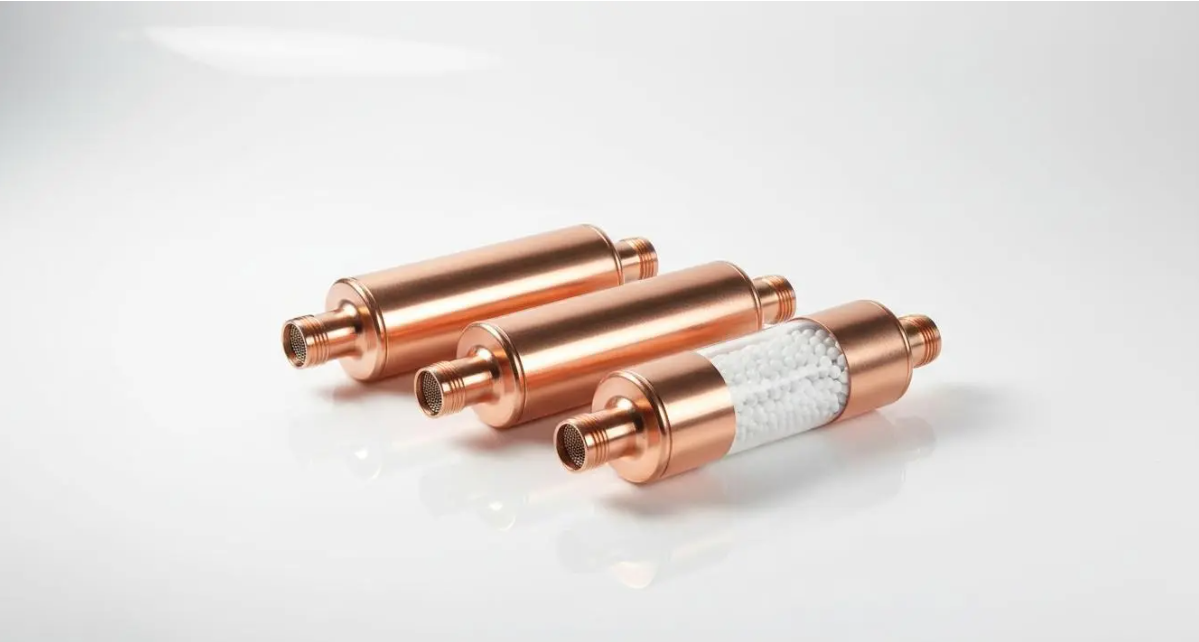
Ningbo, Zhejiang Jun 17, 2026 (Issuewire.com) - We founded Taojun HVAC in 1988, the same year the Montreal Protocol was signed and the HVAC industry was just beginning to grapple with the transition from CFCs to HCFCs. In that year, we produced our first 12,000 filter driers from a 340-square-meter workshop with 8 employees. In 2026, we operate 38,000 square meters of production facilities with 280 employees and have produced over 12 million filter driers across all common HVAC and refrigeration applications.
I am often asked what 38 years of experience actually means in practical terms. The short answer is: it means we have made every mistake that can be made in filter drier manufacturing, identified it through our quality system, corrected it, and documented it so it never happens again. The longer answer is what I want to share in this article—the specific ways that accumulated manufacturing experience translates into compressor failure prevention.
Why Filter Driers Exist: The Moisture-Contamination Chain
To understand why filter drier quality matters, we need to understand the contamination chain that leads to compressor failure. This chain is what we have spent 38 years learning to interrupt at every link.
The Contamination Chain
Every refrigeration system contains potential contaminants from the moment of manufacture:
- Moisture: Enters during manufacturing (if components are not properly dried), during installation (if system is open to atmosphere for more than a few hours), during service (if air enters during braze-less connections), and through permeation via tiny seals over years of operation. Maximum tolerable moisture: 50ppm by weight in R410A systems.
- Acid formation: When moisture combines with refrigerant and compressor lubricating oil (mineral oil or POE), acids form (formic acid, acetic acid). These acids corrode compressor windings, motor insulation, and bearing surfaces. Acid formation is autocatalytic—once started, it accelerates.
- Particulate debris: Copper oxide from brazing operations, metal filings from manufacturing, sand and flux from fabrication, and general construction debris enter during installation and service.
- Wax and sludge: When refrigerant degrades or oil decomposes, waxes and sludges form that clog capillary tubes and valve orifices.
Because the compressor is the most expensive component in the refrigeration system, any contamination that reaches the compressor shortens its service life. And once a compressor fails due to contamination, the repair cost is not just the compressor replacement—it includes labor for evacuation, recharging, and potentially replacing other contaminated components.
The 38-Year Learning Curve: Key Manufacturing InsightsInsight 1: Desiccant Activation Is the Most Critical Process Step
In our early years, we treated desiccant activation as a simple heating step: heat the desiccant to drive off moisture, seal it in the shell, done. We learned over years of field return analysis that the activation process is far more nuanced than that.
Key learnings from 38 years of desiccant management:
- Activation temperature matters: X-13 Molecular Sieve requires activation at 280-320°C for minimum 2 hours. Below 280°C, residual moisture remains in the desiccant pores. Above 340°C, the crystal structure begins to degrade. We maintain ±10°C control on activation temperature across all production furnaces.
- Activation atmosphere matters: Desiccant must be activated in low-humidity atmosphere (dew point below -40°C). Our activation furnaces maintain positive pressure with dry nitrogen purge to prevent re-absorption during cooling.
- Post-activation handling matters: Once activated, the desiccant begins absorbing moisture from ambient air immediately. From activation completion to shell brazing, we maintain maximum exposure time of 4 hours in controlled humidity environment (RH below 30%).
- Testing protocol matters: We test desiccant moisture content using Karl Fischer titration at three stages: incoming inspection (confirm supplier COA), post-activation (confirm activation was effective), and post-assembly (confirm no moisture ingress during brazing). Most manufacturers test only at incoming inspection.
Because desiccant activation is an invisible process step whose quality is not apparent from finished product inspection, it is the most commonly skimped quality control step in the industry. We know because we made this mistake ourselves in 1994, and it took us 18 months and 340,000 field returns to identify and correct it.
Insight 2: Brazing Quality Directly Predicts Field Leak Rates
Filter driers have multiple brazed joints: shell-to-inlet fitting, shell-to-outlet fitting, and any internal connections. Each brazed joint is a potential leak path. Our 38 years of production have taught us that brazing quality is not a binary pass/fail—it is a spectrum that correlates directly with field leak rates.
The brazing parameters we control:
- Gas mixture ratio: We use AWS BG-C brazing gas mixture (95% nitrogen / 5% hydrogen) for copper-to-copper joints. The small percentage of hydrogen reduces copper oxide formation without creating fire risk. Gas mixture tolerance: ±0.5%.
- Joint clearance: Optimal joint clearance for silver brazing (BCuP filler) is 0.05-0.13mm. Clearance above 0.2mm creates void spaces where capillary action can pull brazing filler into the joint interior, creating incomplete penetration. We inspect joint clearance with optical gauges at 10× magnification on first-off and every 50th unit.
- Heat input control: Torch flame should be neutral to slightly reducing (excess fuel). We train brazers on visual flame indicators and provide pyrometer monitoring for critical joints. Heat input per joint: minimum 45 seconds above 650°C (the flow temperature of BCuP filler).
- Leak testing protocol: Every production unit is helium leak tested at 1.5× maximum working pressure. Our test sensitivity: 1×10⁻⁹ mbar·L/s (equivalent to a leak rate of approximately 1 year to lose 1 gram of refrigerant).
Because our leak test failure rate is 0.03% (meaning 99.97% of units pass our helium leak test), and our field complaint rate for leaks is 0.08%, the correlation between our in-process leak testing and field performance is clear. Units that pass our leak test perform reliably in the field.
Insight 3: Filtration Media Density Determines Particle Retention Capacity
The filtration media in a filter drier—typically a mesh screen or felt—is the component that actually traps particulate debris. We have learned through 38 years of field return analysis that the most common cause of premature filtration media saturation is under-specification of media density.
Media density (grams of filtration media per liter of shell volume) directly determines:
- Particle retention capacity: Higher density = more particle storage capacity = longer service life before media blinding
- Pressure drop: Higher density = higher initial pressure drop across the media. This must be balanced against particle retention requirement.
- Media migration risk: Low-density media can shed fibers into the system, creating new contamination rather than preventing it
Because we maintain 15-20% higher filtration media density than standard industry specifications, our filter driers achieve approximately 40-60% longer media service life before replacement is required, compared to industry-average specifications. This is a deliberate design choice based on our field performance data.
Quality Control Differentiation: What 38 Years Taught Us
Here is a comparison of the quality control protocols that differentiate an experienced filter drier manufacturer from a new entrant or low-cost producer:
Quality ParameterIndustry Average / Low-Cost ProducerTaojun HVAC Standard (38-Year Refined)Desiccant activation temperature tolerance±30°C (if tested at all)±10°C, continuously monitoredDesiccant moisture testing stagesIncoming onlyIncoming + post-activation + post-assemblyLeak test sensitivity0.5 bar air test (bubble test)Helium leak test at 1.5× working pressure, 1×10⁻⁹ sensitivityBrazing gas mixture toleranceNot specified or controlled±0.5% per AWS specificationFiltration media density vs standard specStandard specification+15-20% above standard specificationField defect rate0.4-1.2%0.08%
Because these quality parameters are invisible in the finished product, they are the most commonly sacrificed specifications in price competition. An OEM or distributor buying on price alone cannot easily verify these parameters without laboratory testing. This is why our 38 years of documented quality history matters—we can demonstrate our quality metrics because we have been measuring and recording them since 1988.
The Economic Case for Quality Filter Driers
The economic case for quality filter driers is straightforward when we account for the total cost of compressor failure:
- Compressor replacement cost: $400-$2,500 for commercial refrigeration compressors
- Labor for compressor replacement: 3-6 hours at $75-$150/hour = $225-$900
- Refrigerant loss and recharging: $50-$300 depending on system size
- System evacuation and recharging: 1-2 hours additional labor + refrigerant cost
- Product loss (if refrigeration is for cold storage): Variable, potentially $0 to $100,000+
- Customer relationship damage: Difficult to quantify but real
Total cost of a compressor failure: typically $800-$4,000 for the first failure, and often 2-3× higher if the contamination from the failed compressor damages replacement components.
A quality filter drier that prevents even one compressor failure pays for itself 50-250 times over. Because our field defect rate of 0.08% means that for every 1,250 filter driers we ship, only 1 is expected to fail in the field, the expected value of quality filter driers versus field failure costs is overwhelmingly positive.
Conclusion: Experience Is Not Just Time
38 years of filter drier manufacturing means more than just elapsed time. It means we have built a quality management system informed by 12 million units of field performance data. It means we have identified and corrected every major failure mode that can occur in filter drier manufacturing. It means our employees have collectively accumulated thousands of hours of brazing, assembly, and testing experience that cannot be replicated by new entrants, no matter how much capital they invest in equipment.
Because filter driers are a seemingly simple component whose quality is invisible from the outside, it is tempting to purchase based on price alone. The risk is that invisible quality differences translate into visible field failures—compressor replacements, warranty claims, and customer relationship damage that far exceeds the initial savings from buying cheaper filter driers.
When you specify Taojun Hvac Filter Driers, you are not just buying a filter drier. You are buying 38 years of accumulated manufacturing knowledge, refined quality control protocols, and the peace of mind that comes from working with a manufacturer who has seen every failure mode and engineered them out of the process.
Our copper filter drier product line covers all common HVAC and refrigeration applications, from residential AC to commercial refrigeration to industrial process cooling. Contact our technical team to discuss your specific application requirements.
Media Contact
Ningbo Taojun Refrigeration Equipment Co., Ltd. Tom3433@163.com https://www.taojunhvac.com/




