Xianggang, China Jul 16, 2026 (Issuewire.com) - Two e-bikes can advertise the same torque figure and still feel very different on a hill. Motor type, gearing, controller behavior, wheel size, battery condition, traction, and heat management all shape the result.
Two e-bikes may both advertise 100 Nm of torque yet behave very differently on the same climb. One may launch aggressively and then lose strength as the hill continues. Another may feel smoother at the start but maintain useful assistance for longer. The difference comes from far more than the number printed on the specification sheet.
Torque, measured in Newton-meters (Nm), describes rotational force. On an e-bike, riders tend to notice it most when starting from a stop, restarting on an incline, accelerating with cargo, or riding at low speed over difficult terrain. It matters—but it is not a stand-alone score for e-bike quality.
Key takeaway: Real-world performance must be evaluated alongside sustained power, motor type, gearing, controller tuning, wheel size, traction, total system weight, battery condition, and thermal management.
Torque, Power, and Speed Answer Different Questions
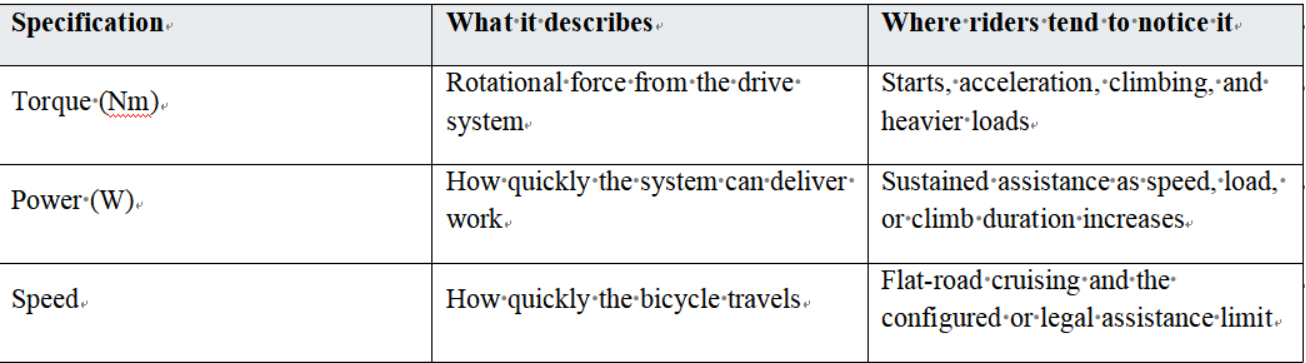
Torque describes turning force. Power describes the rate at which the motor can continue doing work. Speed describes how quickly the bicycle is moving. The three are related, but they are not interchangeable.
The relationship is not merely academic. U.S. Department of Energy motor guidance distinguishes torque from power and notes that motor performance varies with speed, load, and efficiency. That is one reason a brief peak figure cannot fully describe sustained riding behavior. See the Department of Energy's motor selection and application guide.
Why Published Torque Numbers Do Not Always Compare Cleanly
A torque figure is useful only when the measurement has context. Across the e-bike market, brands may report a laboratory value, a short-duration peak, or a figure supplied by the motor manufacturer. The product page may not say where in the drive system the torque was measured or under what operating conditions.
Wheel diameter changes how axle torque is translated into force at the ground. With the same torque measured at the driven axle, a smaller wheel can produce greater force at the tire's contact patch than a larger wheel. Motor design, gearing, tire diameter, controller limits, and system efficiency still affect the final result.
Battery behavior matters too. Voltage can sag under heavy load, and cold, aging, or partially charged batteries may not sustain the same output as a warm, healthy, fully charged battery. An impressive torque claim therefore does not guarantee identical performance in all temperatures, states of charge, or battery conditions.
Practical rule: treat the published Nm value as one data point, not proof that one bicycle will outperform another in every situation.
Hub-Motor and Mid-Drive Torque Are Not Directly InterchangeableHub motors
A hub motor drives the front or rear wheel directly. Its behavior is shaped by motor design, controller tuning, wheel diameter, speed, load, and heat. Some high-output e-bikes use front and rear hub motors to distribute driving force across both wheels. That arrangement may improve usable traction in certain conditions when power delivery is properly controlled, but the result still varies with tires, terrain, front-to-rear output, rider input, and weight distribution.
Riders researching this configuration can use a dual-motor e-bike collection as an example of how brands present motor, battery, and frame choices. The useful comparison is not simply “one motor versus two,” but how the complete system manages traction, energy use, weight, braking, and low-speed control.
Mid-drive motors
A mid-drive sends assistance through the bicycle drivetrain. Because the motor can use the selected bicycle gear, a low gear can increase effective wheel torque during slow climbing. That can be valuable on sustained grades, although shifting technique, chain and cassette wear, and drivetrain maintenance become more important.
A mid-drive should therefore be evaluated together with the bicycle's gearing, shift quality, drivetrain durability, and maintenance requirements rather than by one isolated torque figure.
Brands may report torque at different points in the system, so published hub-motor and mid-drive figures are not always directly comparable.
Motor Torque Is Not the Same as a Torque Sensor
The two terms sound similar but describe different things:
- Motor torqueis the rotational force produced by the drive system.
- A torque sensormeasures how hard the rider presses on the pedals and adjusts assistance in response.
A powerful motor may use a cadence sensor, while a lower-output motor may use a torque sensor to create a more natural pedal-assist response. A product page should identify both rather than using “high torque” as a substitute for explaining the control system.
How Much E-Bike Torque Is Enough?
There is no universal Nm threshold that guarantees good climbing performance. A lighter rider on moderate paved hills may be well served by a lower-torque system with efficient gearing. Cargo use, steep grades, loose surfaces, frequent hill starts, or a heavier combined load may justify stronger low-speed output.
Motor type makes a simple cutoff even less useful. A geared mid-drive can use the bicycle's low gears, while a hub motor applies force directly at the wheel. The more useful question is: can the complete system deliver controlled assistance for the rider's actual route, load, and riding speed?
Where Strong Low-Speed Output Matters MostSteep or repeated climbs
On a climb, the system works against gravity while moving the combined weight of the bicycle, rider, accessories, and cargo. Strong low-speed output can help a bike enter the hill and maintain momentum. Sustained performance, however, is also shaped by cooling, gearing, battery voltage, and whether the motor remains in an efficient speed range.
A useful product page or test report should explain the grade, climb length, rider weight, surface, assistance mode, starting speed, and whether the result was achieved from a rolling start or a stop.
Cargo and heavier combined loads
Consider a rider restarting halfway up a steep hill with 40 pounds of cargo. The relevant question is not simply whether the motor can produce a large peak-torque number. It is whether the system can deliver controllable assistance without excessive wheelspin, severe voltage drop, overheating, or a loss of steering stability.
Motor strength also does not establish safe payload capacity. Frame design, wheels, tires, suspension, brakes, rack ratings, and manufacturer limits must support the load.
Loose or technical terrain
Sand, gravel, mud, snow, roots, and uneven trails reward control rather than a sudden burst of force. Too much torque applied too quickly can spin a tire and reduce steering accuracy. Tire pressure, tread, rider position, assistance mapping, and throttle technique influence whether available torque becomes useful traction.
A broader off-road e-bike buying guide can help place motor performance in context with tire choice, suspension, brakes, frame fit, range planning, and serviceability.
Urban stop-and-go riding
Torque also matters in cities. Riders repeatedly accelerate from intersections, merge with traffic, cross overpasses, and restart on hills. Smooth low-speed response can reduce effort, especially when the bicycle is carrying groceries or work equipment. In this setting, predictable control may matter more than dramatic launch force.
When More Torque Can Be the Wrong Priority
Higher torque can be useful, but it may introduce tradeoffs:
- Traction:abrupt output can spin a tire on wet, loose, or steep surfaces.
- Range:repeated hard acceleration and high assistance can increase energy use.
- Heat:prolonged high-load operation can raise motor and controller temperatures.
- Weight:larger motors, controllers, and batteries can make the bicycle harder to carry or maneuver without assistance.
- Control:aggressive throttle mapping may feel unpredictable at walking speed or in tight turns.
- Access rules:motor output, throttle operation, and assisted speed can affect where an e-bike may be ridden.
Rules vary by state, municipality, trail system, and land manager. The National Park Service, for example, allows individual superintendents to manage e-bike classes differently on specific roads and trails. Riders should check the rules for the exact location rather than assuming one policy applies everywhere. See the NPS e-bike guidance.
How to Read a High-Torque E-Bike Product Page
Instead of relying on the largest number in the specifications, look for answers to the following questions:
- Is the motor front hub, rear hub, dual hub, or mid-drive?
- Is the listed output rated, nominal, maximum, or peak?
- Does the brand identify the source or method behind the torque figure?
- Is motor torque being confused with torque-sensing pedal assist?
- What wheel and tire size is used?
- How is low-speed assistance or throttle response controlled?
- What battery voltage and capacity are fitted to the exact version?
- What is the total payload limit, including rider, cargo, and accessories?
- Do the brakes, wheels, tires, rack, and frame match the intended load?
- Does the manufacturer provide sustained-climb or heat-management information?
- Are replacement parts, service documentation, and warranty terms available?
A manufacturer page can serve as an example of how these details are presented, but published specifications should not be treated as independent laboratory verification. Buyers should confirm the exact configuration because motor, battery, frame, and control options may vary within a model family.
What to Test During a Ride
A short test ride can reveal behavior that a specification table cannot:
- Start from rest on level ground and note whether assistance arrives smoothly or abruptly.
- Restart on an incline and check whether the bike remains easy to steer.
- Make a slow, tight turn and watch for sudden surging.
- Climb continuously and notice whether assistance fades as the system warms.
- Test a loose surface cautiously and observe whether the driven wheel spins.
- Ride briefly without assistance to judge whether the bicycle's weight remains manageable.
- Brake from a representative speed and load to assess control, not merely stopping distance.
The most revealing test is often not maximum acceleration. It is whether the bicycle remains predictable when the rider asks for moderate assistance in a difficult situation.
Final Perspective
Torque helps explain how strongly an e-bike can respond during starts, climbs, and heavier-load riding. It cannot, by itself, predict how well the bicycle will perform over a full route.
For steep hills, cargo, loose terrain, and repeated stop-and-go riding, controlled low-speed output may matter more than maximum speed. The strongest choice is therefore not automatically the bicycle with the largest Nm claim. It is the bicycle whose motor, battery, gearing, wheels, tires, brakes, frame, and software suit the rider's terrain, load, and expectations.
Editorial disclosure: This article was prepared with input from Wallke. Manufacturer specifications should be independently verified, and references to brand materials should not be interpreted as controlled laboratory testing or a comparison against competing products.
Media Contact
Hong Kong tengye Trading Limited doris@wallkeebike.com