Xiamen, Fujian Jul 27, 2026 (Issuewire.com) - By Dany Huang, Ph.D.
When electrode slurry first contacts the current collector foil — a strip of aluminum or copper moving at meters per minute — a split-second event sets in motion a chain reaction that no downstream process can reverse. If the slurry deposits uniformly, spreading to a wet film of consistent thickness and defect-free surface, everything downstream has a chance. If the coating is non-uniform — thickness varying by more than a few microns across the web, pinholes scattered through the active layer — no calender, no slitter, no winding machine can fix what has already been set. The coating machine is where the electrode acquires its physical identity.
Chinese coating machine manufacturers (https://www.tobmachine.com/battery-coating-machine_c142) have become the dominant global source for this equipment — from laboratory-scale coaters for university R&D groups to full-width production coaters for gigawatt-hour factories. TOB NEW ENERGY (https://www.tobmachine.com/) is one of these manufacturers. The challenge for international buyers is knowing what to look for. A coating machine is not defined by its web width or its maximum speed. It is defined by the quality of the electrode it produces.
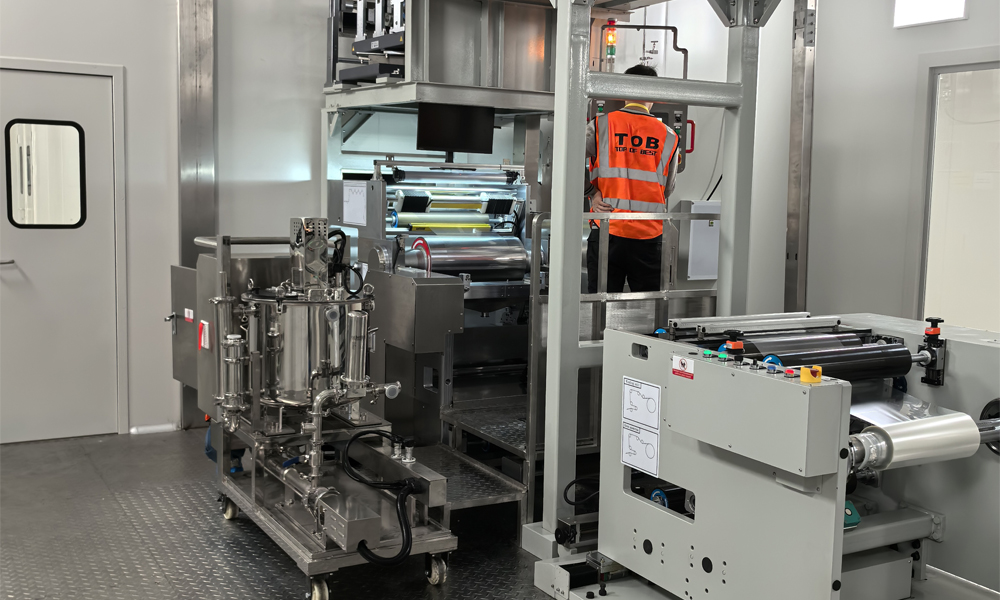
TOB NEW ENERGY battery coating machine solution
Step 1: What Happens During Coating
Coating is not a single event. It is three physical processes overlapping in time.
Slurry deposition. The slurry exits the coating head and transfers to the moving foil. The slurry's rheology — its shear-thinning behavior, its yield stress, its thixotropy — determines how it spreads. A slurry with high yield stress may not level after deposition, leaving coating streaks that persist through drying. A slurry with excessive shear thinning may spread too far, creating edge beads that must be trimmed — and every millimeter of trim is material that was purchased, mixed, coated, and discarded.
Wet film formation. Surface tension and gravity level the deposited slurry into a film of uniform thickness. The leveling must complete before the film enters the dryer — once drying begins, viscosity rises and flow stops. Leveling time is measured in seconds. The coating speed and the distance between the coating head and the dryer inlet determine whether leveling completes.
Edge effects. Surface tension at the edges of the wet film pulls slurry outward, creating a raised bead — the edge bead — that can be 20 to 50 percent thicker than the center. This bead must be trimmed off in subsequent slitting. The width of the trim zone is a direct material yield loss. Reducing edge bead width is a process optimization with million-dollar economics at production scale.
These three processes — deposition, leveling, edge formation — occur in the few seconds between the coating head and the dryer. The coating head design, the slurry formulation, and the web handling parameters must be co-optimized. Change one. The other two shift.
Step 2: Three Coating Methods
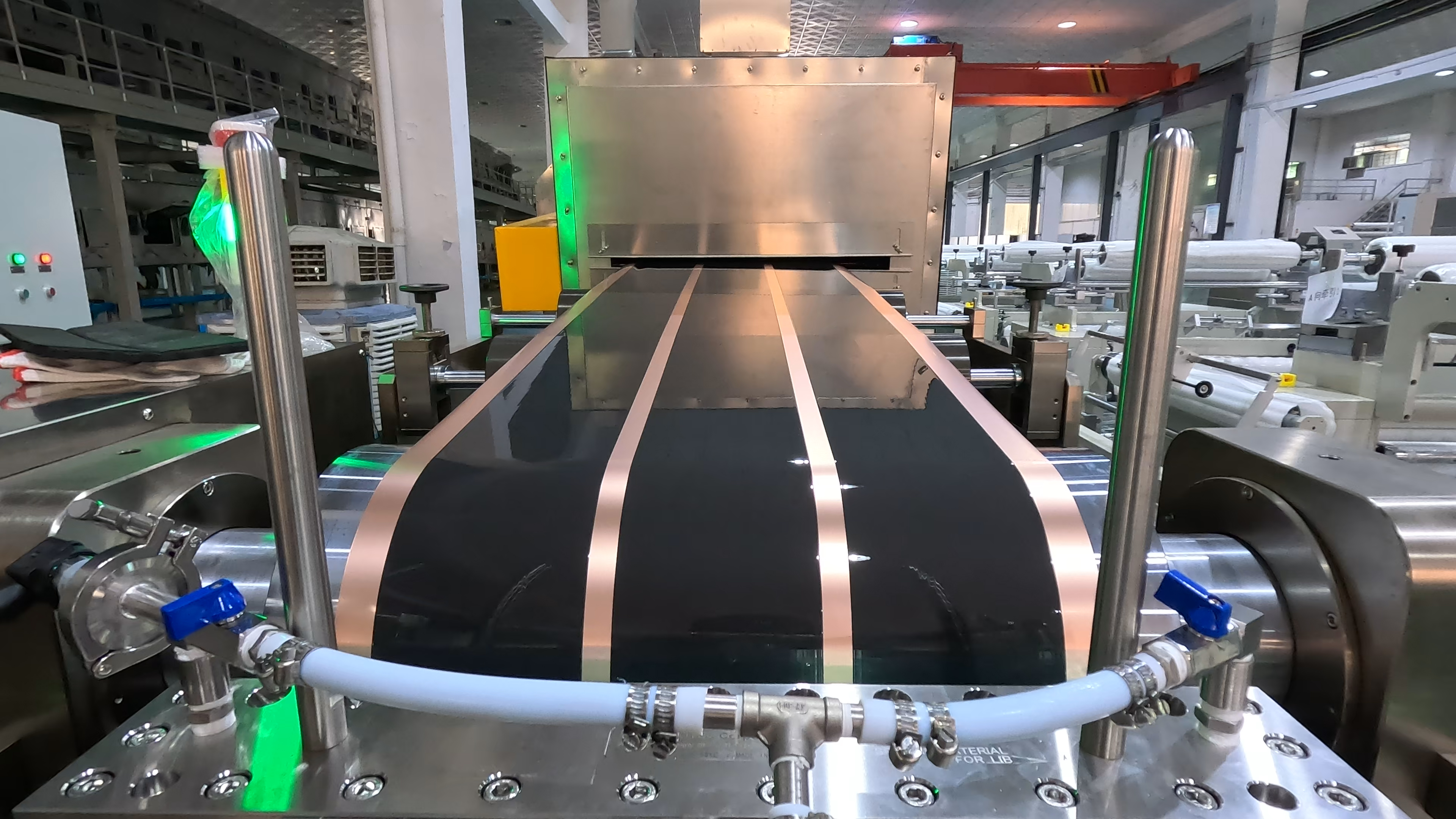
Slot-die coating (https://www.tobmachine.com/two-level-double-sided-slot-die-coating-machine-for-battery-electrode-production_p855.html) is the precision standard. Slurry is pumped through a precision die — a narrow slot machined to micron-level tolerances — directly onto the moving foil. The die-to-foil gap, the slurry flow rate, and the web speed together determine the wet film thickness. The system is closed — slurry is not exposed to ambient air, so solvent evaporation and viscosity drift during coating are minimized. At 600 millimeters width and above, at speeds exceeding 10 meters per minute, slot-die coating is the only method that reliably delivers areal density uniformity within ±1.0 to 1.5 percent — the requirement for automotive-grade electrodes.
Slot-die coating
The die is the heart of the system. Its internal flow channel geometry determines the transverse thickness distribution. A poorly designed die produces a coating that is systematically thicker at one position, or systematically thicker at the center, regardless of process adjustments. Die design is a fluid mechanics problem disguised as a machining problem. The die lip, the surface that contacts the slurry just before it exits, is vulnerable to mechanical damage. A scratch on the lip produces a continuous streak on every meter of electrode. TOB's slot-die coating systems use internally designed and machined dies, controlling the component that most determines coating quality.
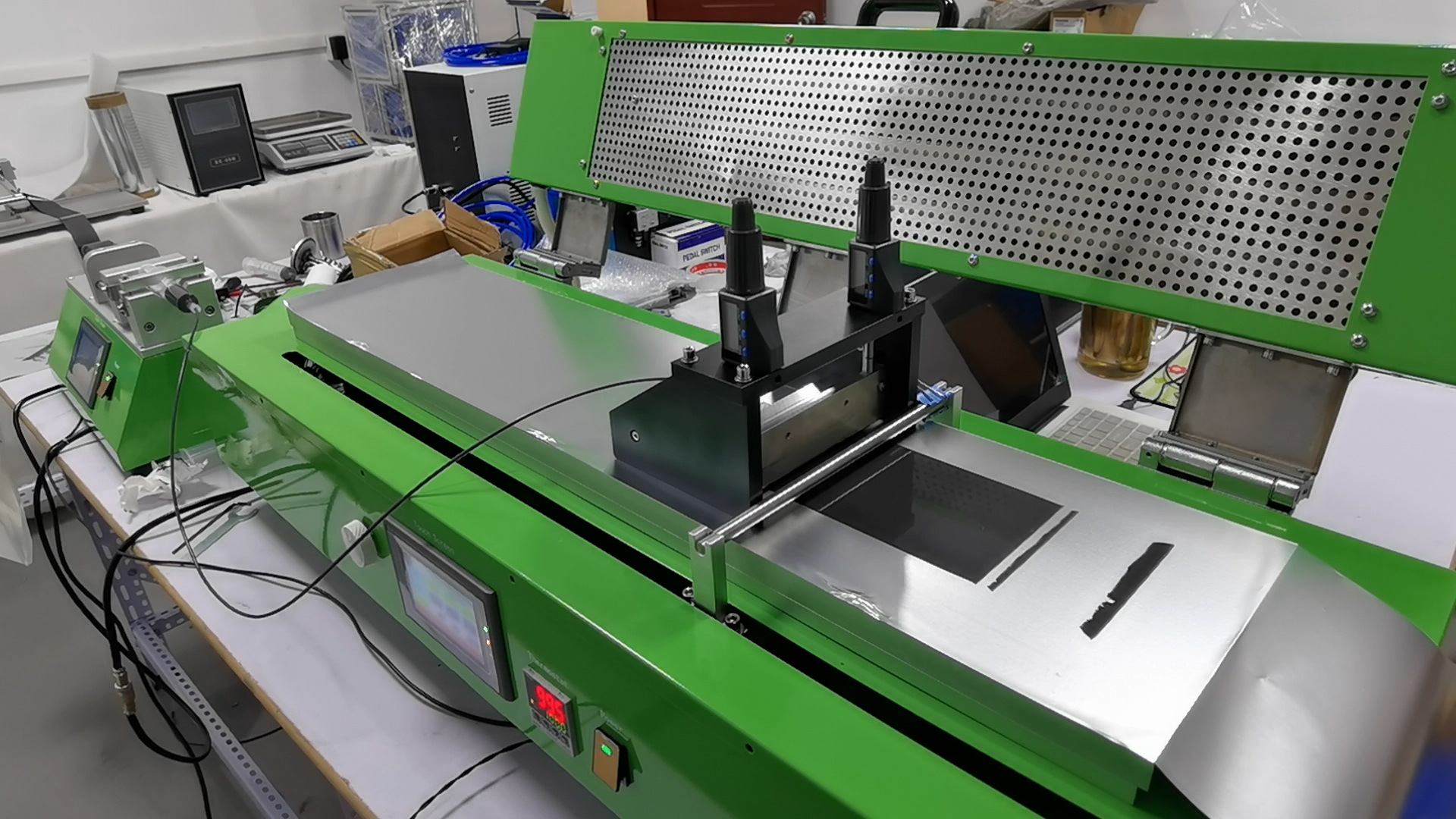
Doctor blade coating (https://www.tobmachine.com/continuous-doctor-blade-coating-machine-for-battery-electrode_p1420.html) uses a rigid blade, positioned at a precise gap above the foil. Slurry is deposited upstream of the blade, and the blade scrapes away the excess, leaving a film whose thickness is determined by the gap. The system is open — slurry is exposed to air, and solvent evaporation shifts the viscosity during coating. For research and mid-tier production at widths below 400 millimeters and speeds under 5 meters per minute, doctor blade coating offers a simpler, lower-cost alternative to slot-die. The areal density uniformity it achieves — typically ±2 to 3 percent — is adequate for consumer electronics cells and some energy storage applications. It is not adequate for automotive cells.
Doctor blade coating
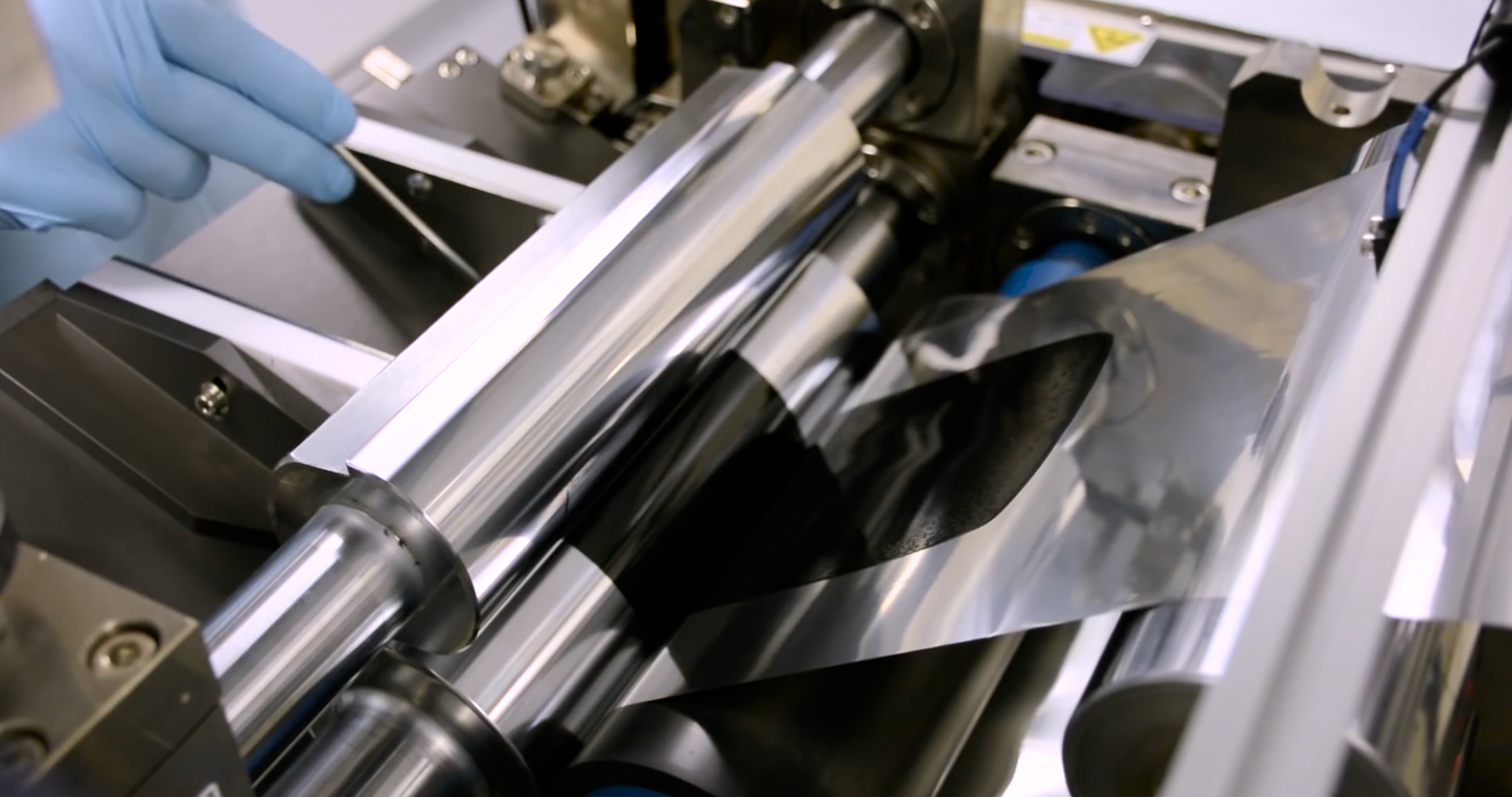
Transfer coating (https://www.tobmachine.com/laboratory-transfer-coating-machine-for-battery-electrode_p1202.html) deposits slurry onto a transfer roller, which then transfers it to the foil. It is the lowest-cost method and the least precise. Areal density uniformity exceeding ±3 percent is typical. In premium battery manufacturing, transfer coating has been replaced by slot-die. It survives in ultra-cost-sensitive applications where coating precision is not the limiting factor on cell performance.
Transfer coating
Step 3: Drying — The Invisible Half of Coating
The dryer section occupies 60 to 80 percent of a coating machine's physical length. It is not an accessory. It is a process.
Drying occurs in two regimes. The constant-rate period, where the wet film surface is saturated with solvent and the evaporation rate is controlled by the air temperature and velocity in the dryer. The falling-rate period, where the surface is no longer saturated, and the evaporation rate is controlled by the diffusion of solvent from the interior of the film to the surface.
If the constant-rate period is too aggressive — temperature too high, air velocity too high — the surface dries before the interior solvent can diffuse outward. The surface skins over. The trapped solvent eventually vaporizes and bursts through the skin, creating pinholes. The electrode leaves the dryer looking uniform. Under a microscope, it is perforated.
Binder migration is the most insidious defect of electrode drying. As solvent evaporates and moves toward the film surface, it carries dissolved binder — PVDF — with it. The result is a binder concentration gradient through the electrode thickness: high binder concentration near the surface, low binder concentration near the current collector. The active material near the current collector loses adhesion. During cycling, it delaminates. The capacity fades. The root cause — binder migration during drying six months earlier — is almost never identified as the root cause.
Mitigation requires gradient temperature drying. The first zone operates at lower temperature, allowing solvent to evaporate slowly while the binder remains uniformly distributed. Subsequent zones increase temperature as the film solidifies and binder mobility decreases. This temperature profile is chemistry-specific. NMC electrodes tolerate different initial drying temperatures than LFP electrodes with different solvent systems. TOB NEW ENERGY's production coating machines incorporate configurable dryers — independent zone temperature control, adjustable air velocity per zone, balanced exhaust flow. These are not premium options. They are the minimum engineering required to prevent the binder migration described above.
NMP recovery (https://www.tobmachine.com/nmp-solvent-processing-system_p811.html) is not optional at production scale — and TOB's coating machines integrate recovery systems rather than treating them as aftermarket additions. NMP vapor is a regulated emission with occupational exposure limits. Recovery systems — condensation or water absorption — capture over 95 percent of the evaporated solvent for reuse. At gigawatt-hour production volumes, the recovered NMP has economic value that partially or fully offsets the recovery system's operating cost. A coating machine without integrated solvent recovery is a laboratory tool. TOB NEW ENERGY's production coating systems include NMP recovery as standard engineering, not as an optional accessory.
Step 4: Quality Metrics That Matter
Areal density uniformity is the first quality metric. The electrode's active material loading per unit area — measured in milligrams per square centimeter — determines cell capacity. Transverse uniformity (across the web width) should be within ±1.5 percent for production-grade electrodes. Machine-direction uniformity (along the web length) should be within ±1.0 percent. These numbers are measured by in-line beta-ray or X-ray gauges positioned after the dryer.
Coating thickness, measured by laser triangulation sensors, complements areal density. Areal density divided by thickness gives the coating density — a proxy for compaction that reveals whether the slurry solid content has drifted during the coating run. If the areal density is on target but the thickness is high, the slurry has been diluted — solvent evaporation from an open feed system, or an operator adding solvent to adjust viscosity.
Surface defects — pinholes, streaks, agglomerate spots — are detected by machine vision systems operating at line speed. A pinhole creates a local current density anomaly during cell operation. A single pinhole in a large-format cell is a stress concentration for lithium plating. Multiple pinholes across a production run are a batch rejection event.
Intermittent coating — where the slurry flow starts and stops to create uncoated gaps for tab welding — adds a dynamic quality challenge. The coating thickness at the start and stop transitions — the ramp-up and ramp-down zones — is inherently less uniform than the steady-state coating. The length of these transition zones determines how much electrode material is lost to trimming. Reducing transition zone length is a process optimization with direct material yield impact.
Step 5: Selecting a Coating Machine Supplier
The specification sheet comparison is misleading. Web width, maximum speed, and oven length look similar across suppliers. The differences that determine electrode quality are not on the sheet.
"Has this coating machine been tested with my slurry?" The slot-die that coats an NMC slurry with 55 percent solid content and carbon black conductive additive at a given gap and speed may produce a completely different result with an LFP slurry at 62 percent solid content and carbon nanotube conductive additive — because the rheology is different, the leveling behavior is different, the drying kinetics are different. TOB NEW ENERGY, whose in-house coating laboratory runs customer-specific slurry trials before equipment specification, provides the resulting uniformity data — not a promise that the machine will work, but evidence that it already has.
"Who designed the coating die?" The die is not a commodity. Suppliers like TOB NEW ENERGY have mastered the essence of coating technology, designing and manufacturing their own coating molds, thus controlling the most critical components of the coating system instead of purchasing them from third-party mold manufacturers. Everything downstream of the die, the dryer, the web handling, and the winding, serves the coating quality established at the die exit.
"What is the dryer's demonstrated temperature uniformity?" A specification sheet gives zone temperature setpoints. It does not give the actual temperature distribution across the web at operating speed. A dryer with a 3-degree-Celsius temperature variation across the web width produces electrodes whose binder distribution — and therefore whose adhesion and cycle life — varies systematically from the left edge to the right edge. Ask for thermal mapping data at operating conditions.
TOB's patent portfolio provides objective context. Three coating-related patents — a continuous feeding device (CN202122096805), a laboratory-scale coating machine (CN202122170366), and a liftable heating device (CN202122096807) — are held by the company. These are publicly verifiable records of specific engineering work on specific coating subsystems.
Step 6: The Coating Machine Sets the Electrode's Physical Identity
The calender that follows coating can adjust electrode density. It cannot redistribute active material that was deposited non-uniformly. The slitter can cut precise dimensions. It cannot remove a coating streak. The winding or stacking machine can assemble the electrode into a cell. It cannot compensate for thickness variation within the electrode.
The coating machine establishes the electrode's physical identity — how much active material is on the foil, and how uniformly it is distributed. Every downstream process operates on that physical reality. The cost of an inadequate coating machine is not visible in the equipment budget. It is visible in the capacity distribution of finished cells — cells that leave the factory with systematically different capacities because the electrodes they were built from were coated on a machine whose die design and dryer control could not deliver the uniformity the cell design required.
Battery Coating Machine Procurement Summary: The electrode coating process — slurry deposition, wet film formation, and drying — is the single most quality-determining step in electrode manufacturing. Three coating methods dominate: slot-die for precision production, doctor blade coating for mid-tier and R&D, and transfer coating for cost-driven applications. Drying controls binder migration, pinhole formation, and solvent recovery — quality variables that are invisible at the coater exit but decisive for cell cycle life. Key quality metrics include areal density uniformity, coating thickness, surface defect density, edge bead width, and intermittent coating transition zone length. When selecting a coating machine, buyers should evaluate the supplier's experience with their specific slurry system, whether the coating die is designed in-house, the dryer's demonstrated temperature uniformity, and the availability of customer-specific coating trials — because a coating machine is not defined by its specifications but by the electrodes it produces.
Dany Huang, Ph.D. — CEO, Xiamen TOB New Energy Technology Co., Ltd.
Media Contact
XIAMEN TOB NEW ENERGY TECHNOLOGY CO., LTD. *****@tobmachine.com 86-18120715609 Building 5th, NO.1633, Jicheng Road, Tong'an torch Industry Phase II, Tong'an District, Xiamen City, Fujian Province, China http://www.tobmachine.com