
Zhenjiang, Jiangsu Aug 2, 2026 (Issuewire.com) - For optical businesses looking to expand their market footprint, navigating the complex world of international procurement requires more than just finding a vendor; it requires securing a strategic partner capable of delivering consistent innovation and flawless execution. By aligning with an established enterprise, distributors can bridge the gap between advanced engineering and commercial viability, transforming a standard supply chain into a powerful mechanism for long-term business growth through a strategic Optical Lens Distributor Partnership.
Establishing a profitable partnership with an optical lens manufacturer is a systematic process that demands careful evaluation across multiple operational pillars. To ensure long-term commercial success, a distributor must look beyond standard wholesale pricing and rigorously assess a manufacturer’s technological infrastructure, production scalability, customization agility, and logistics framework.
The following guide outlines the critical steps required to evaluate, establish, and optimize an international distributor partnership that maximizes profitability and market reputation.
Step 1: Evaluating Technological Capabilities and Production Standards
The foundation of any profitable distributor partnership lies in the manufacturer’s technical infrastructure and adherence to international quality protocols. Distributors must ensure that their supplier utilizes advanced manufacturing machinery capable of producing consistent geometries and pristine optical surfaces across all batches. Variations in substrate purity or coating uniformity can lead to high return rates, eroding retail relationships and destroying profitability.
A premier partner should seamlessly integrate advanced precision engineering into daily operations. For instance, manufacturing facilities optimized with high-caliber vacuum coating machinery, such as South Korea's NVC systems, ensure that thin-film depositions are perfectly uniform. This infrastructure allows for the high-volume production of up to 50,000 pairs of high-quality resin lenses daily, achieving the scale necessary to offer competitive wholesale pricing while maintaining strict quality consistency.
Furthermore, product portfolios must span the entire spectrum of refractive indices—ranging from standard CR-39 (index 1.50) to mid-index 1.56, and premium high-index alternatives like 1.60 MR-8, 1.67, and 1.74 ultra-thin resin lenses. Each refractive index must be paired with precise aspheric and double-sided aspheric designs that minimize peripheral aberration, reduce lens thickness, and enhance aesthetic appeal for the end consumer.
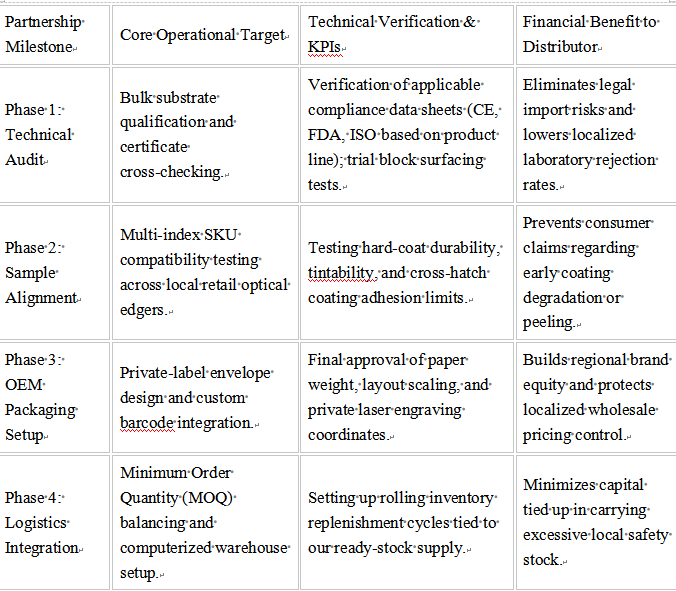
Step 2: Distributor Onboarding & Supply Chain Milestone Framework
Transitioning from initial vendor evaluation to a high-yield regional distribution partnership requires a structured operational timeline. Below is the integration protocol implemented by our international trade division:
Step 3: Assessing Customization, RX Flexibility, and Advanced Lens Designs
The modern optical landscape is increasingly driven by specialized, prescription-driven (RX) demand rather than generic, single-vision stock options. Distributors seeking high-margin opportunities must partner with manufacturers that can deliver sophisticated digital lens surfacing. Without native complex prescription capabilities, a distributor is locked out of the highly lucrative premium managed-care and custom-fit segments of the market.
To fulfill these distinct requirements, a supplier’s facility must be equipped with digital freeform processing technologies, such as the full-automatic VFT-Orbit RX machinery engineered by Germany’s LOH. This advanced machinery enables the fabrication of complex back-surface progressive designs customized to individual patient parameters, translating mathematical wavefront calculations into perfect physical contours within tight turnarounds.
Distributors should verify that their manufacturing partner can integrate proprietary functional designs into their product line, including:
- Myopia Control Defocus Lenses:Utilizing specialized lens designs tailored for selected markets to assist in pediatric visual management, subject to local regulatory requirements.
- Photochromic Spin-Coating Technology:Applying uniform light-responsive matrices via spin-coating to guarantee rapid activation and fade-back transitions, maintaining consistent performance across all refractive indices.
- Blue Light Block (UV420) and Premium Coatings:Incorporating specialized monomer-tinted blue light absorbers or multi-layer anti-reflective coatings that provide comprehensive protection against digital eye strain and harmful ultraviolet radiation without unappealing residual yellow tints.
Step 4: Aligning with Comprehensive OEM and ODM Service Frameworks
True profitability in distribution is rarely achieved by selling unbranded or generic factory items. Long-term enterprise value is built when a distributor can establish their own brand identity, tailored to the specific pricing tiers and regulatory environments of their localized market. Therefore, evaluating a manufacturer's capacity for comprehensive private label production (ODM Service) is a critical phase of the onboarding process.
A robust ODM and OEM framework extends far beyond stamping a logo onto an invoice. The manufacturing partner must offer structured flexibility across custom lens envelope design, specialized branding, and bespoke packaging configurations that protect the product during international transit while presenting a polished, professional brand image to optical shops and laboratories. The provider should function as a seamless backend extension of the distributor’s enterprise, accommodating varying minimum order quantities (MOQs) and supplying comprehensive technical datasheets, promotional collateral, and precise lens charts to support local sales forces.
Step 5: Verification of Logistics, Inventory Depth, and Enterprise Reliability
The final, and often most critical, component of a profitable partnership is operational reliability. In a market where independent practices and optical retail chains demand fast turnarounds on both stock and custom RX orders, supply chain delays can lead to immediate client defection. A manufacturer may possess elite technology, but if their fulfillment pipeline is erratic, the distributor's business model remains vulnerable.
When evaluating an enterprise like CONVOX, a joint venture backed by substantial international investment and over 15 years of seasoned manufacturing experience, distributors gain access to an optimized supply ecosystem. Operational stability is sustained through:
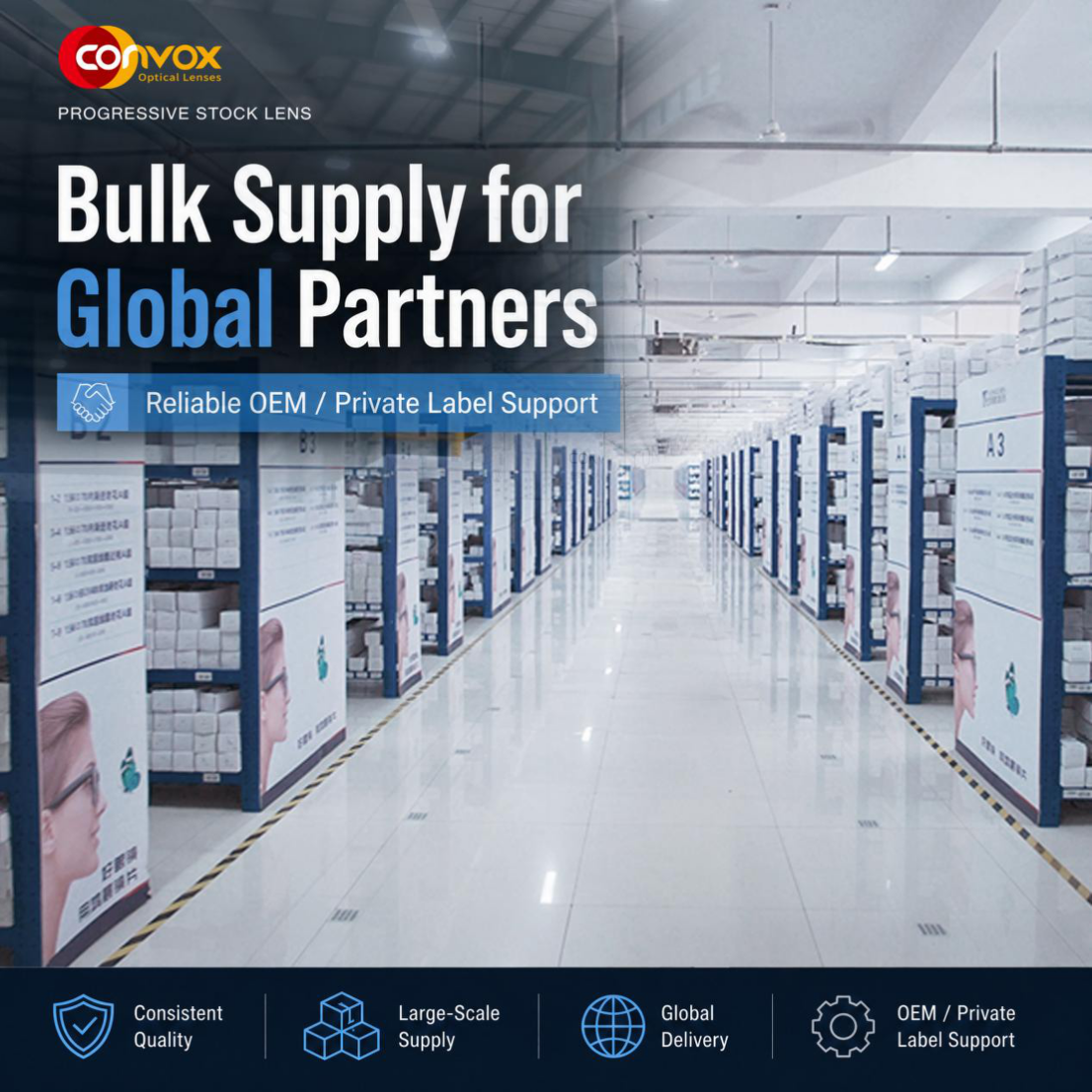
- Modern Automated Storage Systems:Maintaining massive, systematically indexed ready-stock inventory across all major index categories to allow for immediate dispatch of stock lens orders.
- Rigorous Multi-Stage Quality Assurance:Utilizing a strict 5-step inspection protocol that monitors lens geometry, cosmetic defects, coating adhesion, and power accuracy before any shipment leaves the warehouse.
- Strategic Global Logistics Support:Leveraging close proximity to major shipping hubs to guarantee expedited global freight, enabling distributors to minimize their own capital tied up in safety stock while maintaining more reliable fulfillment performance for their local clientele.
By systematically working through these evaluation steps, global sourcing directors can bypass low-tier commodity suppliers and align their businesses with a manufacturing partner that operates at the cutting edge of visual optics. Combining advanced manufacturing precision with commercial scalability creates a sustainable, high-margin partnership that drives measurable growth and delivers clear visual enjoyment worldwide.
FAQ: Enterprise Sourcing & Distributor Onboarding
Q1: What are the Minimum Order Quantity (MOQ) thresholds for private-label OEM envelope printing?
A1: MOQ depends on product type, packaging design, and market plan. Our team can provide tiered options after reviewing your specific product list and packaging layout.
Q2: How does CONVOX protect international shipments against moisture and damage during long ocean transits?
A2: All bulk lens shipments are packed in heavy-duty, moisture-resistant outer cartons and secured with industrial pallet wrapping. Individual custom lens envelopes utilize specialized coatings to resist humidity and friction, ensuring the substrates arrive at your warehouse in factory-pristine condition.
Q3: Does CONVOX grant territorial exclusivity for high-volume regional distribution partners?
A3: For qualified high-volume partners, regional cooperation terms can be discussed based on annual purchase volume and market plan.
Q4: How are technical datasheets and lens layout charts supplied to aid our regional sales team?
A4: We provide comprehensive digital asset packages, including precise base curve charts, fitting cross layouts, spectral transmittance curves, and multi-language marketing technical sheets. These assets can be fully white-labeled under your private brand name to empower your local sales force.
Corporate Website: [https://www.convox-optical.com/]
Contact Email: sales@convox.cn
Initiate Your Corporate Distributor Profile:
Ready to upgrade your regional product portfolio with a certified, high-volume manufacturing partner? Contact our Global Sourcing Desk today to request our comprehensive product matrix catalogs, arrange sample cross-hatch test sets, or review our international distributor contract frameworks.
Media Contact
JIANGSU CONVOX OPTICAL CO.,LTD. sales@convox.cn