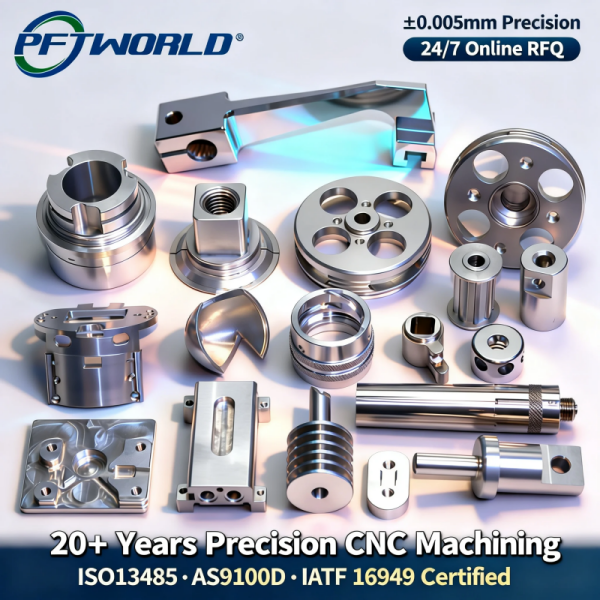
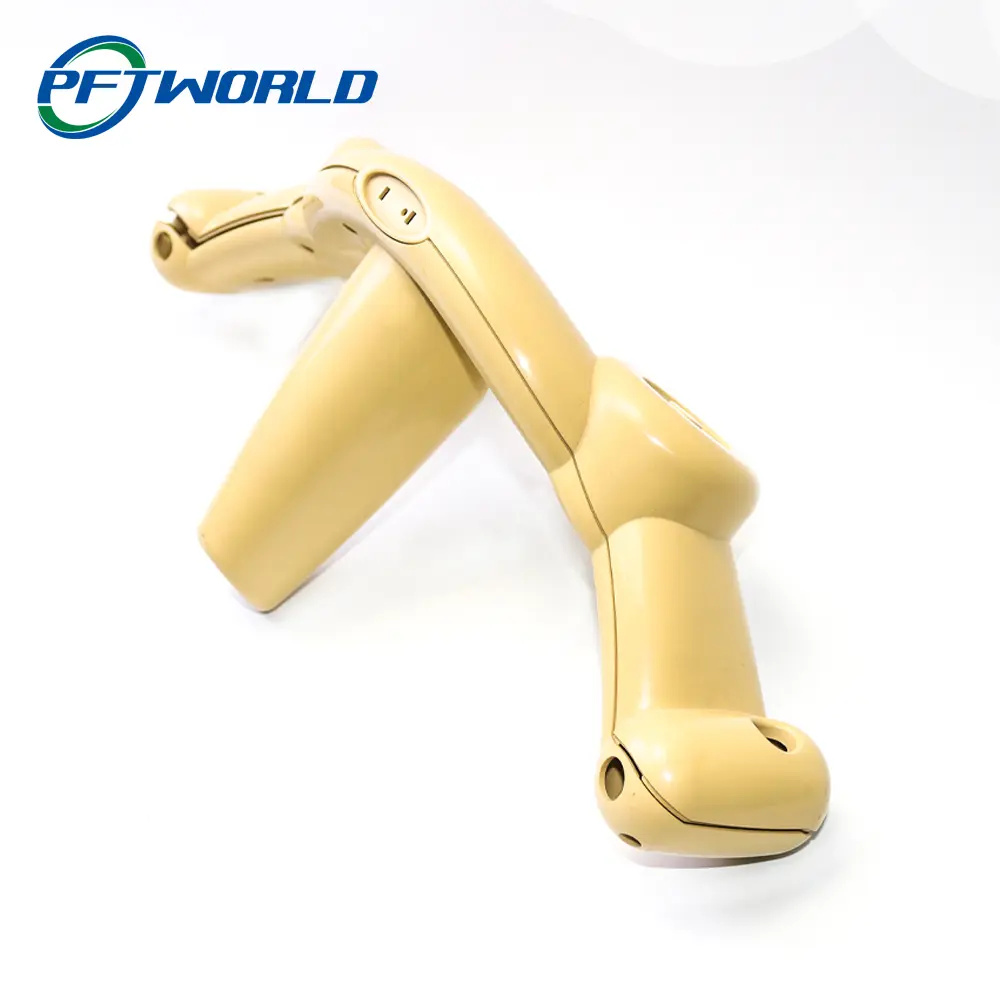
Shenzhen, Guangdong Aug 31, 2026 (Issuewire.com) - PFTWORLD supports robotics component sourcing as a Global Leading Robotics CNC Machining Parts Factory with end effectors, couplings, and cable carriers, alongside sensor mounts and actuators. The manufacturing route adds anodizing, plating, passivation, heat treatment, grinding, assembly, and testing to meet industrial automation standards. Design for Manufacturability (DFM) analysis, prototype, and low-volume work check critical mechanical interfaces before larger-scale production. Combining multi-axis machining with secondary operations ensures assemblies function reliably across high-speed cycles.
End Effectors Connect Machined Geometry Directly to Robot Task Execution
End effectors operate at the functional tip of a robotic arm, combining mounting interfaces, tool attachment features, and application-specific geometry. As the primary interaction point with the workpiece, machining must preserve datums and connection points locating the tool relative to the wrist. Minor deviations in the machined mounting flange can amplify positioning errors at the tool tip, causing assembly misalignment or gripping failures.
PFTWORLD machines end-effector mounting interfaces precisely around robot-specific geometry. This ensures alignment with intended automation tasks, whether for vacuum grippers, mechanical claws, or welding fixtures. Manufacturing follows supplied drawings, while payload, gripping force, and brand compatibility depend on integration specifications. Instead of universal payload ratings, the focus remains on delivering precise geometry, leaving task loads and system compatibility to project drawings.
Couplings Translate Alignment Requirements Into a Precision Mechanical Interface
Beyond end-of-arm tooling, the PFTWORLD robotics range includes couplings, introducing a critical motion-transfer component whose bore, shaft, and concentricity requirements differ significantly from an end effector. Couplings actively translate alignment requirements into a precision mechanical interface between servo motors, gearboxes, and driven linear components. They depend heavily on concentricity, bore fit, shaft interface, and fastener geometry, making dimensional control at connection surfaces central to overall assembly performance and motion accuracy.
If a coupling lacks sufficient concentricity or torsional stiffness, resulting backlash or vibration can severely degrade positioning accuracy of the robotic cell. Material selection, coupling style, and tolerance parameters remain design-specific because the category listing confirms manufacturing capability but does not define one standard coupling architecture for all projects. Some systems require rigid couplings for exact synchronization, while others need flexible designs to accommodate misalignments. Coupling manufacture should therefore be executed as a precision interface task. Final engineering requirements come directly from the motion-system design, ensuring the machined coupling meets the specific torque, speed, and alignment demands without introducing unwanted wear into the drive train.
Cable Carriers Add Protection and Routing Requirements to the Component Map
Cable carriers extend the robotics part range into motion-support hardware that organizes, guides, and protects cables, hoses, or pneumatic lines through repeated automation movement. The robotics category lists cable carriers alongside sensor mounts and actuator components, showing the manufacturing scope includes essential support hardware as well as primary motion interfaces. By integrating these engineered support structures, automated cells maintain reliable power and signal connections over millions of multi-axis motion cycles without suffering from cable fatigue or entanglement.
Bend radius, cycle life, and cable capacity remain design-specific because those critical characteristics depend entirely on exact carrier geometry, routed media, and specific motion applications. There is no universal bend-radius value applied to all orders; instead, each carrier is manufactured to match the precise routing envelope and dynamic flex parameters of the system. This capability demonstrates that robotics machining can successfully encompass movement-support components, provided design-specific motion parameters and routing limits remain clearly defined. Producing these carriers with tight dimensional control ensures links articulate smoothly and resist the abrasive wear common in high-speed industrial environments.
Finishing, Heat Treatment, Grinding and Assembly Extend the Robotics Manufacturing Route
Primary machining defines component geometry, but secondary operations remain essential to address surface condition, mechanical properties, precision interfaces, and subassembly requirements. PFTWORLD supports robotics parts with a comprehensive secondary-operation route after primary CNC cutting, ensuring parts can withstand the environmental and mechanical stresses of automated production lines. The manufacturing portfolio lists anodizing, plating, and passivation among available finish options to improve corrosion resistance, reduce surface friction, or provide electrical insulation.
Additionally, heat treatment and grinding are identified as relevant secondary operations to achieve necessary material strength and precise dimensional control required for high-performance automation environments. A hardened and ground shaft provides wear resistance necessary for continuous linear motion. Assembly and testing can also be included for appropriate work, allowing selected projects to move beyond loose parts when mating hardware and verification requirements are clearly defined. Robotics CNC manufacturing can encompass much more than initial material removal when the project specifies secondary operations and integration work required to produce the final, installation-ready component.
Prototype and Low-Volume Work Can Precede Scale-Up of Robot Components
Transitioning a new robotics component from a digital model to mass production introduces fit, functional, and integration risks requiring staged validation. The manufacturing workflow supports design data input, DFM evaluation, and prototype or low-volume work before transitioning to mass-production-oriented orders, giving integration teams a staged and secure route for new components. Customer CAD files or physical sample inputs can be reviewed comprehensively before machining begins, letting the engineering team resolve access, interface, and manufacturing questions while design changes remain practical and cost-effective.
Prototype or low-volume production can then verify the machined part in its intended physical assembly before the final drawing and process route are frozen for a larger quantity run. This phase allows engineers to conduct real-world fit checks, assess mechanical clearances during full-range robot articulation, and validate sensor mounting positions. A staged prototype-to-volume route reduces the need to treat a newly designed robot component as production-ready before critical interfaces have been physically evaluated. By identifying and correcting interference issues early, this workflow mitigates integration risk and ensures a reliable scale-up for automation hardware.
Integration Data Defines Whether End Effectors, Couplings and Cable Carriers Fit the Robot System
Manufacturing success for robotics components relies fundamentally on precise and complete integration data from the purchasing organization. PFTWORLD connects its robotics CNC capability directly to the interface data that makes end effectors, couplings, and cable carriers manufacturable and integrable within the target automation system. Buyers should provide comprehensive CAD models, material specifications, critical interface dimensions, motion envelope constraints, finish preferences, production quantity, and inspection requirements so each component can be reviewed accurately against the actual robot or automation assembly.
Current robotics CNC component capabilities, tolerance capacities, and secondary-operation options can be reviewed through the official site before initiating project-specific DFM analysis and quotation. By relying on complete engineering inputs, interface-driven DFM significantly reduces ambiguity before robotics parts move from initial prototype stages into larger production quantities. To explore precision machining capabilities, verify material options, and initiate a custom manufacturing review for automation components, sourcing teams and engineers can visit https://www.pftworld.com/
Media Contact
Shenzhen Perfect Precision Products Co., Ltd. *****@pftworld.com https://www.pftworld.com/